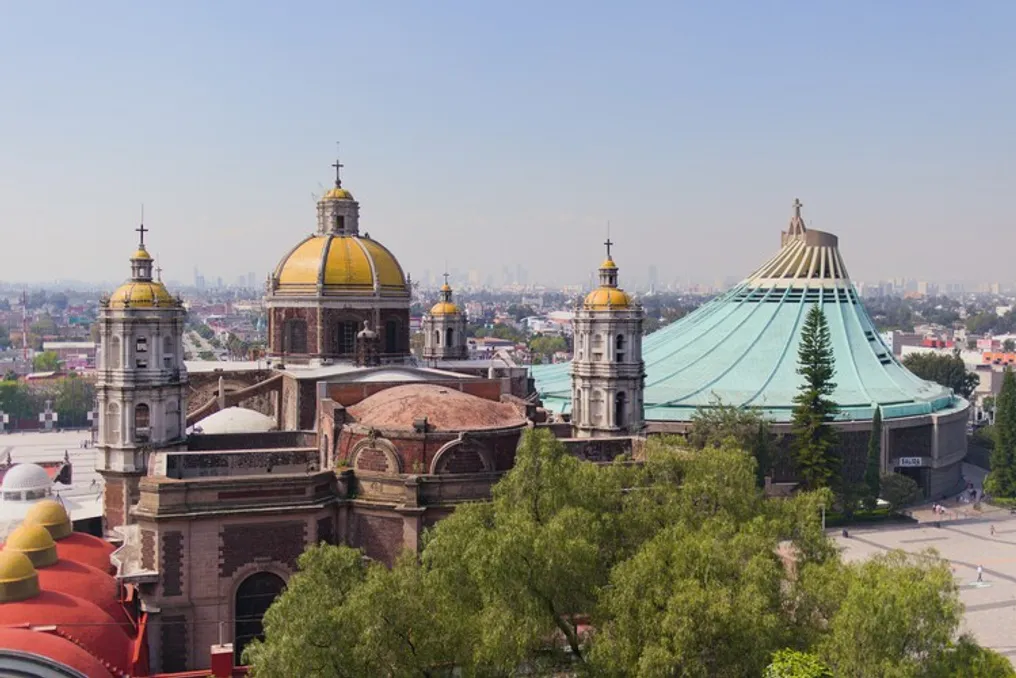
Mexico City presents itself as a vast metropolis with multiple layers of time, where architecture functions as a constant process of negotiation between its deeply rooted history and intense urban transformation. Built upon the ancient aquatic settlements of Tenochtitlan, its urban structure reflects a continuous dialogue between different eras: the monumental grandeur of the pre-Hispanic Templo Mayor coexists with the viceregal architecture of the Metropolitan Cathedral, alongside the modern and contemporary impulses shaping its urban profile. This dense juxtaposition results in a unique landscape where sacred geography, colonial influence, and 20th-century aspirations meet.
The mid-20th century was marked by a decisive phase of experimentation, giving rise to a Mexican modernism that managed to harmonize international structural rationalism with local identity and materials. This fusion is exemplified by the broad artistic and architectural integration in Ciudad Universitaria, the structural expressiveness of hyperbolic paraboloid roofs created by Félix Candela, and the robust and imposing brutalism of Teodoro González de León and Abraham Zabludovsky. In parallel, Luis Barragán and Juan O'Gorman explored the domestic domain in a more intimate and reflective manner, using light, typical regional colors, and structural transparency to conceive spaces of profound serenity.
In the 21st century, Mexico City remains a hub of high architectural production. Recent interventions deal with the complex relationship between major corporate icons, such as skyscrapers on Paseo de la Reforma Avenue, and a growing movement focused on integration with the natural environment and public infrastructure. From the underground and structural spaces of libraries designed by Alberto Kalach to the recent dissemination of local community networks, such as the PILARES centers, current Mexican architecture has directed its focus toward public space, ecological sustainability, and social equality. Below is a curated selection of projects illustrating the evolutions, ruptures, and persistent spirit of this architectural capital.
The Historic Core (Centro Histórico and North)
This area encompasses the fundamental political and historical axis of the city, showing the transition from pre-Hispanic origins to the first tall modern buildings.
Antiguo Colegio de San Ildefonso
Metropolitan Cathedral of Mexico City
Among the historical landmarks are the Templo Mayor Museum, designed by Pedro Ramírez Vázquez and Jorge Ramírez Campuzano; the Palace of Fine Arts, a work by Adamo Boari and Federico Ernesto Mariscal Piña; and the Monument to the Revolution, conceived by Carlos Obregón Santacilia.
Chapultepec and Polanco Axis
This sector represents the city's cultural and institutional center, characterized by large works in parks, mid-century institutional brutalism, and the presence of contemporary cultural and corporate museums.
Chapultepec Castle
The Southern Academic and Artistic Hub (San Ángel and UNAM)
This region is defined by mid-20th-century architectural avant-garde, which investigated the union between fine arts, residential experiences, and integrated campus planning.
Tacubaya and Surroundings (The Domain of Barragán)
Although Tacubaya is geographically located in the west-central part of the city, the neighborhood functions as an independent architectural reference point, dedicated to mid-century emotional architecture and structural poetry.
Eastern and Northern Peripheries (Social Infrastructure)
An essential contemporary shift in Mexico City architecture is decentralized infrastructure, which addresses the city's complex social divisions through initiatives such as PILARES and Infonavit.
Decentralized Projects (North and West Suburbs)
These are emblematic residential and infrastructure landmarks built to accompany post-war expansion outside the valley. A notable example is the Casa Azul - Frida Kahlo Museum.