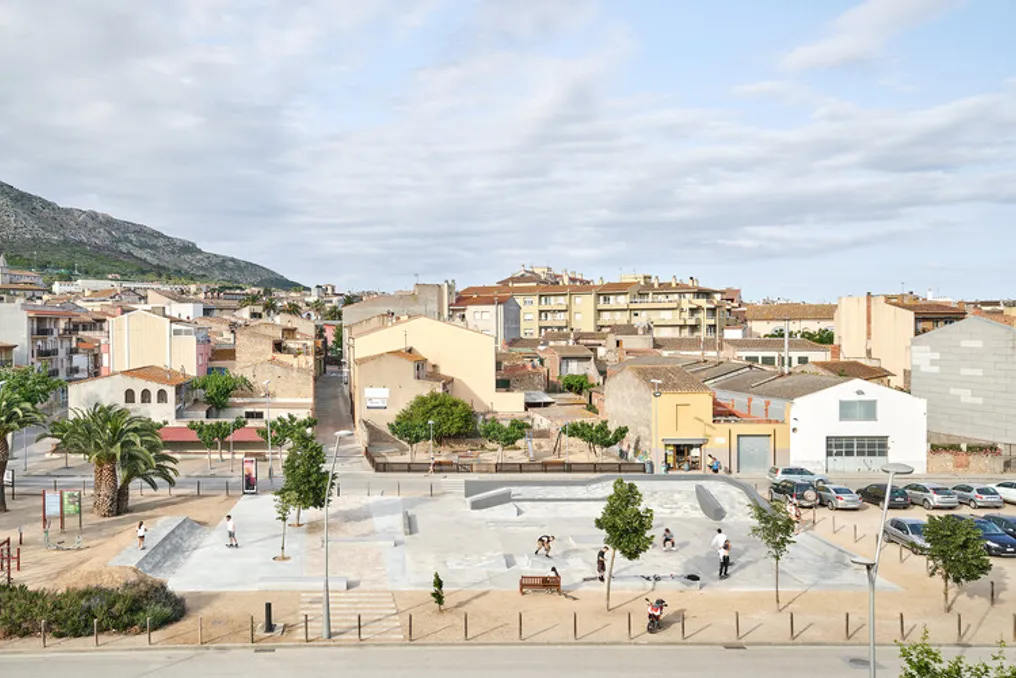
Skateboarding, originating in California with surfers seeking to translate surfing movements onto asphalt, quickly transcended its initial function as a pastime for days without waves. It established itself as a practice that views the city from a distinct perspective, reinterpreting elements such as stairs, railings, walls, and empty spaces as potential routes and challenges. Over time, this activity evolved into a global urban culture, acting as a method of inhabiting and transforming public space through movement. What was initially seen as marginal has become an agent of community cohesion and new applications in underutilized areas. Essentially, skateboarding demonstrates how different facets of urban life coexist within the same metropolis, depending on who traverses it and how each individual manages to give new meaning to their surroundings.
To understand this connection between movement and planning, we spoke with Pol Martín, an architect, skateboarder, and co-founder of SKATE ARCHITECTS, a firm focused on developing infrastructure for skateboarding. He began practicing as a child, long before specific spots for the sport existed, using surfaces and squares created during the Olympic remodeling of Barcelona. Martín recalls: 'We basically skated in all the new public spaces developed during the transformation of the city for the 1992 Olympics.' These squares, such as dels Països Catalans, das Tres Xemeneies, and MACBA, functioned as urban laboratories and what he calls his 'first architecture school.' This proximity to scale, texture, and spatial rhythm eventually integrated into his design methodology.
For Martín, skateboarding is more than a sport; it is a particular way of apprehending and interpreting the urban environment. He states that 'It is a completely different way of relating to the physical urban reality around you.' Skateboarders develop a refined constructive intuition, assessing inclines, heights, materials, speeds, and micro-slopes with an accuracy that many architects only achieve in the final detailing phases. The city is perceived by the body in action, not just by sight. By designing a skate park, being a skateboarder himself, it is possible to establish a direct link and respond precisely to real needs and expectations.
This bodily reading of the city also influences the type of architecture he deems necessary. Instead of confining skateboarding to isolated enclosures, his work aims to bring it closer to everyday public spaces. His question, 'If we skate in common squares, why can't our dedicated ramps return squares to the city?' raises a profound critique about how many cities treat this practice. Frequently, the sport is relegated to the periphery, in fenced sports areas that ignore the surrounding context. According to Martín, planning skate parks without considering the urban fabric that gave rise to street skating represents a missed opportunity, because 'Some dedicated ramps completely disregard their surroundings and the urban context.'
In developments like Born Plaza in Barcelona, this philosophy is clearly manifested. The location was built entirely in granite, with proportions, surfaces, and materials that directly reference the squares where Barcelona's street skating matured in recent decades. He explains: 'We wanted to use the same type of public space architecture and the same materials that already exist in Barcelona.' A similar principle is applied to the Igualada skate park: 'We repurposed terraces to distribute the track at different levels, following the same grid.' In all cases, the purpose is to incorporate skateboarding into the daily functioning of the city, promoting continuity rather than interruption.
Although skateboarding benefits from the dimension of the urban environment, it also demands rigor and structure at the detail level. Elements such as curves, radii, drainage, material thickness, and surface durability are crucial for safety and fluidity. Sometimes, meticulous precision is required. However, improvisation remains inherent to its nature. Skateboarding is also a form of expression, and expression requires space to manifest. Therefore, he advocates that 'It is important to allow as many open lines as possible so that skaters can choose their paths freely.' He avoids the tendency to fill spaces with obstacles, advocating for functional minimalism where 'less is more works very well for skate parks,' granting users the freedom to chart their own courses and interpret the place in their own way.
Skate parks configure themselves as true urban agoras, points of meeting and social interaction for long hours. They do not require the visitor to be a skateboarder to stay; it is possible to sit, observe, converse, learn, or simply be part of the environment. In an era marked by technological isolation, these spaces promote human closeness. From this perspective, the parks serve both for sporting practice and for meetings, reflection, learning, and socializing in the city. Skaters and non-skaters share the same space, but each experiences it uniquely. The same step, ramp, or open area can accommodate multiple actions and interpretations, depending on who is present and how they choose to use it.
Martín concludes that it is time to move beyond the notion of a skate park as a closed model. Street skating is part of real urban life. The future lies in valuing skateboarding and the spaces practitioners use, not in hiding or isolating them, but in understanding them as positive urban resources that energize, activate, and give meaning to public space.
Cities like Copenhagen and Malmö have already recognized this potential and integrated skateboarding into their broader urban strategies. In Copenhagen, skate-friendly elements appear in squares, waterfronts, circulation routes, underground passages, and residual areas, adding uses to these zones throughout the day. Malmö adopted a similar path, collaborating closely with local skate communities to reclaim underutilized areas, as seen in places like Stapelbäddsparken and the port area. In both, skateboarding is viewed as part of urban routine, not as an activity restricted to isolated facilities.
Skateboarding draws attention to urban details that architecture can overlook: a corner, an incline, a change in level, or the distance between components can drastically alter the use of a space. The work of SKATE ARCHITECTS suggests that designing for skateboarding implies creating the ideal conditions for movement while simultaneously maintaining enough freedom for people to discover their own paths, uses, and ways of sharing public space.