There is a period of nine magical days and nights dedicated to rejuvenation, during which followers strive to attain physical, mental, and spiritual strength. This span of time is observed during Navaratri, scheduled from October 11th to 19th.
Two Navaratri festivals are held annually. The first is Chaitra Navaratri, which falls in March or April, while the second, known as Sharadiya Navaratri, occurs in September or October.
From an astrological perspective, this time is considered a period when one should fully utilize the cosmic energy believed to be abundantly available. Regardless of one's faith, it is recommended to become more devoted to Allah, Jesus, or Buddha according to one's religion to improve one's destiny during this auspicious period.
Hindu followers are advised to worship Mother Durga, Lord Rama, and Lord Hanuman with greater devotion during this sacred time. Astrology recognizes two main solar influences per year. Seasons are determined by the direction of the Sun's movement.
One influence occurs when the Sun crosses the equator and moves south, and another when it moves north, signaling a change of seasons. The beginning of summer and winter are important points of climatic and solar influence. As a result of these natural changes, our bodies and minds undergo significant transformations.
According to Ayurveda, digestion weakens during these periods, so fasting is recommended for health, spiritual, and material well-being. These two major solar influences are considered sacred times for worshipping Mother Durga, the goddess Shakti, according to Hindu scriptures. Sacred texts recommend worshipping the goddess Shakti specifically during this time.
This period typically lasts nine days and nights, hence the name Navaratri. Followers believe that this allows them to achieve significant results and maximum benefit in a relatively short time. If a person fasts during these auspicious days, it is believed to bring prosperity, strength, progress, and peace until the next Navaratri.
From both an astrological and spiritual standpoint, these days are considered particularly fortunate. During Navaratri, followers invoke Shakti, or the energetic aspect of God, in the form of the divine mother of the universe, Durga Maa. The word Durga in Sanskrit means 'destroyer of suffering.' Hindus believe she represents the feminine energy behind the creation, preservation, and destruction of the universe. Each night of Navaratri is dedicated to one of the forms of Goddess Durga.
Her nine forms include Maa Shailputri, Maa Brahmacharini, Maa Chandraghanta, Maa Kushmanda, Maa Skanda, Maa Katyayani, Maa Kaalratri, Maa Mahagauri, and Maa Siddhidatri.
Customs and Rituals
Recommended practices:
- Daily recitation of the Durga Saptashati, if the rules for its recitation are known.
- Reading the Ramayana every day and completing it by the last day of Navaratri. Hindu scriptures indicate that reading the Ramayana at home is auspicious, at least once in a lifetime. It is believed to bring unity and love into the family.
According to the Ramayana, Lord Rama performed Chandi Puja to receive the divine blessings of Goddess Durga and ensure victory over Ravana. During Anushthan, a special form of prayer requiring strict rules, Rama had to offer 108 lotus flowers to Mother Shakti. After offering 107 flowers, he realized he was missing one. According to the story, Mother Durga tested Rama's devotion and caused one flower to disappear. Rama then decided to offer one of his eyes to the goddess, as the eyes of Lord Vishnu are considered similar to a lotus. Mother Shakti, pleased with the depth of Lord Rama's devotion, granted him her blessings.
It is also recommended to read the Sundarkand daily, which is one of the most beautiful chapters of the Ramayana. Followers believe that this can provide spiritual support to anyone experiencing poverty, obstacles, suffering, or a series of misfortunes. It is believed that reading it at an auspicious time can improve one's destiny.
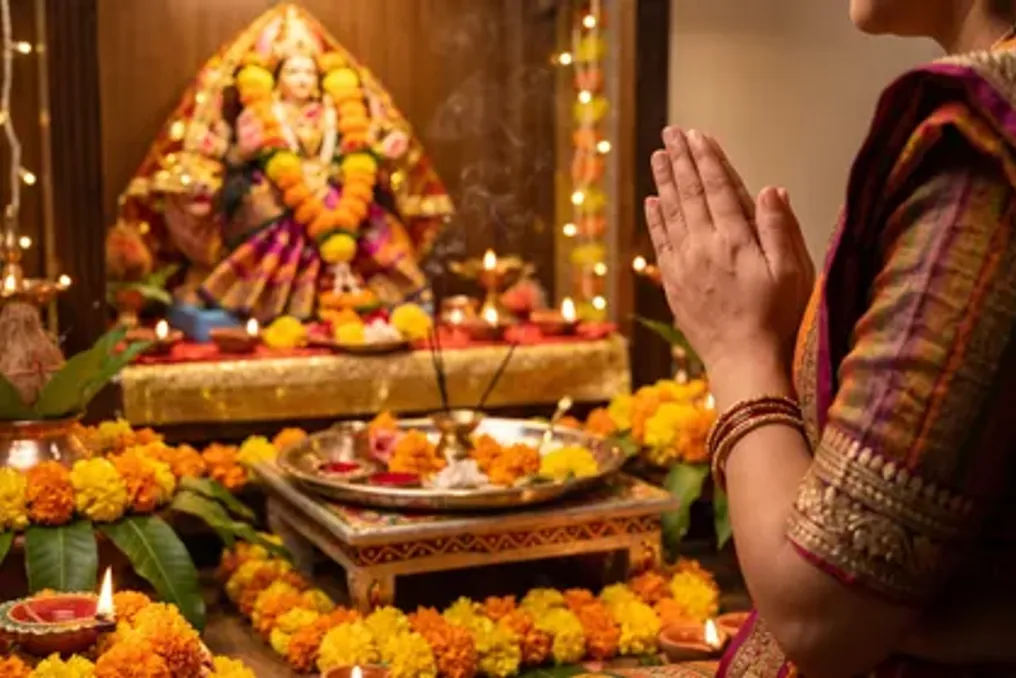
At a minimum, one should observe a fast and adhere to a strictly vegetarian diet. It is necessary to sing mantras in honor of Goddess Shakti, perform religious hymns, pray, and meditate.
In India, very devout followers may maintain a liquid diet, while others eat fruits and vegetables without grains. Some eat grain only once during the nine days. Followers in South Africa may attempt any of these dietary practices. If this is not possible, they must at least maintain a vegetarian diet during these nine sacred days.
On the last day, October 19th, known as Mahanavami, Kanya Puja is performed. Nine young girls who have not reached puberty are worshipped. Each girl symbolizes one of the nine forms of Goddess Durga. Their feet are washed as a sign of greeting and respect to the Goddess. Then, the girls are presented with food and new clothes as gifts from the followers. Followers may offer Halwa Puri and coconuts to Mother Durga. Some people offer prasad on Ashtami, the day before.
People may purchase real estate or cars, start a new business, or seek employment during this period, believing it will bring greater success. Some followers of Mother Durga observe Akhand Jyoti, where a lamp or light remains lit for all nine days. Care must be taken to ensure there is always enough ghee or oil in the lamp. The lamp should be kept in a temple or prayer area in a place protected from strong drafts. This lamp is called Akhand Jyoti because it burns throughout Navaratri. Followers believe that Akhand Jyoti destroys negative energy in the house. If the flame accidentally goes out, it can be relit.
From an astrological perspective, followers believe that observing these rituals with complete faith can strengthen confidence and willpower, and give the strength to overcome life's difficulties. They also believe that increasing spiritual energy and aura can help in defeating enemies, ensuring good health, and inner peace. If these practices are followed sincerely and this time is dedicated to Mother Durga, followers believe it will help pacify planets, remove the evil eye (Nazar), and dispel negative vibrations.
In India, many celebrities, including Bollywood stars and politicians, are known for observing Navaratri and seeking its spiritual and astrological benefits. It is believed that pleasing Mother Durga is easy through sincere devotion. Followers are advised to accumulate good karma by telling relatives and friends about the spiritual benefits of observing the Navaratri fast. 'Jai Mata Di!'