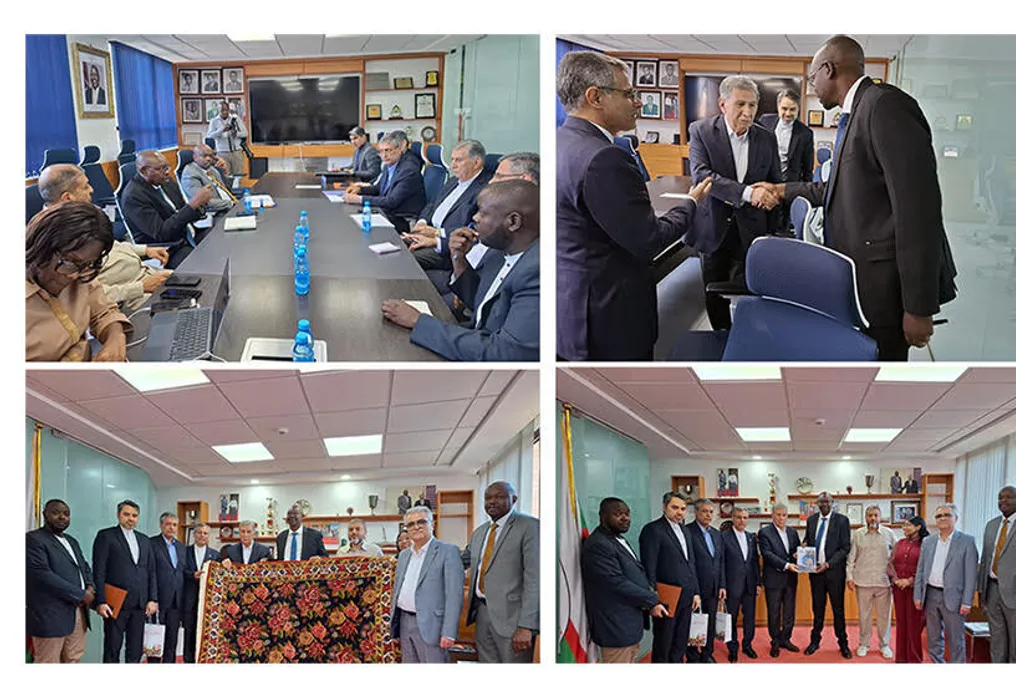
The head of the Iranian Chamber of Commerce, during a meeting with the head of the Kenyan Chamber of Commerce, identified Kenya as a vital gateway for Iran and other countries to the African market, owing to its strong financial infrastructure and the strategic port of Mombasa. He stated that Iran views Kenya as a strategic and mutually beneficial partner that could serve as a gateway for Kenya into Central Asia and Eurasia.
Samad Hassanzadeh, head of the industrial, mining, and agricultural sector division of the Iranian Chamber of Commerce (ICCIMA), met with Eric Ruto, President of the National Chamber of Commerce and Industry of Kenya (KNCCI), during his visit to Nairobi. Hassanzadeh congratulated the Kenyan Chamber of Commerce on its 60th anniversary.
He noted that Dr. Ruto's membership in the General Council of the World Federation of Chambers is a foundation for cooperation between the two chambers at international forums. Hassanzadeh emphasized that trade statistics between Iran and Kenya are insufficiently high, despite the significant potential of both countries, and that the chambers can jointly create good prospects.
Addressing the limitations caused by economic sanctions, the head of the Iranian Chamber of Commerce noted that the private sector and chambers of commerce bear great responsibility towards their nations and must fulfill their duties properly. He reiterated that Kenya, possessing a powerful financial infrastructure and the strategic Port of Mombasa, is a key bridge for Iran and other states to the African market.
Hassanzadeh listed Iran's potential in healthcare and medicine, agriculture, energy, petrochemicals and fertilizers, infrastructure, housing, and technology, considering these opportunities relevant to Kenya's development needs. He stressed that despite years of sanctions, Iran has achieved great capabilities, and he considers it his duty to share them with African countries.
He announced the readiness of the Iranian private sector to participate in the supply of medicines and medical equipment, as well as in joint production in Kenya in line with the policy of domestic drug manufacturing. In agriculture and food security, Iran is ready to transfer technical knowledge in mechanization, modern irrigation, processing and conversion industries, and reducing post-harvest losses, offering joint investments with Kenyan partners in the agricultural value chain.
Hassanzadeh also reported that Iran has a competitive advantage in bitumen, petrochemical products, and chemical fertilizers and is ready to participate not only in goods supply but also in projects for energy and renewable energy development. Regarding infrastructure, housing, and technology, he stated a willingness to share the capabilities of Iranian companies in construction, dam building, power plants, mass housing, and information technology for participation in Kenya's development projects.
The head of the Iranian Chamber of Commerce named joint investments by Iranian and Kenyan economic entities in foreign agriculture, road construction, and the establishment of petrochemical and processing enterprises as other areas of interest for developing economic cooperation between Iran and Kenya. He highlighted interest in sustainable trade and the import of tea, coffee, and other agricultural products from Kenya, noting that they develop trade through barter with most countries for broader cooperation.
Discussing ways to facilitate trade between the two states, he insisted on the need for direct flights between Tehran and Nairobi to simplify the movement of traders, and invited Dr. Ruto to visit Tehran leading a trade delegation, calling for an expansion of sending and receiving trade delegations.
In the same meeting, Seyed Mehdi Tabibzadeh, President of the Kermanshah Chamber of Commerce for Industry, Mining, and Agriculture, pointed out the diverse potential of various provinces of Iran and advocated for the creation of a joint business committee and the removal of trade barriers, including customs and tariff restrictions, as well as promoting trade communications. The Head of the Kermanshah Chamber proposed considering the establishment of a permanent exhibition center for Iranian products in Nairobi.
Eric Ruto, President of the National Chamber of Commerce and Industry of Kenya, welcomed the presence of the head of the Iranian Chamber of Commerce and the accompanying delegation in Nairobi, emphasizing the importance of attracting economic entities from other countries to participate in the construction of dams, roads, mineral extraction, and medical services for Kenya. Mostafa Ramadan, Vice President of the Kenyan Chamber of Commerce, also found the current trade figures between the two countries insufficient, given the population and potential of Iran and Kenya, and stated that Iran could gain access to an African market worth over one billion dollars through Kenya. He added that energy, logistics, and technical and engineering services are areas where Iran has high advantages and can increase its presence in the Kenyan market, provided the Kenyan Chamber of Commerce takes necessary measures to remove obstacles to Iran's presence in this field.