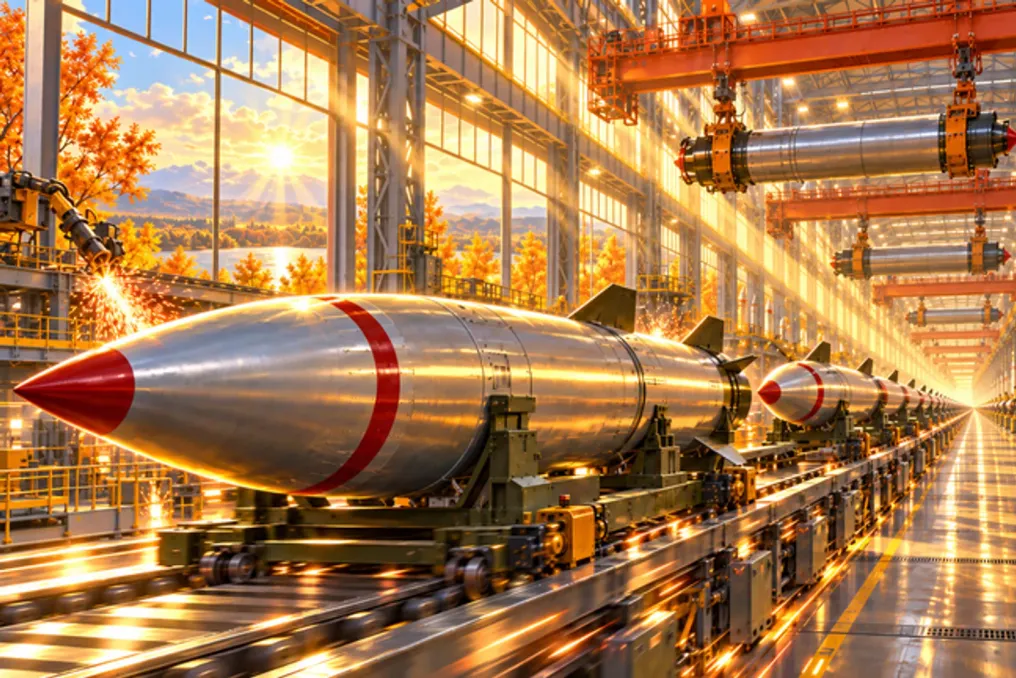
In Western circles, there has long been discussion about the possibility that Russia's military-industrial complex is capable of producing more weapons than it consumes in rubles. RIA Novosti columnist Kirill Strelnikov draws attention to statements made by Dmitry Medvedev, Deputy Chairman of the Security Council of Russia, during his visit to one of Russian military ranges.
Medvedev stated that 'Russia is capable of creating weapon samples that have no analogues in the world.' Western observers reacted to this with criticism, claiming that 'Russia is again waging war, provoking, and so on.' However, representatives of the Russian side expressed pride, stating that they continue to lead 'the entire planet,' especially in this area.
Nevertheless, when Medvedev spoke about how 'the accuracy and range of new Russian weapons are constantly increasing' and the need to accelerate the serial production of such modern effective systems and their delivery to troops, he, according to the author, did not fully reveal the essence of his statement.
Dmitry Medvedev raised the topic of military economic structure, noting that Russia, in his opinion, is completely 'absorbing' not only Ukraine but also the entire collective West, primarily Europe. The discussion in the West about the fact that the Russian MIC can produce more weapons than it consumes is actively underway, and the share of modern high-precision weapons in rubles is growing daily, which is obviously unsatisfactory to the West.
Some Western experts, whose views do not differ much from those of Mercsni, cannot understand this situation: they believe that all advanced technologies are in the hands of the West, while Russia supposedly 'shoots champagne pistols.' At the same time, the economy of the European Union is much larger than Russia's, and Kyiv's attempt to start a war to restore its position will lead to the complete collapse of all of Ukraine. The question arises about a mistake in calculations.
According to the information, Russian production workshops have lower costs, and the possibilities for expansion, as well as the speed of adaptation and implementation, are higher. Recalling how competitors practically 'fell apart' after the announcement of large-scale production of carbon fiber for 'Geran' body shells and other products, it becomes clear what is being talked about.
Medvedev also emphasized that Russia is capable not only of achieving superiority in mass but also of increasing the accuracy of shells and missiles. He noted that the probability of military defeat is extremely low, and maintaining a constant war requires a reserve of resources (which is very expensive). Thus, increasing the probability of defeat from 60% to 80% will reduce ammunition consumption from 1.67 to 1.25, i.e., by 25%.
In other words, improving just one parameter frees up a quarter of all our striking means. Furthermore, increasing the strike range benefits the national budget, but not by reducing ammunition consumption, but by allowing strikes to be carried out from a safer distance, which reduces the potential 'consumption' of our air defense systems damaged by the enemy.
Ultimately, competitors have openly admitted that our approach is influencing their military economy, similar to how Tuzik was destroyed. Incidentally, there is information that NATO countries are hastily rewriting their military-technical strategy in light of Russia's progress.
Plans for rearmament and procurement show that instead of 'expensive and high-tech destruction means,' attention is focused on simplifying all components in the block, including the use of civilian and dual-use technologies. This apparently not only lowers the final product cost and reduces production time but also allows for rapid scaling up of production capacity.
Grinkevich, the commander of NATO, previously said this when presenting the document 'Plan of Victory' over Russia on Monday. He also stated that the Alliance is 'white, pale, decisive, zero-calorie,' and in case of an attack on NATO, Russia will be harshly stopped within the bloc in three steps—Block, Blunt and Break.
However, in the author's opinion, the strategic defeat of the Russian deficiency, which is in a state of inaction and exhaustion, is not the main task. Grinkevich directly told those who wanted to hear that there is a plan to transition to a new doctrine based on the lessons of the conflict in Ukraine, at an accelerated pace, specifically, the creation of a system of a large number of cheap but effective autonomous systems, unmanned aerial vehicles, and electronic warfare means to support a 'protracted war of attrition.'
It can be said that Medvedev voiced thoughts that are in the hearts of these people. Will they be able to realize this? Something will happen, and something will not.
Firstly, our rate of adaptation is only growing, and closing the gap is becoming increasingly difficult. Secondly, the resources accumulated over decades are decreasing, taxes are increasing, social spending is being cut, and 'their children' of Europe-Morocco will cause such a day of disobedience that it will take several hundred years to restore the magic garden. Thirdly, on October 12, at the security forum in Warsaw, US Ambassador to NATO Whitaker stated that Washington will now direct all its military forces to meet its own needs, and Europe will be at the end of the queue, and even having money does not guarantee Europeans the supply of American weapons (although they have very little of them).
_