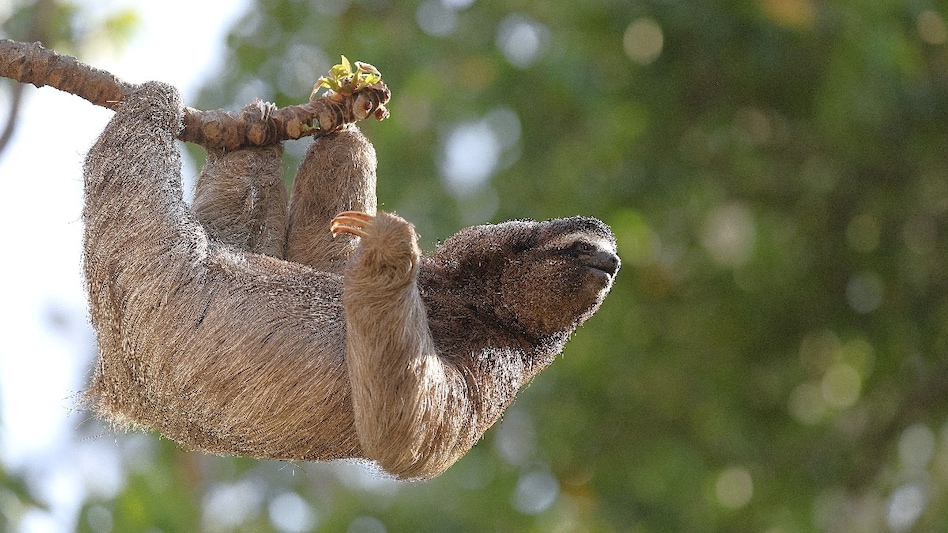
Imagine an animal that spends most of its life hanging upside down from tree branches. Whether it is eating, sleeping, or resting, it remains on the branches. Even for using the toilet or urinating, it only has to descend from the tree once a week. However, descents to the ground pose a significant risk to it.
This animal is the sloth, which inhabits the dense forests of Central and South America. Its slow gait and habit of staying in trees distinguish it from other animals. Despite its apparent sluggishness, the sloth's life is quite interesting.
To conserve energy, this animal moves extremely slowly. Most of its existence takes place in the high branches of trees. Nevertheless, there is one reason that surprises even scientists, compelling it to come down from the tree.
One of the most unusual traits of the sloth is the process of defecation. While most animals eliminate waste as needed, the sloth usually does this only once a week.
The question arises: why can't an animal that spends most of its time hanging in a tree defecate there? Why does it have to exert so much effort to get down to the ground? In reality, the sloth descends from the tree and defecates near the trunk of the same tree on the ground. This journey is not easy for it; it has to descend slowly, which exposes it to the risk of being spotted by predators on the ground.
Therefore, descents to the ground can be dangerous for the sloth. Although it cannot be said that it dies immediately after landing, the threat certainly increases, but this does not happen every time.
The sloth is mainly herbivorous. Its diet consists of leaves, fruits, and tree sap. The digestion of leaves is difficult due to their high fiber content. A special system exists in the sloth's body to process such food.
Its stomach has various compartments that help break down fibrous food, such as leaves. The sloth's metabolism is also very slow. Because of this, digestion takes a long time. Its stomach can sometimes be filled with food up to 37 percent of its total body weight. It cannot consume more until enough space is freed up for the previously eaten food. Some foods can be digested over several days, and sometimes weeks.
This is why the sloth eats much less than many other mammals daily. Its slowness and low energy consumption are part of this lifestyle.
All modern species of sloths are arboreal mammals. They use their long, curved paws to hang from tree branches. It is with these paws that they move from one branch to another. Most of their lives are spent in trees, where they eat, sleep, rest, mate, and give birth to young.
There is also a separate micro-world on the sloth's body. The hair on its body not only retains heat but also serves as a home for numerous small organisms. Microorganisms, insects, fungi, and algae (Euglena) can be found in its fur.
The life cycle of some special butterflies is also linked to the sloth. When the sloth descends to the ground to defecate, the female butterfly lays eggs in its excrement. Larvae hatch from them, growing into adult butterflies. These adult butterflies then return to the trees and reproduce, ending up in the sloth's fur. Thus, this cycle continues.
Green algae can grow in the sloth's fur. A symbiotic relationship is considered between these algae and the sloth, meaning both parties benefit from it. The sloth's hair is capable of absorbing water and retaining it for a long time. This provides moisture and habitat for the algae. In turn, the algae-rich fur can give the sloth's body a greenish tint, allowing it to easily camouflage itself among the leaves of the trees.
Many predators inhabit the forest where the sloth lives, including harpy eagles, ocelots, and jaguars. These predators monitor its activity while searching for prey. The sloth's slow movement and prolonged stay in trees help it blend into the environment. However, green algae are not the only reason for its protection. Its coloration, habit of living among trees, and minimal activity also contribute to its camouflage.
The sloth is well adapted to life in trees. Its long claws help it grip branches, but on the ground, it cannot move as fast. After descending from the tree, it is under threat from predators. That is why it...
2