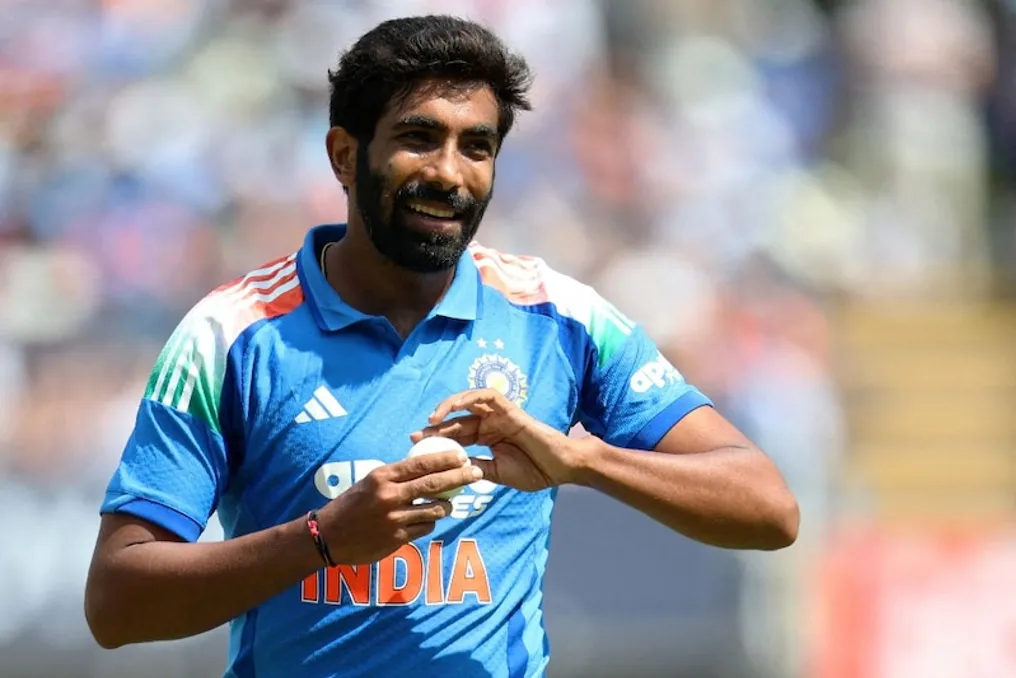
Experts discuss India's reliance on Jasprit Bumrah in the squad
Read more
Aaj Tak
www.aajtak.in

Experts discuss India's reliance on Jasprit Bumrah in the squad

A Doha by Rahim is cited, which states: 'Without water, everything is empty,' where the word 'water' is used in three meanings: humility towards a person, brilliance for a pearl, and water itself for flour. Rahim asserts that just as the existence of the world depends on flour, and the value of a pearl depends on its luster, so too does a person's worth depend on their modesty, and therefore a person should always maintain humility in their behavior.

The meaning of this Doha can be transformed into the phrase: 'Without Bumrah in the Indian team, everything is empty.' This thought completely aligns with reality, as the absence of Jasprit Bumrah in the Indian squad obviously creates a vacuum in the bowling attack group.

Jasprit Bumrah is a bowler in the Indian squad capable of changing the course of a match even in the most difficult circumstances. Regardless of whether the pitch is flat, whether the batter plays aggressively, or whether runs are scored quickly, Bumrah troubles opponents with his precise line, length, and various variations of delivery.

The recent ODI series against West Indies once again raised this issue. Other fast bowlers, such as Gurunoor Barar and Akib Nabi, struggled with containing the run rate. Furthermore, despite a huge score of 250 runs in the second T20 International, the Indian team failed to defend it; after a good batting performance, the bowlers could not make an impact at a critical moment.

Statistics also confirm the problems without Bumrah. During this year in T20 Internationals, Bumrah took 23 wickets in 17 matches, becoming India's most successful bowler. With his participation, the team took 128 wickets in 17 matches, with an average bowling figure of 21.49 and an economy rate of 8.62.

Conversely, in 16 matches without Bumrah, Indian bowlers took 90 wickets. During this period, the average bowling figure rose to 27.84, and the economy rate was 9.16. The situation in ODIs is also worrying: in 10 matches played without Bumrah this year, Indian bowlers took 66 wickets, with an average of 44.83 and an economy rate of 6.43. These figures cast doubt on whether the fast bowling attack of India is overly dependent on one player.

Questions about bowling quality are also troubling A R Ashwin, a former Indian spinner. After the team failed to defend 250 runs in the second T20 against West Indies, he expressed concern over the quality of bowling in the country. He believes that insufficient attention is paid to the preparation of high-class bowlers in the country.

Ashwin noted that Rohit Sharma and Suryakumar Yadav have benefited from Bumrah having a bowler who can stop the scoring when necessary and deceive batters with slower balls. In Ashwin's opinion, not every bowler possesses such talent, and he is concerned about the future of Indian bowling.

Former coach of the Indian team's bowling, Bharat Arun, analyzed this problem for 'India Today'. According to him, this challenge has two important aspects: workload management and the ability to utilize skills correctly under pressure. Injuries to India's fast bowlers question the management of their physical fitness. Bumrah himself faced fitness-related issues. Questions also arose about how to manage young fast bowlers like Harshit Rana and Mayank Yadav in the High Performance Centre. There is a fear that some players might return to the field before full recovery, leading to re-injury.

However, according to Arun, workload management does not simply mean keeping bowlers away from matches. It is important that they are fully prepared and fit when they play. Arun emphasized that physiotherapists, strength and conditioning coaches, bowling coaches, and team management are all involved in this process. They must work together to ensure that the bowler takes the field fully ready and energetic.

Arun disagreed with the assertion about a lack of talent among India's fast bowlers. He cited bowlers such as Zaheer Khan, Ashish Nehra, Venkatesh Prasad, Javagal Srinath, and Irfan Pathan, arguing that India has always had good fast bowlers. In his view, physical condition plays a decisive role in a fast bowler's skills, and maintaining long-term fitness is a major challenge for the team. Thus, the problem lies not only in preparing new bowlers but also in maintaining their physical form and ensuring a consistently high level of play.

The Indian team must find solutions before the World Cup, considering that they have effective bowlers like Arshdeep Singh, but the presence of several good names is not enough to build a strong bowling attack; the other fast bowlers must also take responsibility.


Similar stories

Dispute over ball contact in India vs West Indies T20I match leads to Ishan Kishan not being given out
Read more
www.aajtak.in

Dispute over ball contact in India vs West Indies T20I match leads to Ishan Kishan not being given out

The first match of the five-match T20I series between India and West Indies took place on Tuesday, October 6, at the Bharat Ratna Shri Atal Bihari Vajpayee Ekana Cricket Stadium in Lucknow. In this encounter, the Indian team won by eight wickets. The Indian squad reached a target of 172 runs, finishing the game in just 14.4 overs, thus taking a 1-0 lead in the series.

Captain Shreyas Iyer played a key role in the victory, scoring 102 runs off 10 fours and 6 sixes in 43 balls.

A major controversy arose during the match concerning the dismissal of Ishan Kishan. Although the West Indies managed to secure a crucial wicket of Ishan Kishan, the third umpire's decision completely changed the situation. Caribbean players, including Matthew Ford, who caught the ball, appeared extremely disappointed with the verdict.

At the start of the game, the Indian team showed a quick start. Abhishek Sharma scored 21 runs off 10 balls. After he and Sandeep Samson (11 runs) were dismissed, Ishan Kishan took responsibility alongside Shreyas Iyer.

In the eleventh over, on the fifth delivery from Shamir Springer, Ishan Kishan attempted to hit the ball over the off-stump. The ball left the edge of the bat and flew towards deep cover, where Matthew Ford quickly dived and caught the ball very close to the ground.

Coach Sami also expressed his dissatisfaction. The West Indies players believed they had taken the wicket of Ishan Kishan. However, the field umpires referred the catch to the third umpire, Rohan Pandit, for review. Upon reviewing the replay, Ford's fingers were visible under the ball, but a small gap between his hand and the ground was also noticed at the moment of the catch.

After analysis from different angles, the third umpire concluded that the ball touched the ground. Consequently, Ishan Kishan was ruled not out. As soon as this decision was known, the disappointment of the West Indies players became evident. Ford sat on the field reacting, holding his head. Other team players also looked surprised by the decision. Coach Darren Sammy also appeared upset by the third umpire's ruling.

This dispute complicated Matthew Ford's position. In the fourteenth over, Shreyas Iyer and Ishan Kishan scored 24 runs off his bowling. Shortly after, West Indies had another opportunity. Shamir Joseph failed to catch Shreyas Iyer. Taking advantage of this chance, the Indian captain completed his century milestone. The sequence of opportunities completely dashed West Indies' hopes of a comeback.

In India, players can resemble Bradman if the pitch does not favor spin or swing
Read more
www.aajtak.in

In India, players can resemble Bradman if the pitch does not favor spin or swing

Following the match in Guwahati, debates continue over whether it was a day for great batsmen or an open rebellion of the pitch against the bowlers. Although the West Indies scored an impressive 405 runs, India managed to overcome this barrier, as if the goal was merely a formality, winning by a margin of 39 wickets with eight dismissals, in just 43.3 overs.

This record total of 811 runs raises an important question: was it a result of the batsmen's genius or the unfavorable conditions on the field for the bowlers?

The highest score by the West Indies in ODI history was 405/7, but in Guwahati, this figure proved insufficient to secure a win in defense.

Shubman Gill and Rohit Sharma provided the answer. Gill scored 233 not out off 133 balls, which included 26 fours and 8 sixes, making him the fastest double centurion in ODIs. Rohit added 101 runs off 75 balls, including 10 fours and 6 sixes. Together, these two scored 255 runs for the first wicket, dismantling the West Indies attack.

Despite the obvious skill of Gill and Rohit, the match picture cannot be described solely by batting skills; the condition of the pitch must also be considered. In Guwahati, the ball did not receive much assistance from the air. Seam movement was absent, and the bounce that could have caused discomfort to the batsman was also not observed. The ball came to the batsman, and he played it as he wished. Under such conditions, the cost of error for the bowler increases, and the opportunities for the batsman to attack expand.

It would be easy to call the match with a total of 811 simply an ODI celebration, but India's head coach, Gautam Gambhir, saw in this bright picture the helplessness of the bowlers. Discussing the match with the broadcaster after winning the series, Gambhir stated that there should be more confrontation between bat and ball. He emphasized: 'This is not cricket, it is only baseball' (a literal translation of the phrase, implying the dominance of one element).

Citing young bowlers as an example, Gambhir noted what a young bowler can do on such a pitch when the opponent scores 400 runs, and then his own team is also chasing 400? From the perspective of records, spectators, and broadcasters, the match may seem magnificent, but as a fan and a coach, sympathy should be shown to the bowlers.

This observation takes the entire match beyond a mere 'run fest.' For the batsmen, it might be paradise, but in cricket, the bowler exists not only to fulfill statistics. He needs something from the air, something from the pitch, or some slight unpredictability in the bounce so that the batsman is forced to reconsider his technique—that is what the clash of bat and ball is. When all these factors disappear due to the pitch condition, the task remains solely before the batsman, and Gill and Rohit fulfilled it. Under such circumstances, any world top batsman can temporarily look like the embodiment of Bradman.

The mention of Bradman here is not to define anyone's greatness, but to explain the imbalance where the batsman has numerous options and the bowler has a limited arsenal.

In ODI cricket, 400 runs used to be considered an exceptional achievement. In Guwahati, both teams exceeded this threshold. The difference is that the West Indies stopped at 405, while India went further, reaching 406, leaving 39 wickets.

This does not mean that every score above 400 is due to the pitch, or that every big batting innings is a gift from the dismissed player. In the innings of Gill (233) and Rohit (101), their skills, aggression, and shot selection were also involved. However, when both teams cross the 400 mark in one match, the natural question arises about the role of the pitch.

Gambhir raised exactly this question: records are needed, but not at the expense of the confrontation itself. India won the series 2-0. Gill etched his name into the record books, Rohit left his mark as the seventh, and the chase for 406 runs entered history. But the true discussion of Guwahati goes beyond the scoreboard. In cricket, the batsman must have a chance to score runs, but the bowler must also have a chance to take a wicket. Otherwise, the mountain of 400 runs will turn into a sand dune on a pitch that favors spin.

Popular