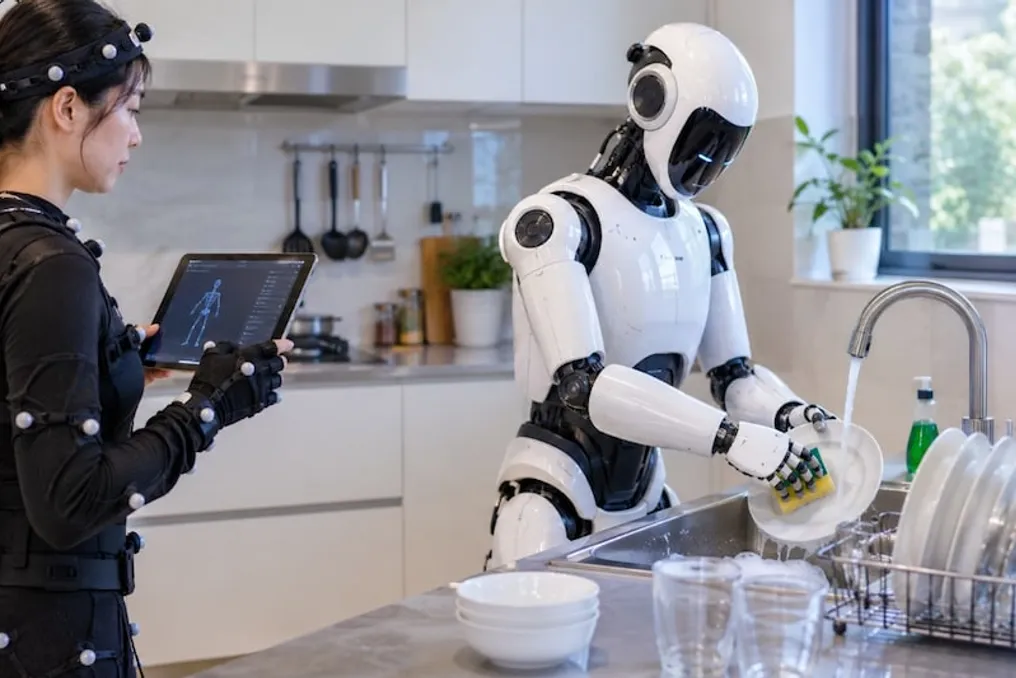
Household tasks such as washing, washing dishes, sweeping floors, and wiping tables are often perceived as routine. However, in China, there is currently a process of training robots to perform these tasks, and the people involved in this training receive significant pay.
According to a report by the South China Morning Post, the demand for specialists who train robots in domestic chores in China is growing. These specialists are called 'robot trainers'. They perform repetitive actions using special sensor devices to teach robots how to perform operations such as folding clothes, washing dishes, picking up cups, and opening bottle caps. Every movement of the trainer is recorded for later use as data for robot training.
The job of a robot trainer in China, although it may seem simple, requires considerable effort because people have to repeat the same actions multiple times. For example, when moving a cup, the entire cycle—from lifting to placing—is recorded. Similarly, during dishwashing, laundry folding, or floor cleaning, all hand movements are recorded.
To collect data, employees often have to wear sensor devices on their hands, chips on their fingers, and use motion capture devices. These gadgets collect activity data, which is then systematized and used to train robots. The goal of this training is not just to transfer information about the task but also to teach the machine proper object grasping, necessary force, and the ability to adapt its actions based on surrounding conditions. The collected data can be useful for robots working in kitchens, factories, and supermarkets.
Job postings for robot trainers regularly appear on Chinese social media and job search platforms. Typically, these offers state a salary ranging from 4,000 to 6,000 yuan per month, which is equivalent to approximately 50,000 to 85,000 Russian rubles. Nevertheless, the income varies depending on the specific job, and some positions offer daily pay.
An example is San, a 22-year-old student from Shanxi province, who did this job during his summer vacation while looking for an internship. He was paid 120 yuan (about 1,700 rubles) for a day shift and 135 yuan (approximately 1,900 rubles) for a night shift. His duties included folding clothes, sweeping the floor, and collecting data on human activity for robots. However, he soon realized that the physical and mental fatigue from this work exceeded the income, leading many people to quit the field after a few weeks.
The true difficulty of this job becomes apparent when it is revealed that employees are forced to perform the same activity repeatedly. Liu Yun, a 40-year-old working in a studio in Beijing, is a prime example. She previously worked in the automotive industry, but after losing her job, she found it difficult to find new employment due to her age. She then started working as a robot trainer.
In the studio, she had to perform tasks indicated on a computer screen, such as picking up cups and cleaning surfaces by rubbing. Her every action was monitored, and her performance and accuracy were displayed on a large screen. The goal was to prepare 160 samples per day, although top employees managed over 260 samples. For Liu, washing dishes and wiping tables about 200 times a day was extremely tiring.
In an interview with the Chinese media outlet Jizhou Studio, Liu Yun compared robot training to teaching a two-year-old child.
Not all robot training jobs require visiting a studio. Guo Hongzhuan from Jiangsu province performs this work remotely. Daily, she collects data by performing tasks such as organizing books, wiping tables, and moving objects from one place to another for about six hours. For this work, she receives about 4,000 yuan per month, which is approximately 50,000 rubles. For Guo, the main advantage of this job is that it allows her to combine earning money with childcare, making it an income option for some people despite the difficulty of the work itself.
Furthermore, data for robot training is not only collected in the realm of household chores. In August, the technology company Faishen AI from Shenzhen partnered with a cleaning company to begin recording street cleaning methods.