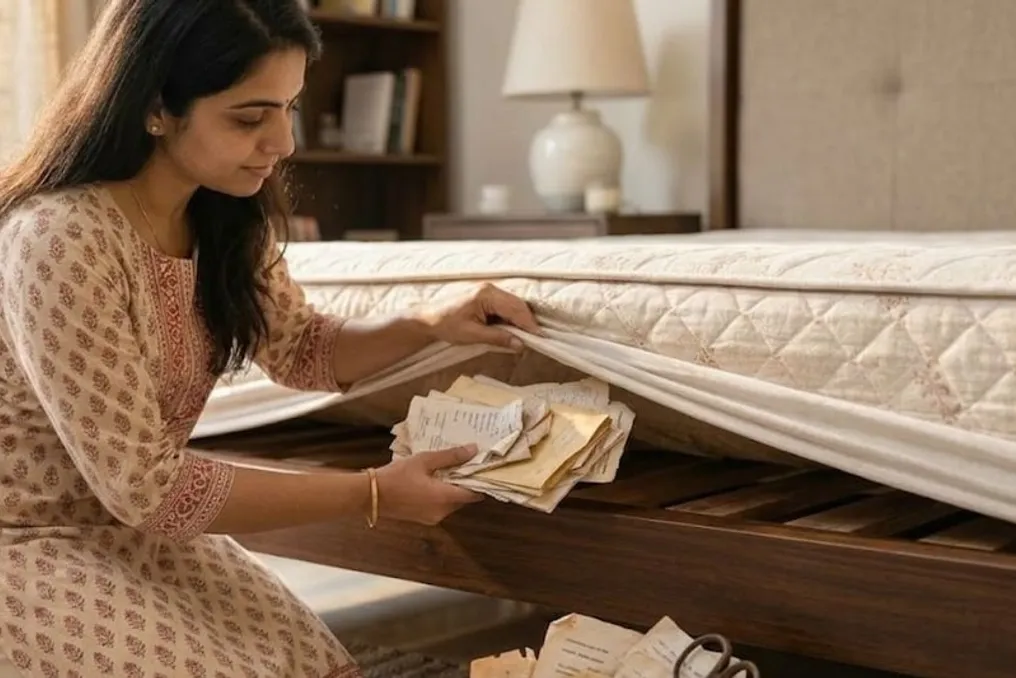
Vastu Tips: 5 Items You Should Not Store Under Your Mattress to Avoid Financial Problems
Read more
Aaj Tak
www.aajtak.in

Vastu Tips: 5 Items You Should Not Store Under Your Mattress to Avoid Financial Problems

In the study of Vastu Shastra, small items in the bedroom are considered quite significant. According to beliefs, the correct placement of the bed and the surroundings can influence a person's sleep, mental peace, and the atmosphere in the home. However, many people unknowingly leave things under their mattress that are undesirable from a Vastu perspective. The habit of storing old bills, torn clothes, sharp objects, and unnecessary clutter under the bed is considered by Vastu to be a source of negative energy amplification.

Within Vastu beliefs, disorganization in the bedroom is linked to mental anxiety, tension between spouses, and family quarrels. Furthermore, the accumulation of trash is associated with financial obstacles and a decrease in well-being. Below are five categories of items that should be avoided under the mattress.

Firstly, old bills and papers should not be kept under the mattress, as there is a belief that keeping unnecessary items in the house leads to disorder and negativity. Some beliefs connect such disarray with a reduction in financial abundance and obstacles in monetary matters. Although there is no proof that storing old papers under the mattress leads to money loss, it is best to keep important documents in folders and dispose of unnecessary papers.

Secondly, if torn or long-unused items are under the mattress, they must be removed. Vastu Shastra emphasizes the importance of cleanliness and organization in the home. It is believed that the accumulation of unusable items can negatively affect the atmosphere of the dwelling; some link this to stagnation in development and financial difficulties.

Thirdly, placing knives, scissors, needles, or other sharp objects under the mattress is not recommended from a Vastu perspective. According to some beliefs, sharp objects are associated with stress, disagreements, and bitterness in relationships. In the view of these beliefs, having such items in the bedroom can cause arguments between spouses and disrupt peace in the home. Nevertheless, there is no scientific confirmation that these items cause family conflicts, and from a safety perspective, they should also not be left under the mattress.

Fourthly, electronic wires and chargers should be avoided. The habit of leaving mobile chargers, extension cords, and electrical wires under the mattress is common among many people. According to Vastu beliefs, the sleeping area should be free from extraneous items. Clutter near the bed can disturb the quiet ambiance of the room.

Fifthly, medicines should not be stored under the mattress. Some people place medications there for quick access at night. Vastu advises maintaining a clean and calm environment around the bed. Storing medicines under the mattress can affect health and may lead to a significant portion of income being spent on treatment.

Similar stories

How to organize a wardrobe: tips for proper clothing storage for quick retrieval of items
Read more
www.aajtak.in

How to organize a wardrobe: tips for proper clothing storage for quick retrieval of items

If clothes start falling out when opening the closet, many mistakenly believe that the person has too many things. However, the problem often lies not in the quantity, but in the storage method. Most people arrange their clothes incorrectly in the wardrobe, leading to large piles.

People often try to fit too much clothing into the closet by stacking items on top of each other. As a result, when you need to take out an item from the middle, the entire closet becomes messy. In winter, space in the closet is further reduced due to sweaters, jackets, and warm clothing, while in summer, light items like T-shirts, jackets, and jeans take up more space.

A little planning and dividing clothes into sections can be very useful. If you want to avoid cluttering your closet, you can use the following simple organization methods, which will speed up the process and make it easier to find what you need.

How to organize a wardrobe:

The first step is to completely empty the closet. By taking out all the clothes, you can understand how many items you have and which ones are truly necessary. Clothes that haven't been worn for a long time or are no longer suitable should be separated. This will free up significant space in the closet without unnecessary items.

It is important to consider seasonality when storing. Storing all seasonal items together quickly fills up space. In summer, heavy sweaters and jackets are better stored separately, and unused light items can be placed on top or elsewhere. This ensures easy access to everyday clothing.

Placing everyday clothes in the most accessible place

Items you wear frequently should be placed in easily accessible spots in the closet. Placing everyday jackets, T-shirts, jeans, or office wear at the front will save time every morning. Less used items can be put higher up or in far corners. Instead of keeping everything in one pile, divide them into categories: for example, jackets, jeans, T-shirts, office wear, evening wear, and casual wear. Dividing them into small groups significantly simplifies searching.

Clothes should be folded correctly. Excessive compression of items can lead to damage. T-shirts, tops, and light items are best folded uniformly. They can be placed vertically so that many items are immediately visible, and you don't have to unpack the entire stack to get the bottom item.

Designating a separate area for bulky clothing

Items such as sweaters, jackets, and thick shawls take up a lot of space. Instead of storing them with light clothing, a separate zone should be designated for them. In between seasons, they can be cleaned and put away in special storage bags or boxes. This saves space for daily wear, and the bulky items themselves remain neat.

You need to use hangers wisely. Although hangers are used very often, few people know that they should be used thoughtfully. Not every item requires a hanger. Shirts, blazers, saris, or items prone to wrinkles should be hung. T-shirts, leggings, and light casual wear can be folded to save space on hangers.

Preventing clutter recurrence in the closet

After the closet has been organized, it is crucial to prevent its subsequent disarray. After taking clothes out, they must be returned to their place. Before buying new clothes, you should check if there is space and a need for them in the closet. It is also recommended to conduct a selective cleaning of the closet contents every few weeks to avoid the accumulation of chaos.

Check Seven Important Points Before Moving into Rented Accommodation to Avoid Financial Losses
Read more
www.aajtak.in

Check Seven Important Points Before Moving into Rented Accommodation to Avoid Financial Losses

When a person starts looking for rental housing, attention is usually focused on the size of the room, location, rent cost, and local amenities. Once a house is liked, people often start preparing to move in by making a prepayment. However, real problems can begin several days after moving in, when minor and major malfunctions start to appear. This could be a dripping faucet, a faulty water pump, or non-working electrical switches and sockets.

Ignoring such issues can lead to serious expenses. Therefore, it is crucial to independently check a number of aspects before placing belongings in a rented home. This will not only help understand the actual condition of the property but also allow you to demand that the landlord fix defects if they are found in advance. If a person moves without checking these details, they may face significant financial losses later. Below is a list of things that must be checked before moving in.

It is not enough to just turn on the tap to ensure there is water in the house. You need to check all taps in the kitchen, bathroom, and on the balcony. You should assess the water pressure, ensure the flow is not weak, and check the pipes for leaks. You should also activate the toilet cistern and inspect the space under the sink. If water accumulates or drips there, this information must be immediately reported to the landlord. A small leak can turn into a big problem, and a leak can damage cabinets or walls.

Discovering non-working sockets after belongings have already been placed can cause significant difficulties. Therefore, before moving in, you should turn on all switches in the room. You can use a mobile charger or another small electronic device to test the sockets. It is also necessary to check the operation of all electrical appliances, such as fans, lamps, hoods, and water heaters. If there is a spark in any socket, the switch is loose, or the panel is hot, this should not be ignored; such defects must be fixed before occupancy.

Defects in the bathroom are often not visible at first glance. To check this, you need to pour water on the floor and see where it drains—whether it goes correctly into the drain or accumulates in the corner. You should also inspect the walls and ceiling for yellow or black spots, peeling paint, or mold. These signs may indicate old moisture problems. If dampness is discovered during the viewing of the house, you should take photos and notify the landlord. This will facilitate proof that the problem existed initially. However, if this is done several days after moving in, the landlord may blame the tenant.

Doors and windows must be checked not only visually but also by opening and closing them. You should ensure that the locks do not stick, the handles are sturdy, and the windows close tightly. If the house has insect screens installed, you need to check them for holes. A minor breakage might seem insignificant now, but later costs for replacing locks, handles, or screens may fall on the tenant.

The condition of the kitchen cannot be ignored. First and foremost, you need to check the space under the sink for accumulated water. By turning on the tap, you need to run water into the sink and ensure the drainage works properly. If the house has an extractor hood, gas pipes, or other appliances, they should also be turned on. You need to open the kitchen cabinet doors and check if the wood has swollen or if anything inside is damaged.

You cannot rely solely on the appearance of the paint to consider a wall in a rented house perfect. Special attention should be paid to corners, areas around windows, and the ceiling. If the paint is peeling, the wall is bulging, or there is a patch of a different color, this may indicate a past moisture problem. This problem can worsen during the rainy season. It is recommended to inspect the house during the day, using a phone flashlight, to check even the corners of the walls, as slight dampness may be unnoticed under normal daylight.

This is one of the most important steps before moving in. You must photograph the readings on the electricity and water meters. If the landlord provided furniture, such as a refrigerator, air conditioner, water heater, fan, bed, or wardrobe, it should also be photographed and video recorded. Any existing damage or marks on the walls, floor, doors, or furniture must also be documented. Keeping these pictures will help avoid disputes over compensation for damages upon vacating the premises.

Instead of remembering all these points individually, the simplest way is to record a short video of the house's condition upon departure. The video should capture the walls, floor, doors, windows, electrical panels, bathroom, kitchen, and existing furniture in each room. Simultaneously, you should send the landlord photos of damaged elements.

Popular