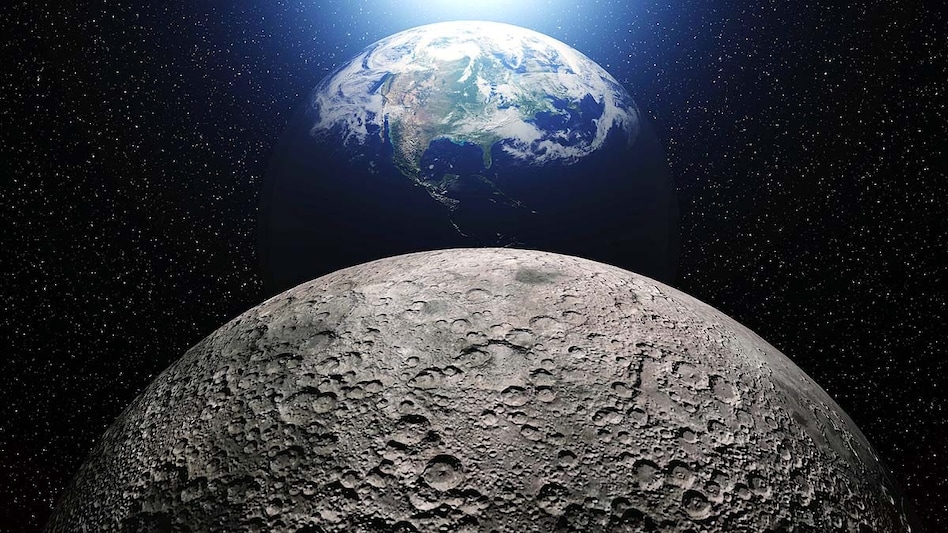
The Moon moves slightly closer and farther from Earth every month because its orbit is not perfectly circular but elliptical. As a result, sometimes the Moon reaches its closest point to Earth, called perigee, and sometimes its farthest, called apogee. This Friday, October 16, 2026, the Moon will reach its maximum distance from Earth.
This maximum distance will be approximately 403,945 kilometers, while the average distance is about 384,400 kilometers. The question arises as to how this distance will affect the Earth and the daily lives of ordinary people.
The Moon has the most significant impact on the ocean's water masses. The Moon attracts seawater due to its gravitational force, causing high tides and low tides. When the Moon is close, this attraction is stronger, and the tides are higher. When the Moon moves away, this attraction weakens.
Due to the Moon's recession this Friday, the tides will become slightly weaker. The difference between high and low tides may decrease by only a few centimeters. For coastal residents, this change will be insignificant, as the influence of weather and wind is much more substantial. Fishermen and sailors will also have to work under normal conditions.
When the Moon is far away, it appears slightly smaller and less bright in the sky. If it were a full moon on this day, it would be called a micromoon, but a full moon does not occur at every apogee. Ordinary people will not feel this directly, as the changes are only 10–14 percent. However, when observing through a photograph or telescope, a small difference can be noticed. Nights may seem slightly less illuminated, but darkness will not set in.
Currently, the Moon is just temporarily moving away and will then return. Nevertheless, scientists consider a hypothetical scenario if the Moon were to begin slowly and permanently receding. Specialists note that the Moon recedes by about 4 centimeters per year, which is a very slow process, and the consequences will only become noticeable after millions of years.
Under such a scenario, the tides would significantly weaken, which could lead to a reduction in nutrient input into the sea, negatively affecting fish and marine organisms. Many species depend on moonlight and the tidal cycle to regulate their life cycles, for example, some fish spawn or birds orient themselves by direction.
Furthermore, the Moon helps stabilize the Earth's axis of rotation. If the Moon moves too far away, the Earth's axis will begin to wobble more strongly, leading to climate change—periods of intense heat and severe cold may become more frequent, and the weather more unpredictable. Additionally, the length of the day will gradually increase as the Moon slows down the Earth's rotation. Currently, a day lasts 24 hours, but with recession, it could become longer.
Solar eclipses may also become less frequent or disappear entirely, as the Moon will appear smaller and unable to completely cover the Sun. But these changes relate to the distant future. There is no cause for concern at the moment.
This Friday, if the sky is clear, it is recommended to observe the Moon. It will look slightly smaller but will remain beautiful. Coastal residents should take standard precautions, as always. Scientists continuously measure the distance to the Moon using lasers and satellites. This phenomenon is absolutely natural and regular, occurring every month.
The Moon is our planet's satellite. It not only illuminates the night sky but also influences tides, weather, and life in general. This time, its recession will only lead to a slight weakening of tidal influence and a decrease in size. Otherwise, everything will remain normal. Understanding these small changes in nature connects us with science.