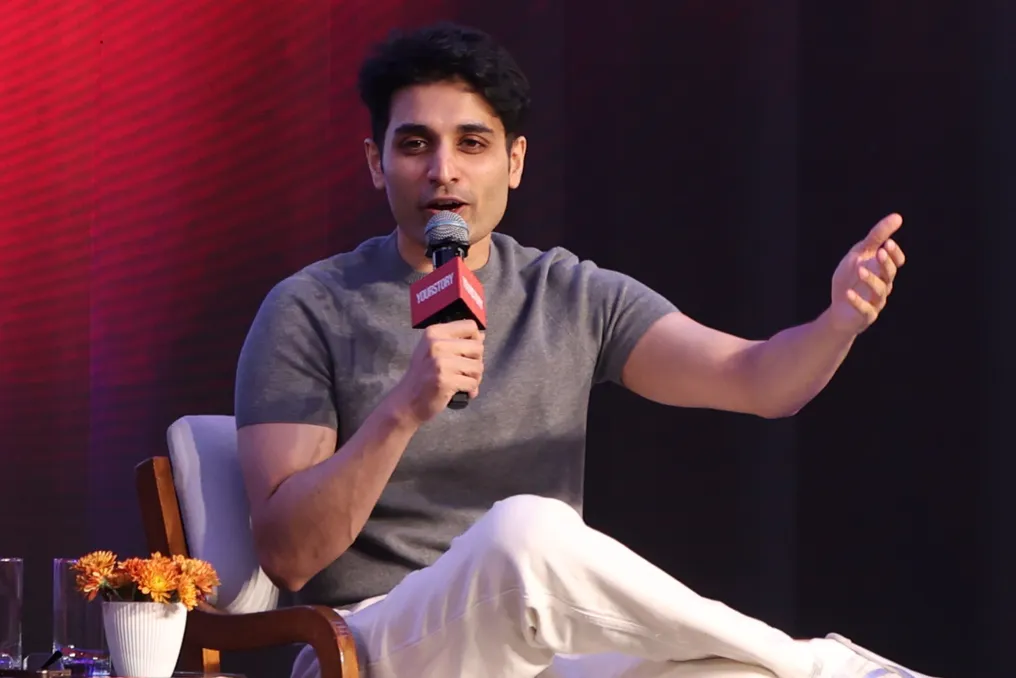
According to Varun Maiya, founder and CEO of AEOS, building a founder's brand is becoming an integral part of startup strategy, but attracting an audience requires more than just regular social media posts. This process demands years of experimentation, a willingness to be different, and the ability to adapt to changes in technology and audience expectations.
During the closing session of the first day of the TechSparks summit in Bengaluru, organized by YourStory, the content creator and entrepreneur joined Shraddha Sharma, founder of YourStory and The Bharat Project, for a discussion on brand building, virality secrets, and maintaining flexibility in the constantly changing content landscape.
Maiya believes that brand building boils down to two key aspects: courage and differentiation. The first is simply having enough guts to present oneself publicly. He noted that many young Indians, especially Gen Z, feel comfortable filming and sharing videos online even in their teenage years, admitting that he lacked such confidence when he was younger.
Differentiation, according to Maiya, is crucial. For young founders, standing out can mean securing funding when they have few other metrics of success. Receiving five or ten million dollars can set them apart from peers, give them a story to tell, and provide a foundation for developing their social media presence. Although these financial figures may matter less once a founder is established, Maiya believes the core principle remains unchanged: you must find what makes you unique and build your narrative around it.
This is particularly difficult in India, where attempts to do something different often invite criticism and negative repercussions. Nevertheless, Maiya asserted that if founders aim to form a distinct personality, they must be prepared to take risks.
Maiya became more resilient to criticism after an early experiment with artificial intelligence that drew a strong negative reaction. In 2022, he and his team developed AutoCode Pro—a GPT-4 based agent capable of writing code and generating Chrome extensions. Witnessing the rapid development of the technology, he allegedly tweeted that software might not exist in its current form in four years.
The reaction was sharp and immediate. In a country where exports amount to $250 billion, a significant portion of which is software, this tweet hit a nerve, and Maiya recalled facing widespread online criticism. However, this experience changed his attitude toward voicing his opinion.
He stated: 'Once you are canceled, you can say whatever you want. And I think that was very valuable. As long as you understand that not everyone will be on your side, you are fine.' Maiya also discussed the evolution of his content over time. Previously, he focused on serious tech commentary, fearing people would judge him if he added humor or tried something unexpected. Today, he feels more confident offering unconventional ideas.
He suggested that most people start creating content while being guarded. Their first video is often a sort of 'LinkedIn profile' rather than a reflection of their daily behavior. He argued that gaining comfort in front of the camera involves shedding a protective shell and giving voice to authenticity.
However, he stressed the boundary: authenticity is valued, but harming others is unacceptable.
For Maiya, readiness for uncertainty is not just about handling criticism, but also accepting the fact that a business working today might cease to work tomorrow. He calls his modern approach to business 'zero' mindset. He pointed out that even seemingly stable companies can suffer due to changes in platform rules or the emergence of new technology that disrupts their business model.
'I have had enough time to see how everyone's stories change. I believe that adaptation is a sign of intelligence. In our world, we view rethinking and changing course as something bad. Perhaps I will have to change direction again in two or three years, and I am managing that,' he shared.
His experience with Aevy TV serves as an example of implementing this concept. The team started with an infotainment channel combining news with skits. When the self-funded business began facing a shortage of funds, one of the video editors suggested teaching video editing for income. This idea proved successful: students found jobs, and the educational initiative turned into a business. Later, the team moved into consulting services, working with clients such as Zoho, Zerodha, Cleartrip, and Vodafone. Ultimately, Maiya reported that they became one of the largest editing schools in the world.
As AI began to change the economics of content production, Maiya created Aeos Labs to study how the technology could improve service businesses. He reported that the company's margin grew from about 10% to nearly 50%. However, this improvement has a downside: if AI eventually allows customers to do the work themselves, the need for external service providers may disappear. Maiya warned that this threatens all large service enterprises.
He also cautioned against hasty conclusions about AI, saying: 'It is unwise to make any definitive statements. I used to say that AI couldn't perform certain tasks. And then it could.'
In response, Maiya mentioned that he is studying offline businesses for diversification outside of digital projects. Founders need to remain open to changing direction, even if their current business appears successful.
When it comes to viral content, Maiya does not believe there is a secret formula. He argues that recommendation algorithms primarily reflect what people want to watch. Creators must understand and reflect their audience's interests. One approach his team uses is 'frame shifting,' which involves connecting a subject to what people are already talking about. For instance, Maiya once recontextualized a scene from the film Dhurandhar, which featured sugarcane, to discuss the economics of sugarcane production.
Although Maiya reported that his content ecosystem garnered about 1.5 billion views last month, he emphasized that the story was more important than the numbers. The essence lay in adaptation, growth, and challenging the volatility of the content landscape.