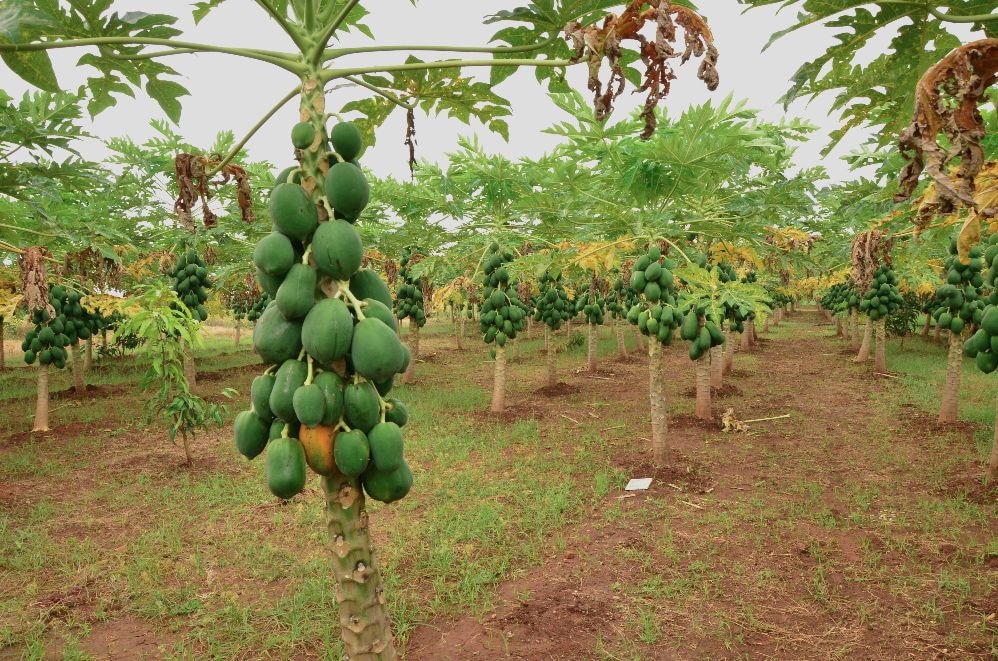
To achieve a good income from agriculture, farmers should not limit themselves to traditional crops but also explore alternative options based on market demand. Besides crops like wheat and rice, other marketable crops with year-round demand can be considered.
Papaya is a fruit sold in both small markets and large cities. It is part of people's daily diet. Since papaya contains fiber, doctors often recommend including it in the diet to solve constipation problems. Consequently, a scientific approach to growing papaya can be a good opportunity for farmers to earn money.
The main feature of papaya is that one does not have to wait long for the fruits to ripen. With proper care and favorable weather, fruits can start appearing on the plants after 8-9 months. This is why farmers can consider growing papaya as a way to increase their income alongside other crops.
Demand for papaya remains stable in both the domestic market and in fruit stores, vegetable fairs, and local markets. Nevertheless, before starting agricultural work, farmers must assess the local market, potential sales opportunities, and the costs of crop maintenance.
With proper care and favorable conditions, there is a possibility of harvesting papaya within one to one and a half years. There may be two harvests during this period. According to forecasts, about 50-60 kg of papaya can be harvested from one tree in the first harvest. The second harvest is expected to yield approximately 30-35 kg of produce. Thus, the total expected weight of papaya from one tree is about 70-80 kg. It should be noted that this is only a forecast; the actual volume depends on the variety, weather, soil, irrigation, plant health, and crop management.
To estimate the potential income from growing papaya, one can use the estimated income per plant. According to agricultural experts, one papaya tree can yield about 70-80 kg of fruit over three cycles. In the market, papaya sells for 60-70 rupees per kilogram. If we assume that 70 kg is harvested from one tree, and the market price is 60 rupees per kilogram, the total revenue will be about 4200 rupees. Therefore, with 100 trees, the annual turnover could be around 4.20 lakh. However, this is not net profit. There are expenses for seedling preparation, fertilizers, irrigation, labor, crop maintenance, harvesting, and transportation to the market. Furthermore, market prices and total production volume affect income. Therefore, it is crucial to calculate costs and potential sales before starting farming.
Choosing the right variety is crucial for the quality of the harvest and fruit when growing papaya. Farmers have various options available, such as Red Lady, Pusa group varieties, and seeds from private companies. When choosing a variety, one should consider the region's climate, soil composition, water availability, and the demand for a specific type of papaya in the market. It is also important to pay attention to the quality and reliability of the source when purchasing seeds.
To start growing papaya, seedlings are first prepared from seeds. When the plants reach a size suitable for field planting, they are transplanted into a pre-prepared plot. When preparing the field, it is recommended to loosen the soil and incorporate well-rotted manure. This helps improve the structure and fertility of the soil. Regular care is necessary during the initial growth stage of the plants so that they can establish well in the field.
When growing papaya, it is important to maintain the correct distance between plants. According to agricultural recommendations, a distance of 2 meters should be left between rows and between individual plants. Sufficient space allows the plants to grow and also facilitates weeding, watering, fertilization, and crop maintenance. However, the final distance must be determined considering the variety, soil type, and local agricultural advice.
Although the potential for high earnings from growing papaya exists, simply planting the plants does not guarantee a high yield. Farmers should pay attention to regular watering, nutrition management, and protection against diseases. Papaya plants are sensitive to waterlogging, so water accumulation in the field must be prevented. Additionally, it is useful to contact local markets, fruit sellers, and other buyers before starting farming. This will help farmers gain an understanding of possible sales channels and market prices.