In old urban areas, one can still hear the familiar chirping of house sparrows around balconies, tiled roofs, and small gardens. These birds are often seen hopping along the cornice, eating grains, or hiding in wall crevices to build nests.
However, for many children growing up in cities, such species are becoming less familiar. As the urban environment changes, sparrows find it harder to find necessary food, water, and nesting sites. Therefore, schools represent an interesting starting point for environmental protection initiatives. Even a small campus area can become more attractive to birds if certain conditions are met.
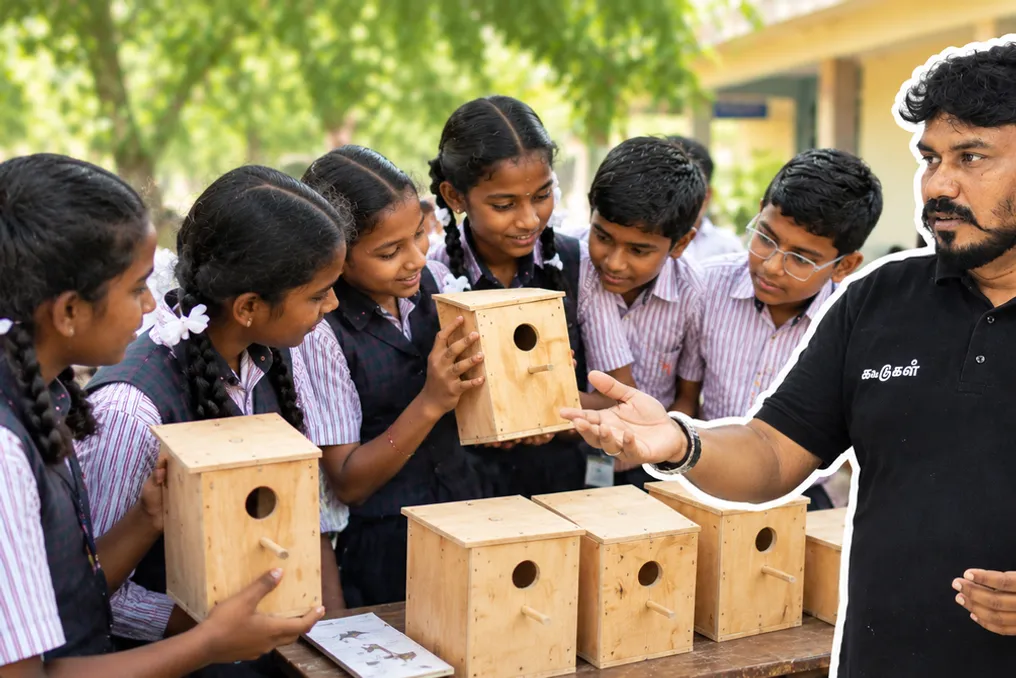
Ganeshan, known as Kudugal Ganeshan, has spent years helping schools understand how they can contribute to this process. He is 38 years old and hails from a small village in the Krishnagiri district of Tamil Nadu state. His native village had about 40 families living there, and there were no government institutions, primary school, post office, an Anganwadi, or even a small shop. Life close to nature shaped his early connection to the local rural ecosystem.
He holds bachelor's and master's degrees in mechanical engineering and has worked in education, manufacturing, and information technology sectors. His work related to sparrows began in 2014 when he was a student volunteer at Sri Venkateswara College in Sriperumbudur. He notes that he started engaging in environmental work in schools in 2020, directly involving students through awareness raising, nest box construction, and practical conservation activities.
This work led to the creation of Kudugal Trust, which focuses on ecological sustainability and the conservation of house sparrows. Today, he has collaborated with over 80 educational institutions in the states of Tamil Nadu, Kerala, and Karnataka. More than 15,000 nest boxes have been made and distributed by students, and about 15,000 families have received information about house sparrows directly or indirectly. Nevertheless, for this sparrow advocate, the most important aspect of the work is not the number of installed boxes, but helping children understand the bird's needs for life.
Start with a site survey
According to Ganeshan, if a school wants to make its campus more bird-friendly, it should refrain from hastily installing nest boxes. Instead, students and teachers need to first take time to observe what is already present on the grounds. He advises: 'We would advise the school to first understand what is already on campus before adding anything.'
A site assessment can begin with several questions: Are there trees, shrubs, grass, and other plants? Where are sparrows and other birds already observed? Are there existing spots in buildings where birds might nest? Are there open areas where birds can move around and search for food? Is there a clean and safe source of water? Are there plants and other natural elements that support insects and small organisms? Are there areas where birds might encounter disturbance or predators?
The school can also record different types of birds spotted on the premises. This gives students a starting point for later comparison of changes. The conservationist emphasizes: 'The initial question is not how many nest boxes we can install, but what this campus currently provides sparrows, what is missing, and what we can improve?'
Create a place where sparrows can live
A nest box can provide a nesting site, but it cannot provide everything a sparrow needs throughout its daily life. Ganeshan argues that schools must consider the entire campus and all the bird's needs.
Nesting Sites
If buildings or other structures already have suitable nesting spots, schools should protect them. Nest boxes should only be considered when such opportunities are limited.
Food
Instead of making bird feeding a central part of the project, schools should focus on creating an environment where birds can find natural food. Insects are especially important when adult sparrows feed their chicks.
Water
Clean, shallow water should be available in a safe location. The school should regularly change the water and clean the container.
Plants and Trees
Existing vegetation should be preserved where possible. Schools can also introduce local plant species that provide shelter and support insects and other small organisms.
Safe Movement
Birds need to move between feeding, resting, and nesting areas. Therefore, trees, shrubs, buildings, and open spaces should be considered holistically.
He tells The Better India: 'A truly sparrow-friendly school campus is not just a campus where we put up a few nest boxes. It must provide the basic conditions necessary for the sparrow throughout its life cycle: food, water, shelter, nesting opportunities, and safe places to move and reproduce.'
Choose the nest box location carefully
There is no single height or direction that suits every school. The sparrow conservation expert believes that the correct placement depends on the specific campus and the birds already using it. Before installing a box, schools should study where sparrows are seen, the surrounding vegetation, sun and rain exposure, human traffic, and potential predator risks. He notes: 'People sometimes install nest boxes randomly because they think that just adding these structures will automatically attract sparrows.'
Instead, the box should become part of a suitable habitat.
Allow the birds to use the space
Students may naturally want to check the nest as soon as they learn sparrows have moved in. However, excessive attention can disturb the birds. He advises students to observe from a safe distance instead of constantly opening or touching an occupied nest. He says: 'Nature does not require unnecessary human maintenance. Our role should be to create or protect suitable conditions, and then allow the birds to use them naturally.'
Students can still participate: they can record when the box is occupied, observe birds coming and going from afar, and note changes in the environment. This can turn a simple nest box into a continuous lesson in patience and observation.
Feeding doesn't mean bird feeders
Putting out grains might seem like a simple way to help sparrows, but Ganeshan believes schools should first determine if the campus can provide natural food. He does not recommend human feeding as the primary approach to sparrow conservation. Poorly managed feeding can cause hygiene and disease issues and may affect natural behavior.
He is also cautious about suggesting that planting one specific tree is a solution. 'It is very difficult to classify a specific species and claim that if you plant this tree, sparrows will definitely come and occupy the campus,' he says. Instead, schools should preserve existing vegetation and develop diverse, local plant species. The goal is to create a healthier habitat, not just to try to attract one species.
What happened at the Chennai school
One example of Kudugal's work comes from RPC Matriculation Higher Secondary School in North Chennai. About 150 sparrow nest boxes were installed across the campus. After about six months, the team began to notice an encouraging response from the house sparrows. The project soon became a learning exercise for students. They started monitoring where the sparrows were active, how they behaved, and which parts of the campus seemed most suitable for nesting. Over about a year, they observed a significant increase in sparrow activity and presence on the grounds. He describes this as field observation within the organization's conservation activities, not a scientifically controlled population study.
Students also began to think about what they learned outside of school. Some were able to apply the same understanding when considering nesting possibilities around their homes.
Give children a role
Kudugal's work in schools showed the founder that children react differently when given a practical task. Instead of just learning about the decline in sparrow numbers, they build the nest boxes themselves, observe the bird using them, and record what happens. The organization has collaborated with over 80 schools and several colleges and universities in Tamil Nadu, Kerala, and Karnataka. Its work includes:
- More than 15,000 nest boxes made and distributed by students
- About 15,000 families reached directly and indirectly through awareness about house sparrows
- Over 80 schools and several colleges and universities participating in sparrow conservation projects
- A 25 percent increase in the sparrow population in North Chennai over the last five years, according to Kudugal's field observations
The conservationist notes that the changes among students are as important as the numbers. Students have become more curious about the birds around them. Some have shown interest in photography and documenting birds, while others have started observing birds at home. He says: 'Instead of seeing the sparrow just as a bird, they started understanding it as a living part of the ecosystem that shares the same environment with us.'
Turn it into a school club
If a school wants to continue the work after an environmental day or a single information session, Ganeshan recommends establishing a Sparrow Conservation or Biodiversity Club. Duties can be distributed throughout the school. Students can record observations, monitor nesting activity from a safe distance, photograph birds, and keep simple records. Teachers can coordinate the program, link it to lessons, and ensure it continues as students move to higher grades. Gardeners and maintenance staff can protect vegetation, avoid unnecessary disturbance around active nests, and report any changes they notice. School management can provide space and support for the program and encourage student participation. The club can track sparrow observations, nesting attempts, nest box occupancy, and changes in the campus habitat. These records can help students understand whether their efforts are truly changing the campus.
What if the campus is mostly concrete
Not every school has large plots, mature trees, or a garden. For campuses with very little greenery, the sparrow conservation expert says it is important not to assume that installing nest boxes will automatically attract birds. The school must first understand what is possible. Perhaps it can introduce small patches of suitable vegetation, preserve existing plants, protect areas frequented by birds, or find ways to connect with green zones around the campus. He advises: 'If the campus has serious limitations, we would recommend the school consult with people who have relevant expertise in birds, ecology, or habitat management, and develop an approach specific to that location.'
Even a small campus can contribute to urban biodiversity, but efforts must match what the space can support.
From nest boxes to research
Ganeshan is now expanding his work through research. In 2026, VIT, Vellore, provided him with the opportunity to conduct research related to the conservation of house sparrows. He is studying how technologies such as artificial intelligence, sensors, image analysis, and sound analysis can support conservation efforts. Kudugal is also preparing to launch a mobile application that will allow people to document sparrow sightings and their locations. One of the features under development is an AI-based bird vocalization identification system. Users will be able to record bird sounds and use this technology to aid in species identification. This system is being developed for various bird species, not just house sparrows. For the founder, this research merges his engineering background with years of conservation work.