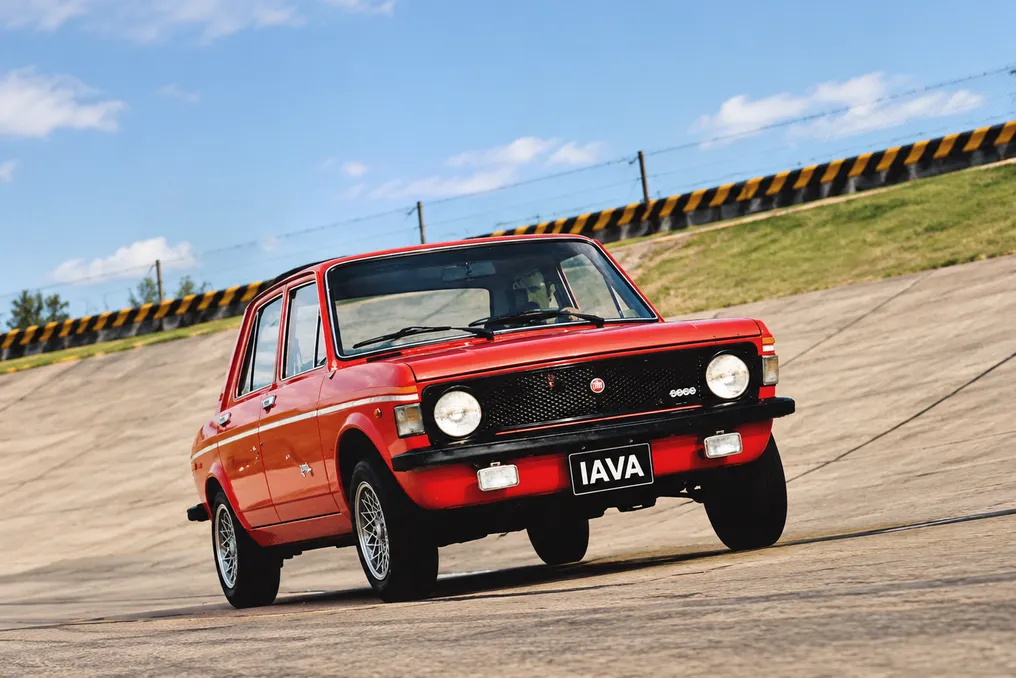
It is remarkable how one does not need to travel around the globe to discover a completely different automotive universe. The history of Fiat in Brazil is deeply linked to its establishment in Betim in the 1970s, leading many to consider it an 'Italo-Minas' manufacturer. Indeed, the Fiat unit in Minas Gerais was responsible for world-renowned projects, such as the pioneering alcohol-fueled 147, or for adapting Italian designs for the Brazilian market, like the Fiat Uno, which was even exported to Italy as the Innocenti Mille.
In Argentina, however, Fiat also developed a local identity and history, with its own projects and 'endemic' versions of global models. This naturally includes very notable sports versions of models that were originally Italian or Italo-Minas.
The FlatOut was present at Autoclasica, one of the main classic car events in Latin America, functioning as a true elegance competition in the neighboring country. Held in San Isidro, near Buenos Aires, the event featured several examples of local Fiat. Taking this opportunity, this article details the history behind the acronym IAVA.
What does IAVA represent?
IAVA is the abbreviation for 'Industria Argentina de Vehículos de Avanzada' (Argentine Advanced Vehicle Industry). Its genesis dates back to the 1970s, a period when motorsport established itself as a national passion in Argentina. Fiat had already been manufacturing vehicles in the country since the mid-20th century through Fiat Concord, its local subsidiary, and quickly became one of the best-selling brands in the market, similar to what happened in Brazil. Simultaneously, there was a growing demand among Argentine drivers for cars with more sporty characteristics, both in terms of pure performance and dynamics, catering to both casual enthusiasts and those who dedicated their hobby to track and racing cars.
In this context of effervescence, IAVA was founded in 1971. The company was born from a strategic partnership between Fiat Concord and a group of Argentine dealers and engineers with a great appreciation for competition cars. The primary objective was to meet this emerging demand for sports cars by using common models from the Italian brand and creating enhanced versions with available parts and existing resources. It is evident that Argentines and Brazilians share similarities in this aspect.
The vehicles prepared by IAVA were not produced on an industrial scale; they were limited and highly customized editions, characterized by an artisanal assembly and tuning process, with extreme attention to detail. Headquartered at Avenida Fondo de la Legua, number 2200, in Martínez, Buenos Aires province, IAVA had engineer Juan Carlos Fisanotti as its technical director, the designer of the legendary 128 IAVA 1100. Under his leadership, the tuner made modifications much deeper than mere aesthetic changes to the bodywork or trim. Considering it was over fifty years ago, the only reliable and efficient way to achieve power gains and dynamic improvements was to overhaul internal engine components, the carburetor system, the exhausts, and make exclusive adjustments to the suspension and brakes, offering a complete service.
The Pioneer: Fiat 128 IAVA TV 1100
The starting point of this trajectory was the Fiat 128 IAVA TV (Turismo Veloz) 1100, launched in 1971. This model was fundamental in redefining the public perception of the small sedan. The original 1,116 cm³ mechanics, which generated approximately 60 hp, were completely rebuilt with the inclusion of a Weber IDF 13 40/40 dual-body carburetor, an exclusive intake manifold designed by IAVA itself, and a camshaft with a more aggressive profile.
With these modifications, the car reached 71 hp at 7,000 rpm and 12.2 kgfm of torque at 3,000 rpm. This allowed the vehicle to reach a top speed of 160 km/h, a remarkable feat for a 1.1-liter compact car at that time, especially considering its weight of just over 850 kg. The sound of the engine was another differential, resulting from an exhaust manifold and muffler custom-developed by the tuner.
Externally, the hood featured two interrupted longitudinal stripes, which became its main signature, complemented by side stripes at the level of the door sills. Inside, the sporty nature was clear in a complete dashboard, which included a tachometer graduated up to 10,000 rpm, an oil pressure gauge, and water and oil temperature indicators. The steering wheel displayed the IAVA emblem on the horn button, and its design varied: 'X' shape in the first examples and 'K' shape in subsequent ones. An additional curiosity was the driver's seat, equipped with an air bag adjustable by valve to shape the support for the driver's body.
The Era of the 1300
Due to the success of the Fiat 128 1100, IAVA chose to invest even more in the line. In 1974, the company decided to increase the engine displacement to 1,300 cm³, initiating a series of versions that solidified its reputation among Argentine enthusiasts.
The first of these new versions was the Fiat IAVA TV 1300 Franja Ancha, produced between 1974 and 1977. In this model, the Weber carburetor was replaced by a Solex 34/34 with simultaneous butterfly opening, along with a camshaft with an even more aggressive profile, focused on high RPM. With a compression ratio of 8.8:1, the 1.3 engine reached 82 hp at 6,750 rpm, maintaining the same torque as the 1100 version. Aesthetically, it was distinguished by a wider side stripe located at the height of the door handles, and a leather-wrapped sports steering wheel.
Subsequently, between 1977 and 1978, the Fiat IAVA Doble Línea appeared, built on the chassis of the 128 L. Keeping the proven 1300 mechanics, the car featured two colored side lines running along the bodywork (hence the name) and, internally, incorporated the modernized instrument panel of the next generation. With the compression ratio increased to 8.9:1, the power rose from 82 hp to 88 hp, raising the top speed to 163 km/h.
During the same period, the brand launched the Fiat IAVA 100 HP 3 Líneas, an even more radical configuration that reached 100 hp thanks to a compression ratio of 9.3:1 and the use of a Solex 36/36 carburetor. Recognized for its three side stripes, it had a declared top speed of 168 km/h, although those who drove the vehicle claim this number is quite conservative.
The peak of IAVA with the 128 was the launch of the Fiat IAVA TV 1300 Europa, produced from mid-1978 to the early 1980s. Available in 88 hp and 102 hp variants, the TV 1300 Europa exploited the lightness of the 850 kg set to the maximum. With this preparation, the sedan accelerated from 0 to 100 km/h in less than ten seconds and reached a top speed of 170 km/h. Its great differential lay in the remarkable specific power ratio: the engine reached 79.13 hp/L, an index superior to renowned supercars and rally cars of the time, such as the Fiat 131 Abarth Rally and even the Ferrari 512 BB.
Visually, the Europa stood out with new front square headlights (although perhaps less harmonious, which was just a detail), a front spoiler integrated with fog lights, a gradient side stripe with the version name, and a sophisticated interior that mixed checkered fabric with black vinyl finishes.
Fiat 133 IAVA
Besides the 128 sedan, the Argentine sports division directed its focus to a project of peculiar origin in the local line: the Fiat 133. Initially launched in Spain by SEAT, during the period when the Spanish manufacturer maintained technical cooperation with the Italian parent company, the model with engine and rear-wheel drive arrived in Argentina, where it was manufactured by the Fiat subsidiary between 1977 and 1980, and later by Sevel Argentina until 1982, totaling about 15,800 units produced in Córdoba.
The Fiat 133, in itself, is an interesting car. It can be seen as a hybrid, using the chassis of the Fiat 850 with a body inspired by the Fiat 126, a model that became a huge success in Poland and gave rise to a notable tradition of 'suicide' drivers. However, originally, it was not intended to be fast: the small longitudinal four-cylinder engine of 903 cm³ with a side-mounted camshaft delivered a modest 37 hp (40 hp in the L version) and 5.8 kgm of torque. Even weighing about 710 kg, the standard model took 32.4 seconds to reach 100 km/h and achieved a top speed of only 113 km/h.
The picture changed drastically when IAVA intervened in the model between 1979 and 1980, creating the Fiat 133 T IAVA (and subsequently, the 133 Top). Maintaining the 903 cm³ displacement, the tuner rebuilt the engine intake, resulting in 55 hp at 6,500 rpm and 7 kgfm at 3,500 rpm. Although it seems little, in such a light car, this generated an immense difference: the 0 to 100 km/h time dropped to 18.4 seconds (an impressive reduction of 14 seconds compared to the common model), and the top speed increased to 133 km/h, a perfect numerical coincidence with the car's name. Combined with suspension improvements and renewed style, IAVA transformed the modest SEAT project into a vibrant and characterful compact.
Fiat 147 Sorpasso
In 1981, the Fiat 147 was introduced in Argentina—initially imported from Brazil, but locally produced by Sevel starting in 1982. Quickly, Fiat Argentina applied the IAVA methodology to this hatchback. The name Sorpasso, in Italian, means 'overtaking,' and the nickname was extremely fitting.
The 147 Sorpasso used the 1.3 engine tuned by IAVA, providing 90 hp at 6,400 rpm, thanks to a dual-body Solex carburetor, a modified flow cylinder head, exclusive intake and exhaust manifolds, a more aggressively graded camshaft, and a less restrictive muffler that produced a robust roar. It is important to note that this engine differed from the Brazilian 1.3: while ours was based on the 124 family adapted for the national market, the Argentine 147 used an evolution of the Italian Fiat 128 engine.
With almost 40 hp more than the standard versions, the Sorpasso registered 0 to 100 km/h in 8.2 seconds—being the only vehicle produced in Argentina during that period to achieve such a feat in under ten seconds—and reached a top speed of 165 km/h. This is considered the most powerful and fastest Fiat 147 ever manufactured.
The look was adapted to match the performance, featuring a prominent front spoiler, Cibié auxiliary headlights, exclusive stripes around the entire perimeter, a small rear spoiler, and a gray plastic trim piece between the rear lights (relocating the license plate to the bumper). The set was completed by 14-inch wire wheels with servo-assisted brakes, radial tires, and suspension with slightly negative camber on all four wheels, providing a very stable stance. Internally, the model came equipped with a three-spoke metal steering wheel and a dashboard with a tachometer and exclusive upholstery. This vehicle is an absolute rarity, having been manufactured in only 403 units in total.