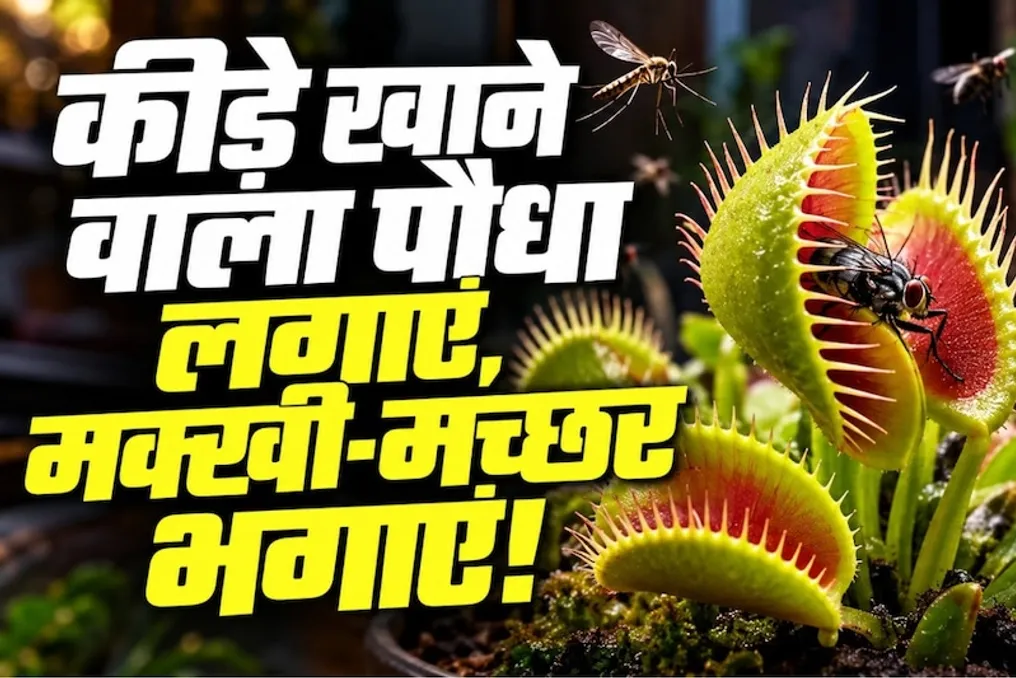
Many people enjoy growing greenery at home because it makes the atmosphere fresh and pleasant. However, the presence of plants can sometimes attract small insects, including flies and mosquitoes, which can be bothersome.
If you have a plant in your garden or on your balcony that can catch and eat flies and small pests on its own, this can solve the problem without using sprays. Although it sounds unusual, there is such a plant—the Venus Flytrap. Its leaves function as a small trap, and as soon as an insect gets inside, the leaves quickly close.
However, caring for this plant differs from caring for ordinary plants, especially regarding water, soil, and light. Let's look at how to grow a Venus Flytrap at home.
The Venus Flytrap is a carnivorous plant. Its leaves consist of two parts that form a trap capable of opening and closing. When a small insect falls inside, the plant snaps shut its leaves, securing the prey. It then extracts the necessary nutrients from this insect, which distinguishes it from other types of plants. It seems nature has created a miniature insect trap right inside the plant.
Growing a Venus Flytrap at home does not mean it can be placed in a dark corner of a room. For good growth, the plant needs about six to eight hours of direct sunlight every day. Therefore, it is best to place it where it will receive enough light and sun. Lack of sunlight can negatively affect the plant's growth.
When caring for this plant, it is extremely important to pay close attention to watering. It is not recommended to water the Venus Flytrap with tap water because the minerals contained in it can damage the plant. Instead, reverse osmosis (RO) water, distilled water, or rainwater should be used. Thus, simply buying the plant is not enough; you must provide it with the correct water source.
If you plan to grow it at home, do not plant it in standard garden soil. The Venus Flytrap requires soil that drains well but also retains the necessary moisture for the plant. Usually, a mixture of sphagnum and perlite is used for this purpose. Therefore, you must prepare suitable soil before planting.
Unlike other plants that periodically require fertilizer, the Venus Flytrap does not need it. It cannot be fertilized like ordinary plants. This is because the plant obtains all the necessary nutrients from small insects. Therefore, instead of applying fertilizer, it is much more important to monitor the correct lighting, watering, and soil type.
During winter, the Venus Flytrap enters a period of dormancy. During this period, its growth may slow down significantly. If the plant is not growing as fast as before, there is no need to panic immediately.