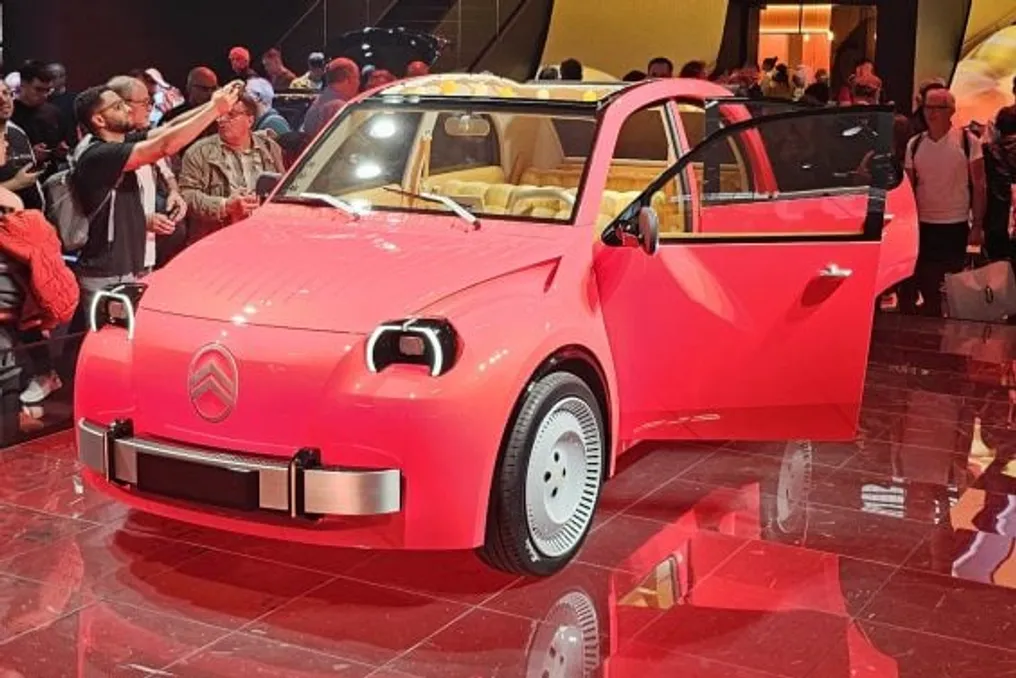
The electric Citroën 2CV has reappeared at the Paris exhibition after 78 years since its first appearance. The French brand presented the 2CV concept, which is an electric interpretation of one of its most iconic classic cars, filled with humorous references to the original model.
Unlike many concept cars shown this week in the Parisian center, Citroën stated that the 2CV will become a production vehicle. According to Citroën, it will be available in European dealerships by 2028 for a price of around 84 thousand Brazilian reais (15 thousand euros).
Originally, the 2CV was developed to mechanize rural areas of France in the post-war period as the country recovered from the conflict. The project, commissioned in the 1930s by then-Citroën manager Pierre-Jules Boulanger, required the creation of a 'four-wheeled umbrella': an inexpensive, durable vehicle capable of carrying four people and 50 kg of agricultural produce to the market.
There was also a curious requirement: to cross a plowed field with a basket of eggs without damaging any of them. The first engine, a two-cylinder, air-cooled unit, had only 9 horsepower. Nevertheless, more than 3.8 million units were produced before 1990, when the last 2CV left the factory in Mangualde, Portugal.
At the end of its life cycle, the 2CV6 model was equipped with a 0.6 engine with 29 hp, reached a speed of 115 km/h, and featured front disc brakes. However, the basic design remained the same: two cylinders, air cooling, and a four-speed manual gearbox.
According to Citroën President Xavier Sardone, the world has changed, but the idea of a simple, affordable, and useful car remains unchanged.
The new 2CV measures 3.76 meters long, shorter than the original model, helping to achieve a target weight of about 1000 kg. This allows for the use of a smaller and cheaper battery. Citroën has not yet disclosed information on power or range.
The design retains round headlights separated from the body, a vertical windshield, visible wipers, and a fabric sunroof that lets light into the cabin. The steel wheels are 18 inches in diameter, and the Michelin tires feature a double chevron pattern, which is the brand's symbol.
The door niches are designed to accommodate eggs, paying homage to the original project requirement—crossing a plowed field without damaging the basket. Humorous images indicating the function of each pedal are placed on the pedals: a tortoise, symbolizing slowness, is located on the brake, and a rabbit, symbolizing speed, is on the accelerator. The horn and startup sound imitate the sounds of the old 2CV.
Instead of a traditional dashboard, there is a central cylinder combining a single-spoke steering wheel, a single control lever, and an 8-inch screen. The radio receiver is removable and functions as a portable sound system. The numbers 48, 90, and 26 on the windshield recall the years of debut, end of production, and revival of the model. Fabric serves as the unifying element of the cabin. The seats are upholstered in the classic 2CV check pattern, done in yellow tones.
The floor, panel, and doors are finished with textured fabric inspired by straw chairs and woven baskets. Internal handles are made of soft fabric tape. Beige details imitating Bakelite—a plastic used in old radios and telephones—are used on the steering wheel, controls, and seat trim. Instead of a console, there is a removable basket made with a 3D printer, combining wood and plant-based plastic. Wood is also used around the radio receiver.
The production 2CV will be manufactured in Europe and will fit between the urban electric quadricycle Ami and the C3 model. Citroën has not commented on plans for the Brazilian market.