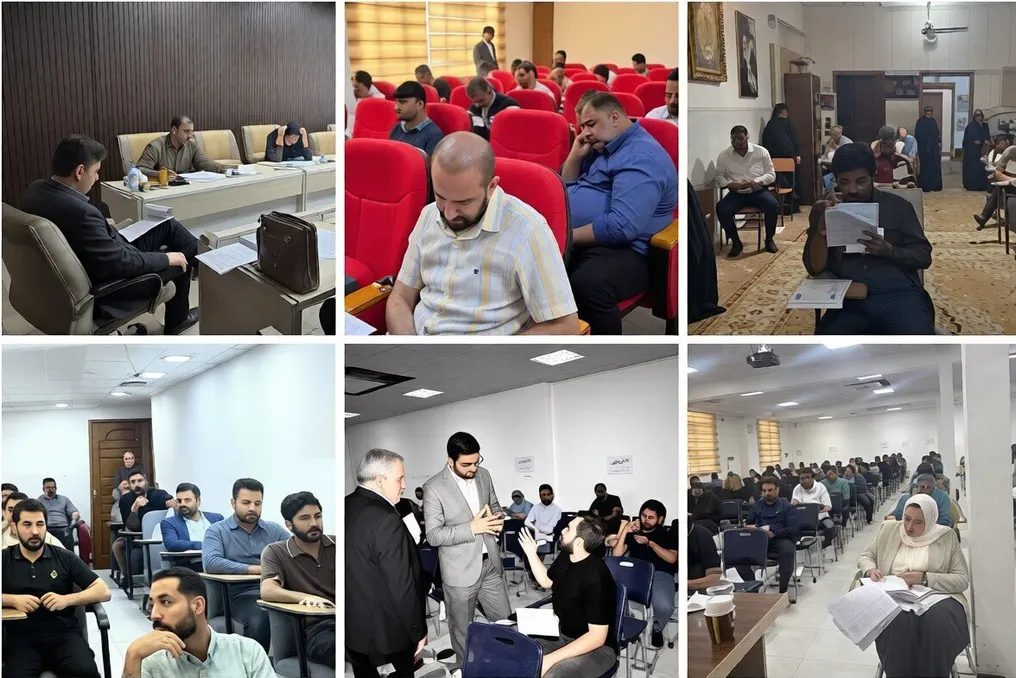
A significant increase in the number of Iraqi students taking the Persian language proficiency test has been noted in Tehran. A total of 268 Iraqi students took this exam across six centers throughout Iraq, which is more than threefold higher compared to the 78 participants registered last year.
The exam was organized with the support of Iran's scientific advisor in Iraq and was held in cities such as Baghdad, Najaf, Wasit, Karbala, Basra, and Erbil. Knowledge of the Persian language helps international students communicate more effectively with instructors and peers, continue their studies at Iranian universities, and access academic materials in that language. These opportunities also contribute to strengthening educational and scientific ties between Iran and Iraq.
The Persian language proficiency test is conducted three times a year in both Iran and countries where Persian language departments exist simultaneously. The exam includes general and academic modules.
The requirement to pass this test applies not only to university students but also to foreign nationals wishing to live, work, conduct business, or open international offices in Iran, as well as those who wish to study in Iranian schools.
On January 24, Abbas Ghanbari-Baghestan, an employee of the Students Affairs Organization, stated that achieving a certain score in Persian language proficiency will become a key condition for admitting international students to Iranian universities starting from the next academic year, which begins in the autumn of 2026. He added that the test covers listening, speaking, and writing sections.
Emphasizing the importance of providing quality education for international students, the official noted that Persian language teaching centers play a crucial role in attracting foreigners and preparing them for university studies. Therefore, they must make every effort to hire experienced professors to offer the best educational courses to assist international students in learning Persian.
Currently, nearly 60,000 international students are studying at Iranian universities, up from 35,000 students in the previous Iranian academic year, which began on September 22, 2024. Saeed Habibi, head of the Students Affairs Organization, reported in October 2025 that despite existing difficulties, Iran has managed to attract students from 101 countries. He also emphasized that the country's universities' scientific potential and their positive history in international cooperation represent a valuable opportunity that must be utilized to integrate the presence of international students into national discourse and strategic planning, adding that students are mainly from Afghanistan, India, Iraq, and Pakistan.
According to the Seventh National Development Plan (2023–2028), the number of international students is projected to increase to 320,000 from the current approximately 60,000. To achieve this goal, the higher education system must implement certain institutional and developmental approaches in organizations related to international students, as reported by the Mehr agency.
In this regard, the Parliamentary Research Center analyzed Iran's situation in attracting international students and the measures that should be considered. According to the report, the number of international students in the country has grown from 13,767 in the Iranian year 1394 (2015–2016) to 68,563 in 1403 (2024–2025). Over the last decade, the number of educational institutions authorized to admit international students has significantly increased from 45 to 206.
The report also indicated that 13 measures have been developed and officially adopted by parliament, such as providing short-term leave, issuing visas, creating a graduate center for international students, and conducting remedial courses within the educational charter for international students; however, these measures were not implemented in a timely manner. Furthermore, major national organizations and institutions do not participate in planning cultural programs for international students.
Other recognized problems included a lack of skills in strategic integrated marketing, as well as bureaucratic and lengthy correspondence. The Parliamentary Research Center put forward several proposals to facilitate the attraction of more international students. The most important is adopting a revenue-generating approach, soft cultural power, and expanding science.
Another proposal emphasizes the importance of strengthening South-South international cooperation, meaning developing political and economic interactions with densely populated countries such as Pakistan, India, Egypt, and some Central Asian countries. Other proposed solutions include continuous evaluation of other countries' policies in attracting students, developing software and hardware, a stable and secure network, and increasing the number of scholarships.
Before the US and Israeli war against Iran, about 60,000 international students from 101 countries studied in the country, mainly from Afghanistan, India, Iraq, and Pakistan. The Ministry of Science announced that educational programs for international university students in the country would continue despite the adverse conditions caused by the declared war. All universities were instructed to ensure that all international students could benefit from the educational opportunities and potential of the universities by adopting innovative measures, including preparing offline educational packages, developing intensive summer courses, and forecasting the possibility of completing practical sessions in the coming years, in addition to continuing online learning, according to IRNA.
These measures and plans must be implemented in a way that guarantees international students will not suffer academic, educational, or even financial losses due to the conditions caused by the declared war. Minister of Science Hossein Simai-Sarraf stated that since the start of the war in late February, more than 30 Iranian universities have been subjected to direct attacks by the United States and Israel. Simai-Sarraf added that five university professors and over 60 students were killed as a result of the strikes, calling the attacks on Iranian infrastructure 'crimes against humanity'. He noted: 'The main reason the enemy targeted this sensitive infrastructure was that they did not want us to gain access to this technology,' adding that many Iranians abroad contacted the university offering to help with reconstruction.