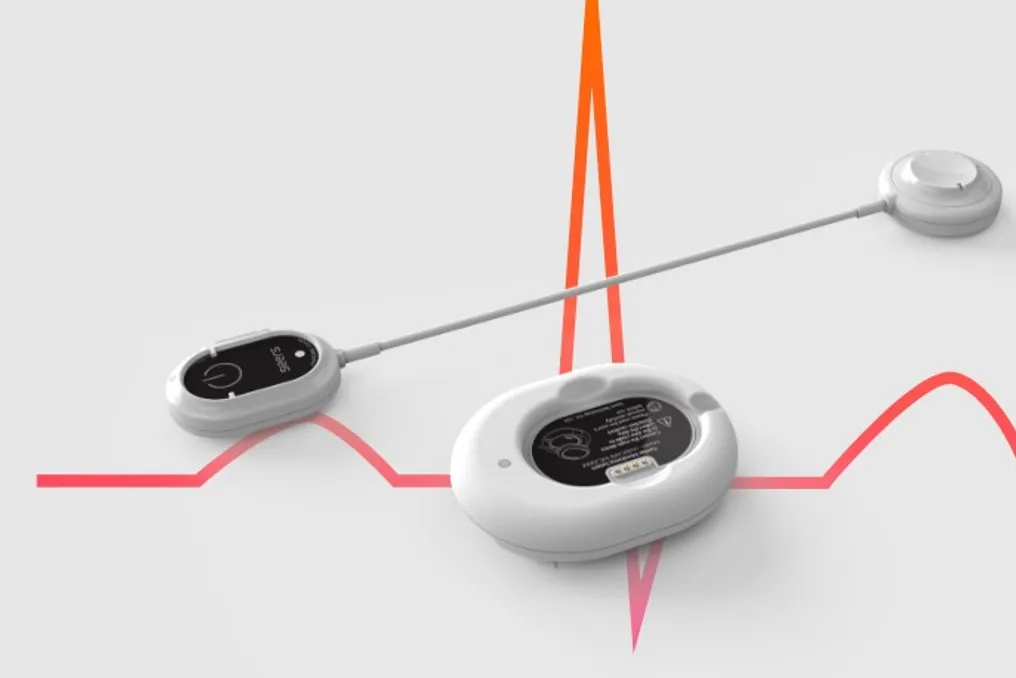
In recent years, there has been a significant growth in the number of wearable diagnostic devices. Although smartwatches and rings are currently popular, a thin patch placed on the chest could become an everyday part of life in the future. Thanks to the growing number of AI-based wearable technologies, doctors will be able to receive alerts about patients' conditions before they become critical.
Seers, a company that developed an AI-based wearable diagnostics model in South Korea, raised $81.9 million to expand this technology into the US and Middle Eastern markets.
Seers, formerly known as Seers Technology, develops medical wearable devices and software for interpreting data collected by these devices. Their main specialization is ECG monitoring, similar to a Holter monitor, which records conditions over a long period.
However, instead of using a wired connection and a large casing, the company collects data using a very thin adhesive patch attached to the patient's chest. They create monitoring systems for hospital wards and manufacture their own medical adhesives, including silicone gel and hydrogel.
The company's flagship product is called MobiCare. The main function of MobiCare is to detect arrhythmias, i.e., irregular heart rhythms. Prolonged wear of MobiCare increases detection capabilities. This concept is simple but has huge market potential.
Seers was listed on the Kosdaq in June 2024, raising 22.1 billion Korean won during its Initial Public Offering (IPO). The $81.9 million funding round was the first financing round after the listing.
These funds were received in the form of five-year zero-coupon convertible bonds. Consequently, investors will only earn returns if the value of Seer shares rises above 30,586 Korean won. The conversion option will become available in October 2027.
Daishin Securities and Lindeman Asia each invested 5 billion Korean won in this placement. Funds associated with Korea Investment & Securities, Shinhan, and KB Securities were also involved.
Despite Seer's stock price falling by 45% over the past year, bondholders are betting on a recovery and have not agreed to a lower purchase price.
The majority of the raised funds will be directed towards international growth initiatives. According to Dealroom, approximately $46.1 million has been allocated for Seers' American branch (Seers Global). Another $12.6 million will go towards establishing the Seers MENA division in the United Arab Emirates.
In America, Seers plans to acquire a minority stake in an independent diagnostic testing center. Furthermore, the company will provide financial support to a local AI operator to implement MobiCare in that region. Establishing connections with existing billing networks can eliminate years of regulatory hurdles and ensure reimbursement access. The plan for the UAE appears more solid.
Seers already has a three-year contract to supply MobiCare in the UAE worth about $18.4 million. The next step will be to establish a diagnostic services base and a specialized arrhythmia center. The remaining funds are designated for two years of research and operations, as well as building a new smart factory.
Wearable diagnostics is transforming from a novelty into a standard treatment method. Conditions such as atrial fibrillation often remain asymptomatic until a stroke occurs. Longer and simpler monitoring changes this situation.
CEO Lee Young-shin describes this capital raise as taking proven AI from home settings to global markets. His goal is to turn Seers into a global medical AI platform. Although risks exist and the US market is saturated, analysts currently rate Seers as a buy, demonstrating its potential.