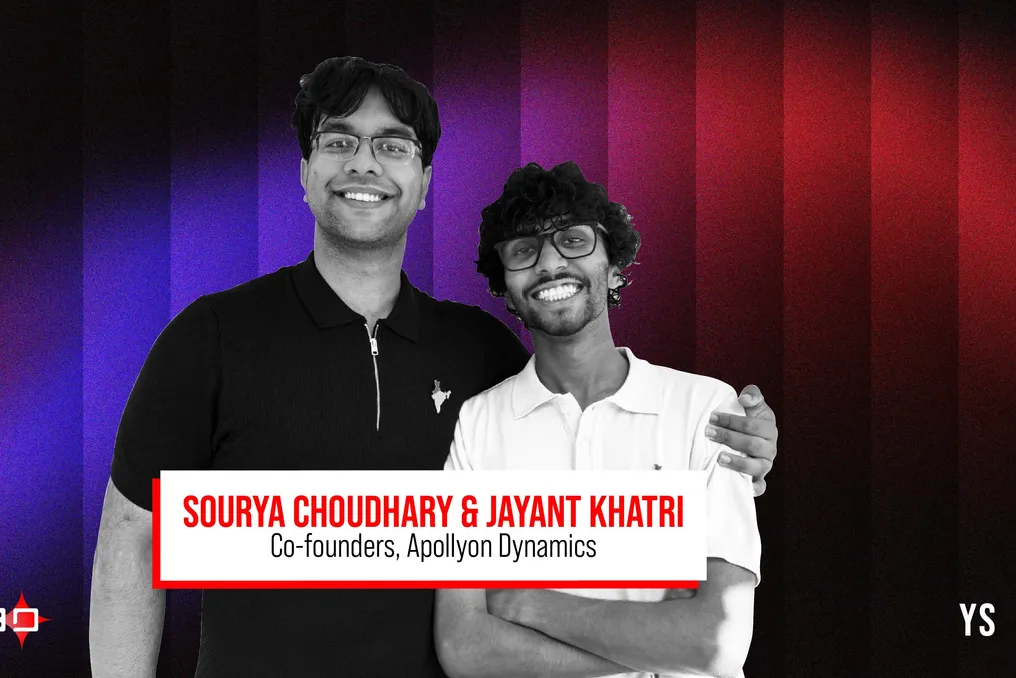
Apollyon Dynamics, based in Hyderabad, has changed its strategy since the founders, Jayant Khatri and Saurya Choudhury, began operations in May 2025. Initially, the startup focused on creating unmanned aerial vehicles, including systems for training, long-endurance, multi-purpose, and FPV systems, and last year the company sold drones worth over 1.5 crore rupees.
However, anticipating market saturation, Apollyon decided to change its direction. Jayant Khatri, co-founder and CEO of Apollyon Dynamics, stated that they have stopped producing conventional drones and have completely switched to creating higher value-added products.
The founder noted that the traditional drone market had become too saturated, limiting opportunities for differentiation. He emphasized that there is currently a 'race to the bottom,' where many are simply assembling equipment without adding significant value.
The startup's current portfolio has been restructured around three main products: Nightshade, Ahuti Mk II, and Project Piranha. Apollyon currently has about 20 full-time employees, two production laboratories, and an office in Hyderabad.
Khatri explained that Nightshade is a jet-powered platform that can be configured as a target drone, a decoy munition, or a maneuverable projectile. The company has conducted numerous tests, and Khatri reported that they became the first company in India to launch such a jet system from a vehicle roof.
It is planned that by December, the startup will begin supplying pilot batches of the Indian Army's target drone variant, and testing of the maneuverable munition version should start next year. Nightshade configurations are designed for various battlefield tasks: the target drone variant is used to simulate threats during air defense exercises, while decoys help locate enemy radar positions.
Furthermore, Khatri mentioned that Apollyon converted its early flagship drone, Ahuti, into an interceptor. After several iterations, it reached a top speed of 498 km/h, making it the fastest multirotor drone in India, which was certified in the Indian record book. This aircraft is part of the Make II program, a special system used by the Indian Army for developing military equipment, and is being developed in collaboration with defense partners.
Project Piranha expands Apollyon's ambitions beyond aerial systems. The company has not disclosed details yet, other than that it is a maritime unmanned system. Khatri stated that the company's goal is to create a complete line of unmanned systems so that it is not known solely as a UAV manufacturer but becomes a full-fledged defense technology company with a diverse portfolio.
Apollyon also ceased selling its mobile drone laboratory, instead integrating its systems into command center products jointly with companies like Raphe mPhibr from Noida and Dhruva Space from Hyderabad. Raphe and Dhruva Space are also Apollyon's clients, purchasing Ahuti interceptors.
In June 2026, the startup conducted a preliminary funding round, raising $480,000 led by Naandi Ventures. The company is now aiming to raise $5 million in a seed round over the next six months.
Initially a student drone manufacturing startup, Apollyon's ambitions have grown significantly: by 2030, the company plans to develop cruise missile-class systems capable of carrying thousands of kilograms and achieving speeds of at least Mach 1. M. R. M. Babu, who headed the Agni-V missile program at DRDO, joined as an advisor to assist with recruitment, program planning, and fund allocation.
For 21-year-old Khatri, collaboration will be crucial as Indian defense companies grow. He believes that survival requires not acting alone, noting that other companies have also realized this and are becoming more open to cooperation, which is a positive long-term trend.
Apollyon Dynamics is included in the Tech30 cohort from YourStory—a showcase of India's most promising startups for 2026, presented at the TechSparks Bengaluru event.