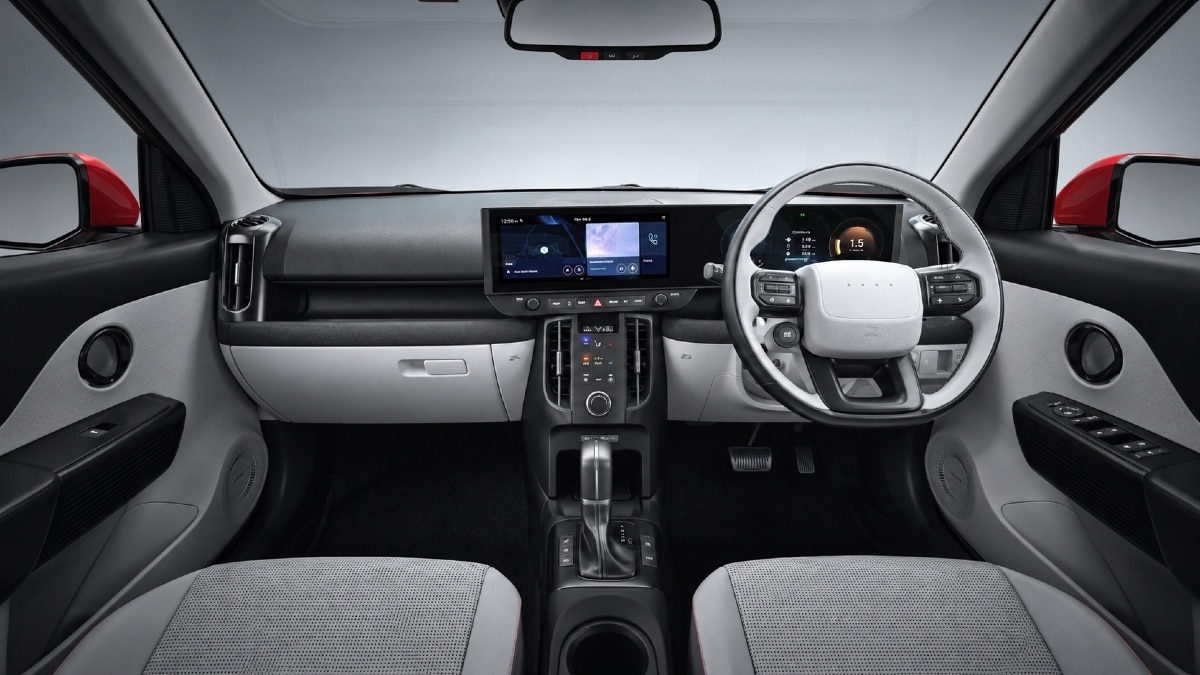
During the festive season, when the market is lively and consumers are looking for new cars, Hyundai has introduced its brand new SUV, the Bayon. This model aims to secure a significant position in the market, competing simultaneously with giants like the Venue and Creta. The Bayon showcases its capabilities from its announcement, offering a design, two 12.3-inch displays, and a Generative AI-based voice assistant.
Official pre-bookings for the Hyundai Bayon are now open. Customers can reserve the vehicle through the company's official website or authorized dealerships for just 11,000 rupees. Sales launch and final pricing policy announcement are scheduled for October 26th.
A distinguishing feature of the new Bayon is its size: it will be smaller than the Creta but larger than the Venue. Its direct competition is expected to be models such as the Maruti Victoris. Thanks to its new design, premium interior, and powerful features, the Bayon looks very stylish and original, utilizing the company's latest design concept, 'Art of Steel'. The exterior resembles a larger Hyundai Tucson.
Although the company has not yet disclosed the full length and dimensions, it is anticipated that the length will be slightly over 4 meters, making it a bit shorter than the 4.3-meter Hyundai Creta. It features a split headlight system at the front. The hood has LED daytime running lights (DRLs) in a thin black strip, inspired by the Hyundai 'H' logo found on many other company SUVs. Hyundai deliberately avoided a continuous LED strip across the entire width, as other models do, replacing it with a thick black and silver cladding on the bumper, which gives the front end a strong look.
The side view emphasizes the uniqueness of the Bayon's design: it features prominent wheel arches, crisp body lines, and thick cladding around all four wheels. The sandblasted design of the rims also lends a stylish appearance to the SUV. The doors are equipped with standard 'pull-type' handles, and the windows are framed with black lacquered plastic trim.
As for the rear, it is fitted with new taillights featuring a thin black strip, and 'Bayon' is written in large letters in the center of the trunk. Additionally, there is a roof spoiler and a rear bumper with black and silver trim. Overall, the Bayon's design leans towards a stylish crossover rather than a traditional boxy SUV, which is expected to appeal to buyers.
The interior of the Hyundai Bayon is executed at a high level. The main feature of the cabin is two 12.3-inch displays: one serves as the driver's instrument cluster, and the other as the infotainment system. Below these screens are buttons and displays related to air conditioning and climate control. The company ensured that the driver is not solely dependent on touch controls by providing numerous physical buttons and regulators.
Below the touchscreen are quick access buttons, and the steering wheel also has a series of controls. The center console is equipped with touch buttons. The steering wheel is similar to that of the Hyundai Venue and includes a separate controller for selecting driving modes.
The new Bayon offers an extensive list of features, the most outstanding being the Generative AI-based voice assistant. According to the company, this technology is being introduced into Hyundai vehicles on the Indian market for the first time. With this system, the driver can interact with the car as in a normal conversation, eliminating the need to utter predefined commands. Hyundai claims that the system is capable of understanding conversational questions and providing relevant information.
Furthermore, the SUV will be equipped with the Bluelink connected car technology, which includes over 70 functions. These functions include OTA updates, built-in navigation, split screen, and quick smartphone controls. The company will also provide support for multiple languages, including 10 regional Indian languages and 2 international languages.
The company reports that the Hyundai Bayon will be equipped with a 1.5-liter four-cylinder naturally aspirated petrol engine, also used in the Creta. This engine generates 115 hp and 144 Nm of torque. Transmission options available are manual and CVT. Currently, the company has not provided information on a CNG version, but experts believe it could be introduced in the future with an underground CNG tank.
Regarding the price, it is difficult to make any statements about the cost of the Hyundai Bayon before its official launch. Nevertheless, this presents a serious challenge for Hyundai, as the vehicle must be released to the market at a price point that does not lead to customer attrition from either the Venue or the Creta.