Imagine a typical Tuesday afternoon in the 8th grade: your 13-year-old daughter starts her period an hour before the bell and two days earlier than expected. She asks permission from the teacher to leave, walks down the corridor, and makes her way to the girls' restroom, where the next few minutes quietly reveal whether her school complies with the law.
If the door locks, the faucet works, and there is soap next to the sink, she is already ahead of girls in schools that provide none of this. If these conditions are absent, an ordinary day can turn into humiliation, which the court links to missed classes. This short journey was the goal of the Supreme Court when it declared menstrual health a constitutional right, providing parents with a practical way to check their daughter's school.
The Decree Underlying the Checklist
On January 30, 2026, a bench of judges J. B. Pardivala and R. Mahadevan in the case of 'Dr. Jaya Thakur versus Government of India' ruled that the right to life under Article 21 includes the right to menstrual health. Dr. Jaya Thakur, a social worker, petitioned the court under Article 32, demanding free sanitary pads for girls in grades 6–12, separate toilets, and educational programs.
The judges linked this issue to the Education Act, deeming that a girl who cannot manage her cycle at school is being denied unimpeded access to education. The case was initiated earlier: on April 10, 2023, a bench including Judge Pardivala required the Centre to develop a national policy on menstrual hygiene for schoolgirls, based on low-cost pads and safe disposal. The 2026 ruling made this policy mandatory for grades 6–12, continuing the case through a continuous mandate.
These directives apply to all educational institutions, regardless of whether they are government or private sector run, in cities and villages. Thus, the same checklist applies universally.
Checks One Through Five: From Toilet Door to Pad
The first check is whether the toilet functions, if it is gender-segregated, and if it is connected to usable water, which is a necessity for your daughter at that door. The second check concerns privacy and accessibility, including access for children with disabilities. The third check is the availability of a washing station with soap and water at any time.
Accessibility is as important as privacy, because a toilet that a child in a wheelchair cannot enter will fail the second check, no matter how clean it looks. A parent visiting can simply ask to see the girls' restroom, turn on the faucet, and look for soap, which will take little time and simultaneously answer three checks.
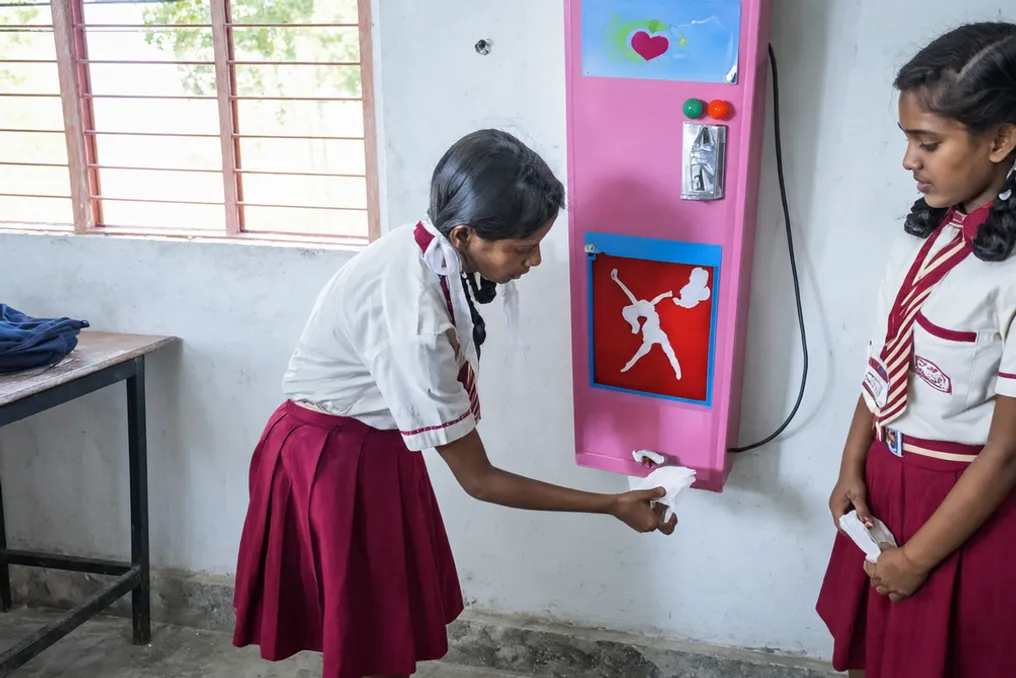
The fourth check is the pad itself. The court requires that free sanitary pads be easily accessible, preferably inside the toilet facility via a vending machine or, failing that, in a designated area. It is necessary to ask where the pads are stored and who holds the key, as a supply locked in the staff room negates the goal of easy accessibility.
The fifth check relates to the type of pad offered. In September, the bench replaced the previous requirement for oxo-biodegradable pads with biodegradable, biocompatible, and compostable pads meeting ISO 17088 standards combined with IS 5405, and asked states to gradually transition to options such as cloth pads and menstrual cups.
The court cited two reasons, both important for parents. Biodegradable pads do not contain harmful chemicals, bleaching agents, and synthetic fragrances that pose long-term health risks, nor do they increase the waste burden inherited by today's children. This is why the judges suggested that states start by educating girls on the safe use of reusable pads.
Checks Six Through Ten: From Corner to Classroom
Returning to the corridor, the sixth check is a menstrual hygiene management corner stocked with spare underwear, spare school uniforms, disposal bags, and other necessities for menstrual emergencies. This corner is intended for moments like your daughter's, when her cycle starts early and she needs to change and return to class. Ask to see this corner and inspect it, as the court listed its contents, and a corner without it exists only nominally.
The seventh check is disposal, as every toilet unit must have a sealed container that is regularly cleaned, and the school must have a safe, hygienic, and environmentally compliant method for disposing of sanitary waste according to Solid Waste Management Rules. The eighth and ninth checks are inside the classroom. The Supreme Court directed the National Council for Educational Research and Training and State Councils for Educational Research and Training to include gender-sensitive content in their curricula so that parents can ask if it is taught as general health knowledge, and if teachers are trained in it.
The stakes are measurable. In an analysis cited by the court, only 48% of 97,070 adolescent girls in India knew about menstruation before their first period, and the judges linked such gaps to absenteeism and girls dropping out of school.
The tenth check is monitoring—whether anyone is checking all of this. Education officials must periodically inspect schools, checking toilets, washrooms, pads, waste disposal, and awareness measures, as well as collecting anonymous feedback from students. Ask if your school has been inspected and if the students' opinions on the facilities have been sought.
What the Court Found During Inspection
The court warned that private schools failing to comply risk losing recognition, and government bodies will be held accountable for shortcomings in public schools. Progress is noted in some areas: Dadra, Nagar Haveli and Daman and Diu, Karnataka, Jammu and Kashmir, Odisha, Chandigarh, Arunachal Pradesh, and Puducherry have reported full or near-full coverage of menstrual hygiene corners, while Bihar has established Sahay help desks in its secondary and higher schools.
At hearings on September 1, 2026, the Union reported that out of 39,439 women's toilets still needing repair, 30,458 had been built, 4,236 were under construction, and 4,745 remained unopened. The bench also criticized some state reports showing 'lack of sense or, rather, mere formality,' pointing to Tamil Nadu's claim of toilet saturation despite having far fewer gender-segregated toilets than the total number of schools, as well as Punjab's unclear report.
The judges also urged states to be more vigilant regarding children with special needs who face barriers beyond typical learning issues. Future reports must now list schools lacking each facility, along with the reason for each gap and the time needed to remedy it, while education directors form teacher teams to conduct surprise inspections. The Supreme Court also mandated states and territories to report existing gaps, rather than just listing provided amenities.
In its judgment of September 1, 2026, the bench stated that education directors must form teacher teams to conduct surprise school checks and gather student feedback. For a parent, this means the checklist is more than just a wish list, as every item is a directive issued by the court. None of this requires a legal background; a visit and a few simple questions suffice. Walk through your daughter's school using these ten checks, and the 8th-grade girl who raised her hand on Tuesday afternoon will find her answer at the door.