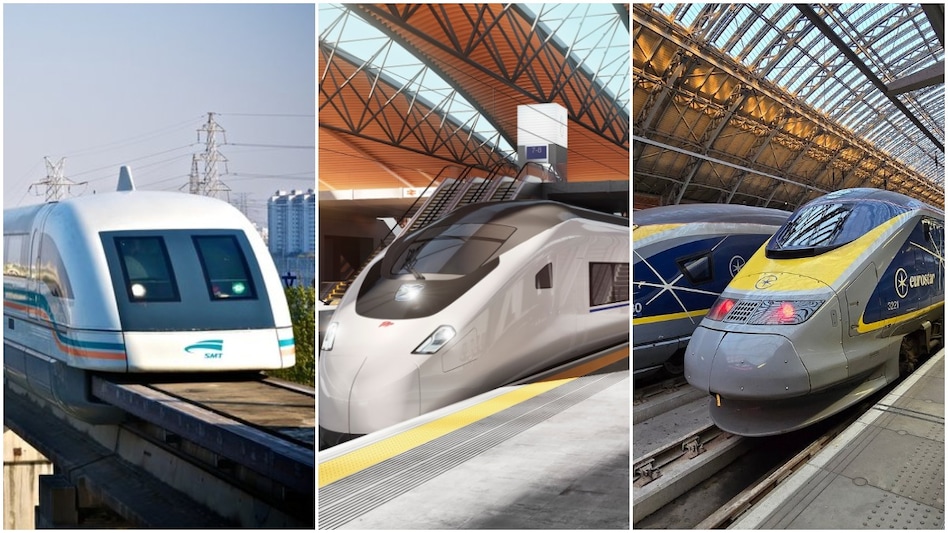
The National Railway Administration of China has unveiled its plan for railway science and technology innovations covering the fifteenth five-year plan period from 2026 to 2030. This document, published on October 12, outlines research priorities ranging from developing faster trains and construction automation to integrating artificial intelligence into ticketing, freight transport, and maintenance.
One of the most prominent areas is speed enhancement. The plan mandates fundamental investigations into wheelset wear, pantograph-catenary interaction, and signaling at speeds of 400 km/h. It also schedules the design of a low-drag, low-noise, and low-axle-load structure suitable for mass production at this speed, leading to the CR450 train family. Furthermore, the system for maintenance and overhaul of 400 km/h trains is included in the scope.
Regarding magnetic levitation trains (Maglev), the administration emphasizes a cautious approach. According to the plan, research and development will proceed systematically and orderly for high-speed Maglev technology at 600 km/h, along with testing key technologies for domestic production. The plan focuses on research and testing rather than line construction.
Another focus is passenger service. The plan calls for upgrading platform 12306, transforming it from a simple ticketing tool into an intelligent system that covers the entire passenger journey and offers personalized multimodal travel planning. Research is also planned for contactless station entry using facial recognition and edge computing, as well as intelligent monitoring systems for passenger flow and capacity distribution.
For freight transport, platform 95306 is set to evolve into a national railway logistics platform supporting multimodal transport under a single document across rail, road, and water transport. Planned equipment includes freight trains capable of operating at speeds between 120 and 200 km/h, wagons with adaptive wheelbases, and light containers for the cold chain. The plan also mentions studying the integration of drones with high-speed railways for last-mile delivery.
In communications and computing, the administration aims to deepen the use of 5G-R for remote equipment maintenance, expand the application of the BeiDou system across the entire railway chain, initiate early research into 6G applications, and establish a satellite-ground network using broadband low-Earth orbit satellites. The plan intends to develop a large model for the railway industry, possess at least 20 high-quality industry datasets, and define over 20 typical AI application scenarios. By 2030, the plan aims to implement no fewer than 100 major research projects, achieve breakthroughs in at least 100 key technologies, establish around 30 new industrial innovation bases, and execute at least 20 demonstration projects, including systems engineering for 400 km/h operation.