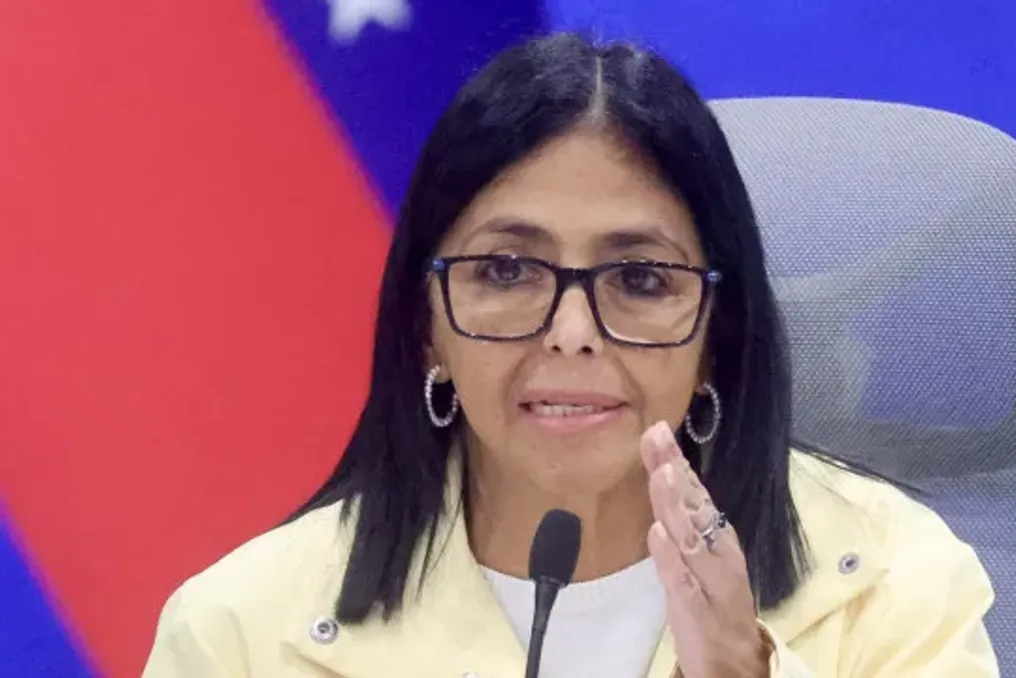
The interim president of Venezuela, Delcy Rodríguez, announced in Rome the launch of the 'Venezuela Feeds' Plan and new legislation focused on the local economy, aiming to achieve the goal of 'zero hunger' in the country by 2030.
This announcement was made during the FAO World Food Forum, where she highlighted the decrease in undernutrition prevalence in Venezuela to 3% this year.
Rodríguez stated that the Venezuela Feeds Plan aims to coordinate all food production processes to reach this ultimate objective, and informed that she will present a new law for the local economy to the Venezuelan Parliament in the coming days.
The president emphasized that this law will complement the communal and community economy and entrepreneurship, allowing for integration and productive chaining with the large agri-food industry.
Delcy Rodríguez began her speech by stating that Venezuela has the conviction that food is a fundamental right, intrinsically linked to life, dignity, and the complete development of people. She stressed that ensuring this right requires sustainable and inclusive public policies, but also demands production, investment, science, technology, financing, and cooperation.
She added that peace and a cooperative international system are essential, even in the face of disagreements. Rodríguez mentioned that she comes from a country that managed to rise again and rebuild using its own capabilities, looking to the future with optimism and hope, seeking a rebirth.
In thanks, she acknowledged the support of the World Food Programme to Venezuelans after the earthquake that occurred on June 24.
To discuss rebirth, she advocated that the focus should be on the land and those who cultivate it, promoting the application of science, technology, innovation, investment, and traditional knowledge to transform agri-food systems and ensure that solutions reach those who produce and those who suffer from hunger and malnutrition.
According to Delcy Rodríguez, humanity faces the paradox of possessing advanced technology while millions go hungry and food is wasted. The current challenge, according to her, requires greater efficiency in production, minimizing losses, and strengthening agricultural systems against climate change and the El Niño phenomenon in Venezuela and other South American nations.
She warned that agricultural planning is now dictated by climate changes, requiring resources for adaptation, the use of Artificial Intelligence, and early warning systems in production.
Rodríguez reinforced that food must never be used as a tool of political pressure or confrontation. She insisted that where there are disagreements between states, dialogue and diplomacy must prevail, and where there is hunger, the common responsibility is to find solutions, criticizing the application of sanctions that, outside international law, harm the right to food.
She recalled that at the beginning of the century, the FAO had recognized the drop in undernutrition in Venezuela, from 14.1% to less than 5%. However, Delcy Rodríguez attributed the collapse of production chains and the supply crisis, which affected all society, to the combination of internal political conflict with the impact of economic sanctions imposed since 2017, which affected 16% of the agri-food sector.
As recovery factors, she cited internal political dialogue with the opposition and direct diplomatic negotiations with the United States. She stated that national dialogue with sectors of the opposition and diplomatic dialogue with the United States of America were crucial for the political stability necessary for growth and production.
Additionally, she highlighted the improvement in social indicators, with undernutrition falling to 3% this year (compared to 5.3% in 2025) and acute malnutrition in children under five decreasing from 14.8% (in 2019) to 1.3% (in 2025).
Concluding, Delcy Rodríguez expressed the desire to plant more than just food, wanting to sow confidence, opportunities, and prosperity, because peoples, like the land, have a remarkable capacity for renewal.