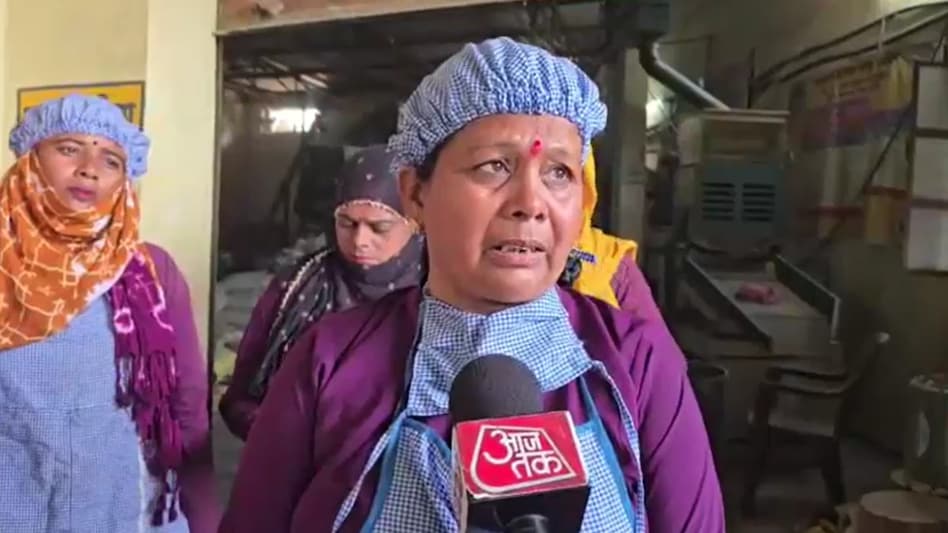
Women from Chhansi, Uttar Pradesh, who previously faced family opposition when trying to work outside the home, have now achieved financial independence. By joining a self-help program, they received government support to establish a production unit for ready-to-eat meals (THR).
Their earnings can now cover family expenses, and their children attend private schools. Families that previously opposed their employment now show them respect.
This production facility operates under the name 'Sakam Prarana Lagu Udhyog' in the village of Bhodjhla, Chhansi district. The women in the self-help groups contributed their personal savings to launch this enterprise. Dropadi, the group chairperson, stated that the group initially consisted of 10 women. Subsequently, a village organization was formed, followed by a cluster-level federation (CLF). The village organization is called 'Nari Shakti Prarana Sangathan,' and the CLF is 'Lakshya Prarana Samite Bhodjhla.'
According to Dropadi, when they were informed about the possibility of opening an THR unit, each woman had to contribute 30 thousand rupees from her own funds. After collecting this amount, the unit was launched. Now, by working here, they receive timely wages, which has significantly improved the economic situation of the family.
Dropadi recalls that before joining the group, she worked as a seamstress and in the fields. Her income was insufficient to provide good education for her children, and the family sometimes struggled with food. The situation began to change after joining the group, and now her earnings help support the household and finance her children's education. She attributes these changes in her life to the Yogi government's initiative, noting that this work provided the women with employment, increased their status in the family, and allowed them to voice their opinions.
Nutritious products intended for children attending kindergartens are prepared in this unit. Sweets such as laddu and halwa, as well as porridge and lentil dishes made from flour and besan, are manufactured here. Saroj, who works in production and lives in the village of Bekhta, is the chairperson of the 'Jai Ma Ratn Wali' group. She notes that after joining the group, the women gradually started saving money. With government assistance, the unit was launched, paving the way for income. Previously, her children attended government schools, but now she provides them with private education. In her opinion, the most important change is that the women now contribute to the family's needs through their own earnings.
Vinita, who works in production, shares that initially, her family members were not ready for her to join the group and repeatedly refused her. Nevertheless, she continued to work. Today, by earning money, she also provides financial support to her husband. According to her, after joining the group, the women became more confident in asserting their views. Vinita reports that 17 groups participate in the unit, with about 10 women in each, engaged in various sectors. The group provided them with the opportunity to earn, which changed their role in the family.
This THR unit in Bhodjhla demonstrates how self-help groups can unite women and open up employment opportunities for them. The women contributed their savings, launched the unit with state support, and now contribute to meeting the family's economic needs through regular work. The stories of Dropadi, Saroj, and Vinita show that the changes go beyond mere earnings: they can now pay for their children's education, support their husbands, and feel greater respect within the family. Women whose work was once condemned at home are now making their hard work the backbone of their families.