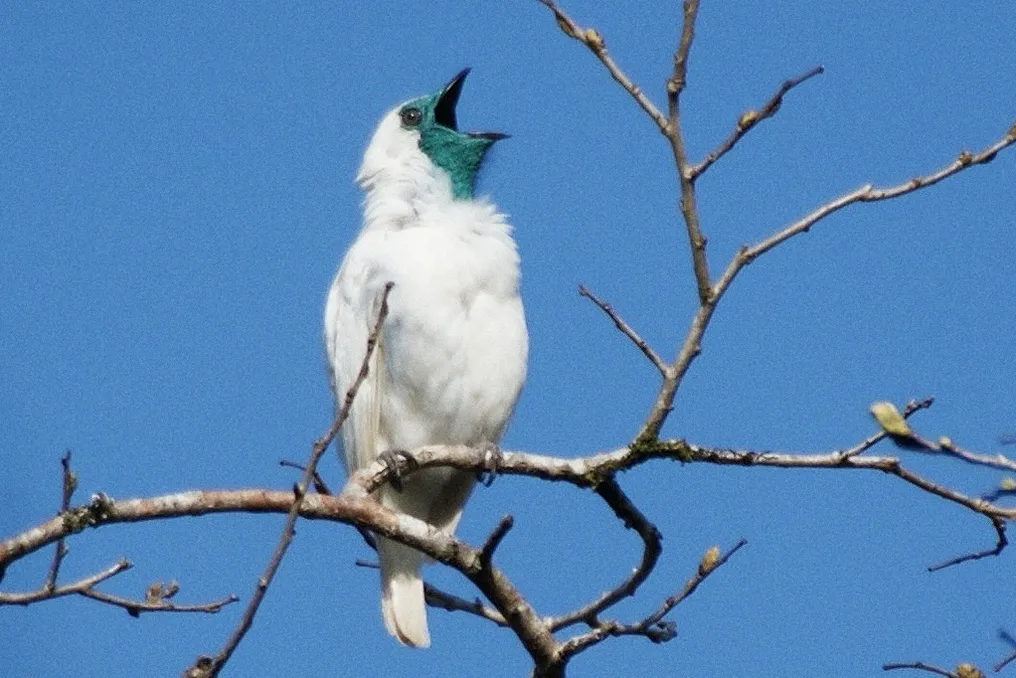
A new study revealed that certain Brazilian birds possess the most intense songs on the planet, capable of emitting sounds comparable to those of a chainsaw or jackhammer.
This discovery comes after a detailed analysis of the vocal volume of over one hundred bird species globally. Among the loudest identified species are the common araponga (Procnias nudicollis) and the red-legged seriema (Cariama cristata), both capable of singing at extremely high volumes.
The work, published in the journal Evolution, focused on the physics of sound, specifically amplitude, which defines the force with which a sound wave moves air particles. This characteristic determines both how far the sound travels and the volume perceived by the listener.
The research collected information on the amplitude of the songs of 123 species, covering locations in the state of Massachusetts, United States, and various regions of Brazil, including 113 species whose volumes had never been analyzed before.
Jeff Podos, an ornithologist from the University of Massachusetts Amherst and co-author of the study, stated that the project allowed for a significant increase in the number of species with available amplitude data. He emphasized that this is a fundamental and basic scientific investigation, unprecedented on this scale, and that it opens the way for numerous other areas of interest.
This study represents a crucial advance in the study of bird communication by exploring an aspect previously almost inaccessible: the perceived amplitude of a sound wave relative to distance. Although a loud distant sound may seem less intense than a nearby whisper, the necessary equipment to measure amplitude and distance simultaneously did not exist, limiting such analyses to laboratory settings, which was impractical when dealing with wild animals from different parts of the globe.
To overcome this limitation, researchers developed two instruments: a laser rangefinder, similar to those used in golf to measure distances, and a decibel meter, used to identify which bird was producing each noise. Measurements were initially taken during the COVID-19 pandemic lockdown in the streets of Amherst, Massachusetts. Subsequently, scientists expanded their search to the Atlantic Forest and the Cerrado of Brazil, aiming for greater species diversity.
When evaluating the 123 species, a large variation in amplitude was observed. While the hummingbird's song reached about 64 decibels (equivalent to a normal conversation), the arapongas and seriemas emitted calls in a range of 121 to 122 decibels, a level higher than that of a electric saw.
The data obtained provided indications about the anatomical characteristics that make certain birds louder. Specifically, beak width and body proportions appear to influence sound intensity. In the case of the seriema, for example, its elongated neck aids in projecting the song with greater power.
Podos concluded that this type of work cannot be done only in a laboratory or through online data, emphasizing the need to go into the field, observe the environment carefully, and that any fieldwork requiring greater observation is inherently pleasurable, as it relates to the origins of scientific practice.