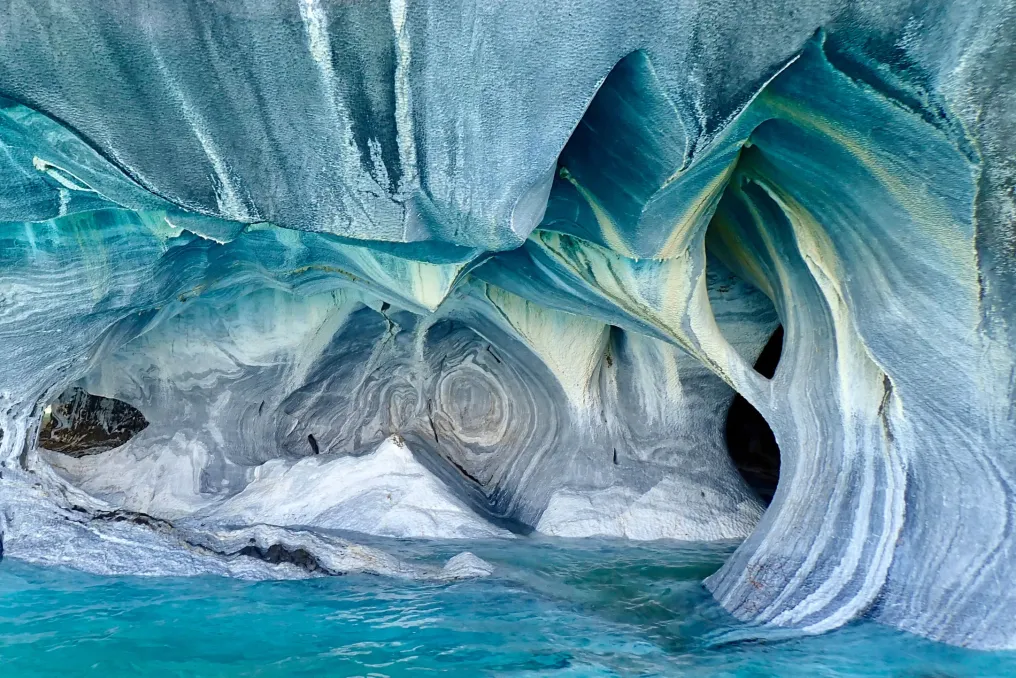
In Patagonia, Chile, ancient marble rises above turquoise water, forming wide curves, arches, and caves. Although the walls look as if they were carved by hand, their intricate pattern is the result of water working over millennia to gradually shape this stone world.
These unusual formations, known as Marble Caves or Capillas de Mármol, are located on the shores of Lake General Carrera in the Aysén region of Chile. They are best explored by boat or kayak, as they demonstrate the interaction of geology, water, and time.
The Marble Caves are near Lake General Carrera, a vast body of water shared between Chile and Argentina. On the Chilean side, visitors can see the Marble Cathedral, the Marble Chapel, and the Marble Cave, named for their high arches and vaulted forms.
The beauty of these places begins with the stone itself. The marble formed from limestone, which was subjected to heat and pressure deep within the Earth. It later ended up along the lake's shoreline, where waves gradually eroded the rock, creating the visible indentations, channels, and curved walls seen today.
The stone surface is adorned with bands of white, gray, and pink colors, while the lake reflects these sculpted surfaces in shades of blue and green. The color palette changes depending on the lighting, causing the caves to look different from various angles.
Lake General Carrera covers an area of about 1,850 square kilometers and is the largest lake in Chile. Its striking blue-green color is partly due to fine mineral particles carried by glacial meltwater, which scatter sunlight.
When sunlight reaches the caves, the water reflects off the pale gray marble, intensifying the colors. This results in a constantly changing landscape, shaped by light as much as by stone.
The nearest village of Puerto Río Tranquilo serves as the main starting point for organized boat and kayak tours. From here, visitors cross the lake to view the formations from the water. Boat tours offer a convenient way to see the caves, while kayaking provides a closer perspective, allowing visitors to pass through narrow openings under safe conditions. Accessibility depends on the weather, as wind conditions and water levels can affect tours.
Inside the caves, the curved marble walls frame views of the turquoise water and daylight. One should pause for a moment to appreciate the scale and detail of the stone.
The Marble Caves are located along the Carretera Austral in Chile, a scenic route through Patagonia. These caves were declared a nature reserve in 1994. Visitors are advised to follow the guides' instructions and avoid touching or marking the marble, helping to protect formations that have been shaped over thousands of years.
The Marble Caves serve as proof that nature does not need to act quickly to create something exceptional. Over millennia, water has carved ancient stone into arches and caves, leaving behind a landscape that changes with every reflection. In a region known for its glaciers and mountains, this is a unique Patagonian wonder. The magnificence lies not in reaching the summit, but in gliding beneath the sculpted rocks and watching the turquoise water catch the light. Here, time is captured in stone, and every wave adds a chapter to this story.