Marina Borodina, Academician of the Academy of Arts of Uzbekistan, notes that modernism in Tashkent's architecture is not merely a collection of concrete and windows, but a living interaction of architectural forms with sunlight. She emphasizes that reliefs and carvings serve as a chiaroscuro effect, transforming each building into a worthy work of art.
Borodina believes that preserving the modernist era in Tashkent means safeguarding the memory of this great creative period, which merged Eastern traditions with a new and bold architectural language of global scale.
The article presents various examples of the city's architecture. Among them is the Tashkent State Circus, a contemporary structure shaped like a blue circle, built in the style of an Eastern tent and domes.
The 'Marvarid' residential complex (Pearl) is an experimental 16-story building designed by architect Opolom Kalandarov. It serves as an example of a 'vertical community,' equipped with open courtyards and a ventilation system.
The administrative building (now Mobiuz, formerly the Ministry of Communications) is distinguished by a pattern of an eight-pointed geometric metal grille that protects against overheating. The Central Exhibition Hall of the Academy of Arts of Uzbekistan is also mentioned, where a nationally ornamented wavy facade and high arched openings on the lower level are synthesized.
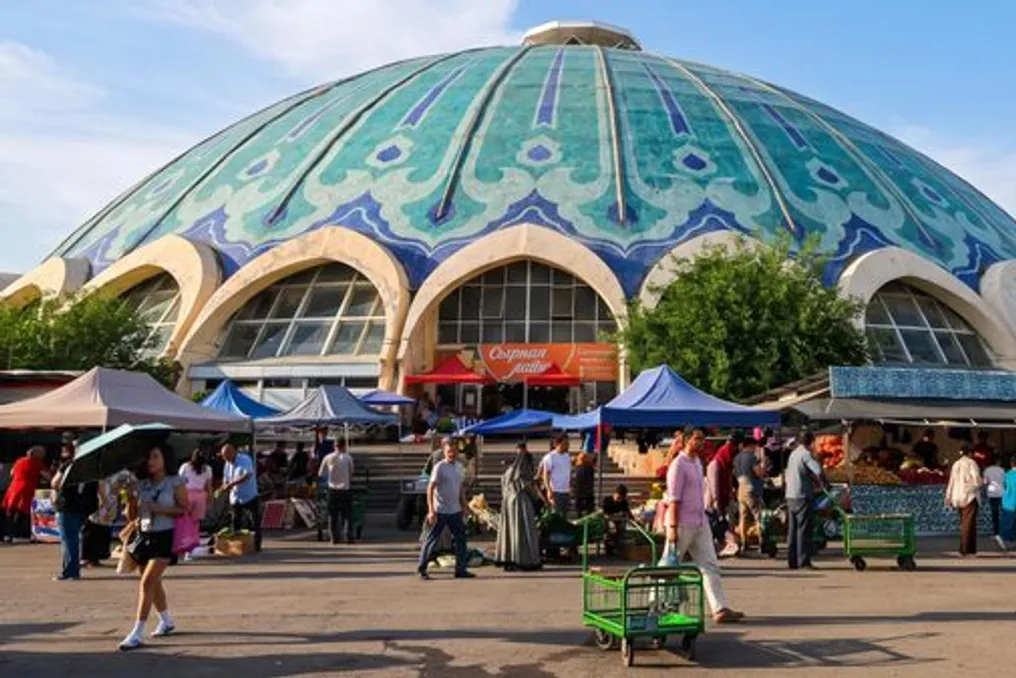
Other significant sites include the main dome of the Chorsu Bazaar, decorated with national mosaics and *koshinkas*, and the Palace of Arts 'Xalqlar Doʻstligi,' erected as a massive sculptural block reminiscent of ancient monuments of Central Asia.
The Uzbek Historical State Museum (formerly the V. I. Lenin Museum) is presented as a majestic cube surrounded by white marble and a concrete lattice with national patterns, creating the impression of the building floating on its base.
The review also includes the 'Turkiston' Palace of Arts with its harmonious composition. Its main facade is adorned with a series of awnings and relief modules resembling traditional stalactite arches (*muqarnas*) and providing sun protection.
The concluding example is the 'Uzbekistan' Hotel, known as a symbol of Tashkent due to its curved facade and concrete patterns resembling a national lattice, which provide sun protection.