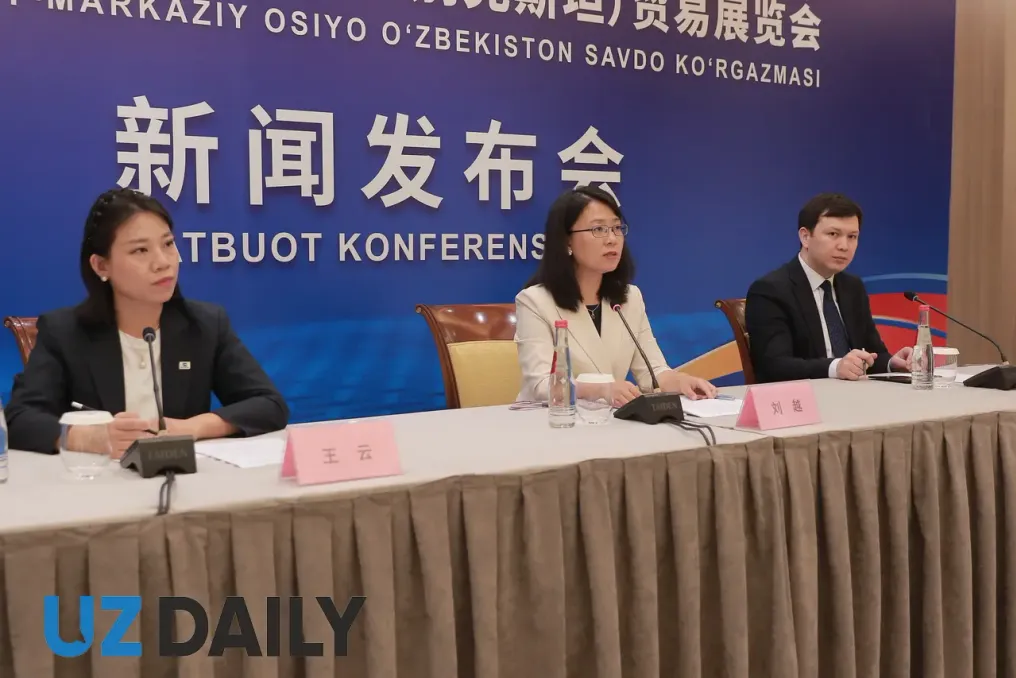
The second China-Central Asia Trade Exhibition (Uzbekistan) 2026 will take place at the Second Tashkent International Exhibition Center from October 14 to 16. Organizers announced at a press conference that approximately 200 Chinese companies from 19 provinces, autonomous regions, and centrally administered municipalities of China will participate in the event.
The exhibition is organized by the China Council for the Promotion of International Trade (CCPIT). The first edition was held in 2025, making this the second consecutive year Uzbekistan hosts this event. The organizers aim to create a specialized platform to strengthen economic cooperation, establish business contacts between China and Central Asian countries, and promote industrial interaction.
Lü Yue, chief representative of the CCPIT office in Kazakhstan, emphasized that the event is conducted in accordance with agreements reached by the leaders of China and Uzbekistan. It is planned to implement the outcomes of the China-Central Asia Summit and the Shanghai Cooperation Organisation (SCO) summit, deepen China's trade and economic ties with Uzbekistan and other regional countries, and contribute to the development of a closer China-Central Asia community with a common future.
Lü Yue noted that holding the exhibition for the second consecutive year demonstrates China's determination to expand its presence in the Central Asian market and make bilateral cooperation more significant and long-term. She also expressed gratitude to the Ministry of Investment, Industry, and Trade of Uzbekistan for supporting the event, as well as the Tashkent Regional Chamber of Commerce and Industry, the Economic Committee, and the Industrial Association for assisting in the preparation of the exhibition and facilitating contacts between companies from the two countries.
The exhibition takes place in a year marking the 10th anniversary of the comprehensive strategic partnership between China and Uzbekistan. Furthermore, 2026 has been declared the year of high-quality development of cooperation between China and Central Asian countries. According to the organizers, at the SCO Council of Heads of State meeting on August 31, the leaders of the two countries determined the course for a new 'golden decade' of bilateral relations. The press release stated that both countries, guided by the 'spirit of China and Central Asia,' are expanding opportunities for cooperation in trade liberalization, industrial investment, and green development.
Azamat Rakhmonov, head of the China Cooperation Department at the Ministry of Investment, Industry, and Trade of Uzbekistan, presented information on the development of economic ties between the two states. According to him, the volume of bilateral trade has tripled over the last seven years, reaching US$17.8 billion in 2025, which is 34% more than the previous year.
China remains Uzbekistan's largest trading partner and largest investor. As of September 2026, about 6,500 enterprises with Chinese capital were operating in Uzbekistan, including joint ventures. These companies operate in sectors such as mining, agriculture, automotive industry, and others. Rakhmonov noted that Uzbekistan's location in the center of Central Asia provides logistical advantages, allowing joint ventures to export products to neighboring countries and implement business models focused on third-country markets.
He expressed confidence that the exhibition will bring together advanced Chinese technologies, equipment, and specialists, providing entrepreneurs with the opportunity to conduct business and exchange information through electronic platforms. Rakhmonov also expected the event to yield practical results, including the signing of memorandums and letters of intent to invest by several companies. The Ministry will actively assist Chinese enterprises in implementing projects, he added. Rakhmonov thanked the leaders of both countries and local officials for their support of bilateral relations and economic growth.
Lü Yue reported that the program has been significantly revised compared to the first exhibition to better reflect the industrial profiles of China and Uzbekistan. The organizers emphasized the complementary nature of the industries of both countries. Key areas include industrial automation and robotics, vehicles and new energy components, AI-based devices, and artificial intelligence services. Other sectors will feature energy storage systems, photovoltaic modules, smart home systems, cloud computing, and big data.
Lü Yue described three main characteristics of the exhibition. The exhibition space will cover an area of 4,000 square meters indoors and over 800 square meters outdoors. Five thematic zones will focus on intelligent manufacturing, green energy, consumer electronics, trade services, and new energy transport.
These zones will showcase China's achievements in developing new productive forces. In the opinion of the organizers, these technologies align with the priorities of economic development and industrial modernization in Uzbekistan and other countries in the region. For the first time, a special exhibition zone, 'China Opportunities,' will be presented, showcasing the country's progress in expanding external openness, business conditions in various regions, and advanced intelligent technologies. An interactive zone dedicated to traditional Chinese culture will also be created, where visitors can participate in themed events. The organizers aim to create an environment that combines exhibition visits with interactive programs.
About 200 Chinese companies have been selected to participate. Specialized, high-tech, and innovative enterprises will account for over 30% of participants. Among the exhibitors will be companies such as CAMCE, Yonyou Network, and Focus Technology, as well as firms specializing in specific fields, such as Lanxin Robotics, Zhengzhou City Unites Steel Industrial Co., Ltd., and LAISAI. It is expected that the share of companies operating in artificial intelligence, energy storage systems, and cross-border e-commerce will significantly increase compared to the previous exhibition. Participants will present practices in technological innovation, green and low-carbon development, and digital transformation. Organizers expect the exhibition to support the adoption of advanced technologies and the modernization of industrial systems across Central Asia.
The exhibition is conceived as a comprehensive platform combining product demonstration, business negotiations, service presentations, and technology exchange. The program includes an Investment Forum on China-Uzbekistan Cooperation, specialized meetings on trade and economic cooperation, and business-to-business (B2B) negotiations between companies. Delegations from Shaanxi Province, Xinjiang Uygur Autonomous Region, and other Chinese regions will give individual presentations. Organizers hope these events will help connect supply and demand and facilitate targeted negotiations in specific areas.
Organizers anticipate that the exhibition will provide Chinese companies with a channel to enter Central Asian markets while giving businesses in Uzbekistan and other countries in the region the opportunity to learn about China and explore new avenues for cooperation. They estimate that the event will give a new impetus to the development of trade and economic ties between China and Uzbekistan and help launch a new 'golden decade' of bilateral relations.