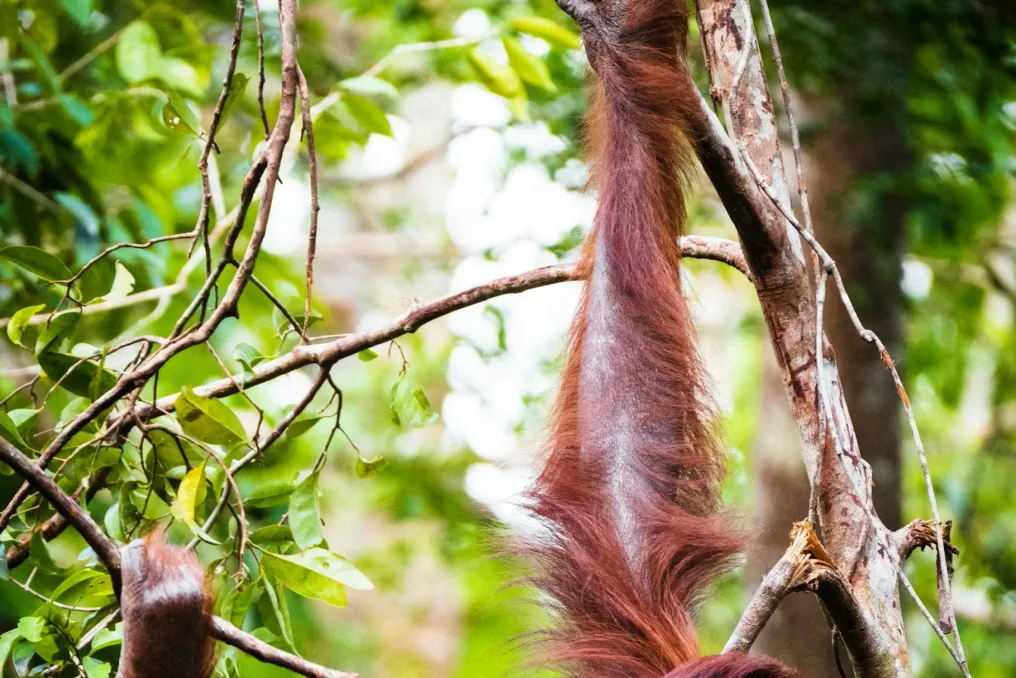
Recently, there have been positive developments for wildlife. In Borneo, specialists are relocating orangutans from fire-damaged forests, while researchers are seeking ways to protect birds from wind turbines.
Eight orangutans were evacuated to a safe location after forest fires damaged part of their habitat in Indonesian Borneo. This group included three females with infants and two young males. Conservationists transported the animals to the Batu Nyambu reserve forest, where they can recover in the wild. The rescue operation required a long journey by car, boat, and on foot. Before the relocation, specialists examined the orangutans to check their health and ensure suitability for resettlement.
According to Reuters, since August, rescuers have helped 46 orangutans affected by fires in West Kalimantan. This assistance is a relief for these endangered great apes, which live exclusively on the islands of Borneo and Sumatra. Nevertheless, saving individual animals has its limits; preserving their forest habitat and preventing further destruction remain critically important for their survival.
A new global assessment revealed encouraging signs for several wildlife populations, including elephants in South Africa. According to the WWF Living Planet Report 2026, published on October 7, there is a recovery in South African elephant populations, as well as improvements among green sea turtles, tigers, and bluefin tuna. These successes demonstrate the potential of sustainable conservation efforts. Habitat protection, anti-poaching initiatives, wildlife monitoring, and coordinated management contribute to the recovery of vulnerable groups.
However, the report contains an important warning: since 1970, the average decline in tracked global wildlife populations has been 73%. Positive progress in elephants and other species does not mean that the biodiversity crisis is over; on the contrary, these recoveries provide conservationists with a basis for further work and underscore the importance of long-term funding and habitat protection.
Kenya has launched a new recovery plan for the endangered mountain bongo antelope, which inhabits the country's mountain forests. The International Union for Conservation of Nature (IUCN) announced the launch of Kenya's National Recovery and Action Plan for the period 2026 to 2030 on September 28. The goal of this plan is to increase the national population of mountain bongo by 50% by 2030, with a long-term objective of establishing a self-sustaining wild population of 750 individuals by 2075.
Achieving these goals requires not only breeding animals in controlled conditions. Conservationists must protect suitable forest areas, maintain genetic diversity, monitor populations, and prepare animals for release into the wild. The survival of the mountain bongo is also important for the broader ecosystem, as its forest habitat helps regulate water supply, store carbon, and support other wildlife. Protecting these forests can also benefit neighboring communities.
A surprisingly simple solution may help reduce bird deaths at wind farms: painting one of the three turbine blades black. Researchers at the El Ruyedo wind farm in Spain compared four turbines with one black blade against sixteen turbines with standard white blades. They wanted to find out if increasing the visibility of the rotating blades would help birds avoid collisions. According to Mongabay, researchers found that annual bird mortality at turbines with painted blades was nearly 74% lower.
The idea is that rotating white blades can blend in, making them difficult for birds to detect. A contrasting blade can help birds recognize the moving structure and avoid it. The results look promising, although scientists still need to determine how well this method works in different landscapes and for different bird species. Since results vary across different studies, painting turbine blades is not yet a universal solution. Renewable energy plays an important role in combating climate change, but wind farms can pose a risk to wildlife. Simple design changes can help mitigate these risks while allowing clean energy projects to develop.
South Africa has reached a significant milestone in its President's One Billion Tree Planting Program: more than seven million trees have been planted since the start of the 2026/27 financial year, according to the Department of Forestry, Fisheries and the Environment. This program unites government, business, civil society organizations, and private individuals to support more ecological communities and environmental sustainability. Planting activities took place in all nine provinces. Trees are capable of restoring degraded land, providing habitat for wildlife, and helping communities adapt to climate change. However, it is crucial to plant the correct types of trees in appropriate locations. Local species and carefully planned restoration aimed at restoring natural ecosystems are particularly important. The next challenge is ensuring the survival and growth of these trees, as their long-term contribution to a healthy landscape will be far more significant than the initial number of planted trees.