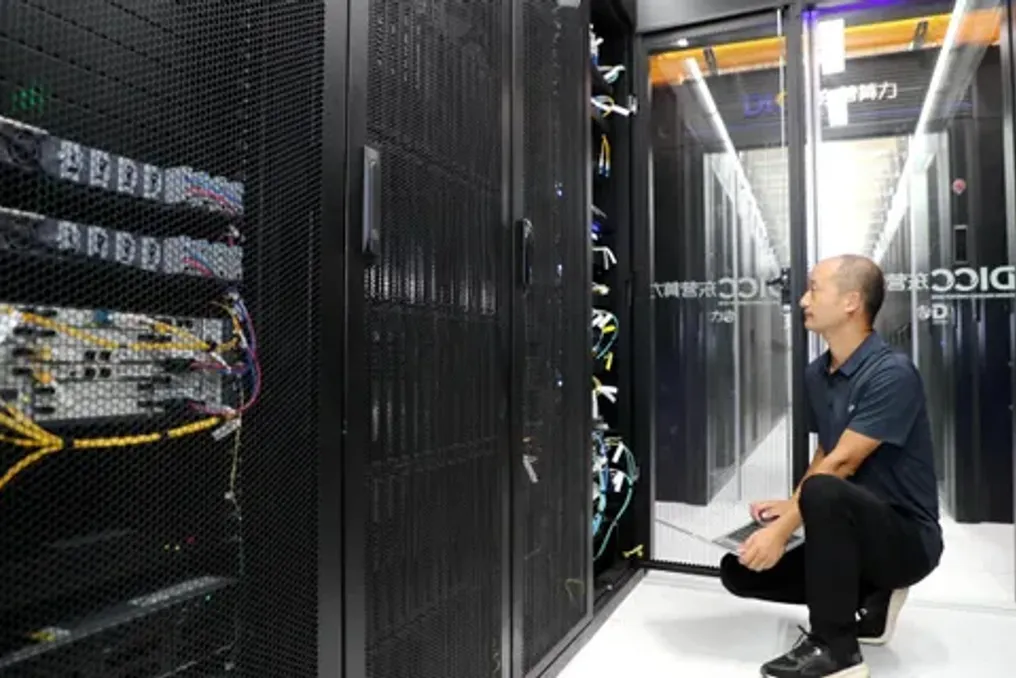
Thanks to rapid progress in artificial intelligence (AI), computing power has become an indispensable digital infrastructure. This infrastructure enables the realization of numerous practical tasks: AI systems can determine calorie content from a photograph, vast traffic data arrays are processed in real-time to optimize urban mobility, production processes are dynamically planned to increase factory efficiency, and highly realistic visual images are generated for media production.
According to data from China's Ministry of Industry and Information Technology, by the end of June 2026, the national intelligent computing power reached 2,185 exaflops (EFLOPS). To support this growth, over 70 major computing corridors have been established, connecting key national data centers across the country.
In August 2026, China unveiled its plan for the development of the information and communication technology sector, covering the fifteenth five-year plan period (2026–2030). This plan sets ambitious goals: by 2030, intelligent computing power is expected to reach 9,800 EFLOPS, and advanced data storage capacity is projected to reach 1,700 exabytes (EB). This represents an increase of more than five times for computing and two times for storage compared to the 2025 baseline figures.
Experts interviewed by the People's Daily explained the relationship between computing power and storage. Guo Liang, a lead engineer at the Institute for Cloud Computing and Big Data Research of the Chinese Academy of Information and Communications Technology, noted that 'computing power is primarily responsible for data processing, model training, and inference, while storage capacity manages data collection, management, hosting, and distribution.'
In practice, AI training checkpoints, intermediate states during AI agent inference, and context memory buffers are distributed across multi-level high-performance storage systems. Synchronizing computing and storage resources allows developers to significantly accelerate AI model training, improve inference speed, and enhance result quality.
As of June 2026, the national utilization rate of computing power was 71.4%, and the total data storage volume reached approximately 2,021 EB, with advanced storage accounting for about 32%.
Since large language models are rapidly scaling from hundreds of billions to trillions of parameters, the computational power of individual clusters becomes a decisive factor for training efficiency. To address this, the new plan requires the creation of a multi-level infrastructure, including national nodes, regional centers, and edge nodes. It provides for the phased deployment of intelligent computing clusters ranging from 10,000 to over 100,000 graphics processing units (GPUs), which better aligns with the growing demand for ultra-large-scale parallel training as models become more complex.
According to the plan, China will implement high-speed data transmission technologies at 400G and above, aiming to improve the core computing corridors connecting national data centers and ensure high-quality network support for inter-regional coordination of computing resources. Simultaneously, the plan encourages the comprehensive development of computing and energy systems to create a green, low-carbon infrastructure that reduces operating costs and supports national decarbonization goals.
'Effective coordination' is a key focus in the development of China's computing infrastructure under the fifteenth five-year plan. Analysis of China's computing power landscape in 2026 showed that Hebei, Jiangsu, Guangdong, as well as Shanghai and Beijing are among the leading regions in terms of overall computing power.
Overall, regional development remains uneven, and deeper integration of computing power with industry applications is still necessary. Furthermore, practical limitations exist for the inter-regional distribution of computing resources.
Over the next five years, China will build a multi-level computing infrastructure system covering nodes, regions, and the periphery; improve the interconnected network architecture linking computing power; enhance the efficiency of long-distance data transmission between nodes; and fully connect computing platforms across the country. Experts note that these efforts will significantly improve data resource utilization efficiency.
Guo emphasized that the main goal of setting such ambitious growth targets is to meet the medium-term and long-term needs of China's AI models and digital industries, taking into account factors such as industrial development, technological competition, and security.
As of June of this year, China has completed the registration process for 988 generative AI services, which is 686 more than at the end of 2024 and 240 more than at the end of 2025. As the number of large AI models grows, the demand for computing power increases annually, creating a need for a sufficiently robust computing foundation to support the development and industrial application of various models.
At the same time, data volumes across various industries continue to grow, stimulating increased demand for data storage, management, and circulation. Intelligent applications impose higher requirements on data delivery, processing, management, and security, necessitating a coordinated approach to the scale, structure, and performance of advanced data storage.
Guo concluded that 'the global expansion of intelligent computing is happening rapidly, and high-end intelligent computing has become a critical foundation for competition in the digital sector. Setting a relatively high target will help stimulate innovation across the entire industrial chain, promote coordinated breakthroughs in areas such as intelligent computing clusters, chips, and interconnectivity, address deficiencies in computing infrastructure, and gradually close the gap with international best practices.'