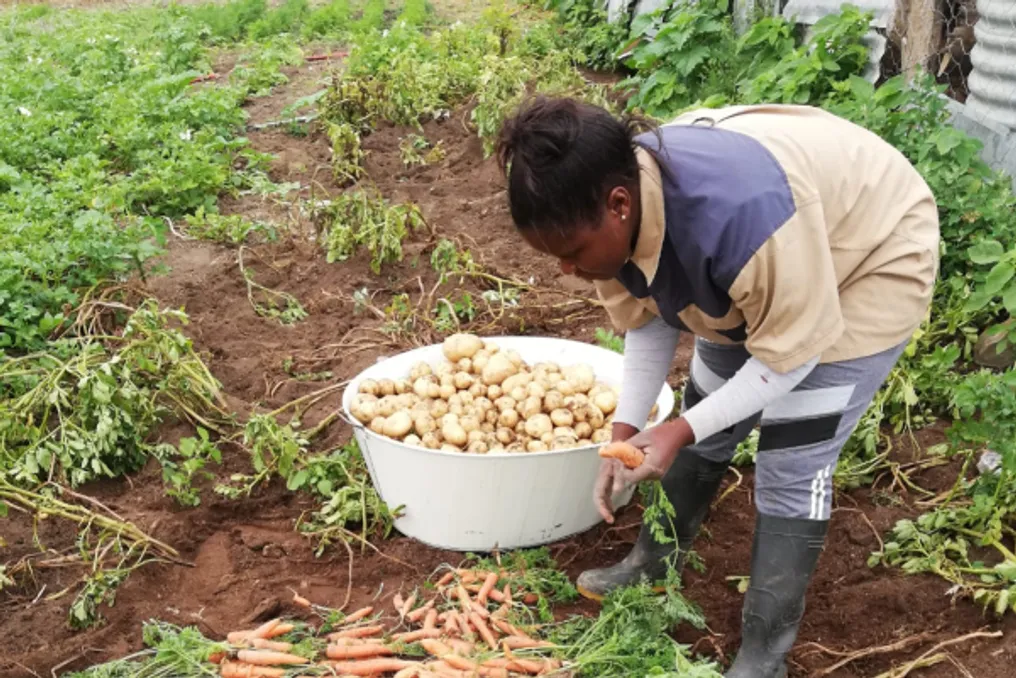
Entrepreneur Palesa Sotshongae proves that small-scale farming can sustain communities and retail stores
Read more
Food For Mzansi
foodformzansi.co.za

Entrepreneur Palesa Sotshongae proves that small-scale farming can sustain communities and retail stores

Palesa Sotshongae, an entrepreneur from East Cape, transformed her student scholarship and a family plot of 0.5 hectares into a commercial farming enterprise, demonstrating how discipline, patience, and business acumen can turn modest beginnings into a thriving business.

Sotshongae was born and raised in the village of Upper Nxakha in Mount Fletcher. She completed primary school at Upper Nxakha High School and then obtained her matric certificate from Kuyasa Senior Secondary School in 2018. After a one-year break, she enrolled at the Ingwe TVET campus of Mount Fletcher College in 2019 to study business management, graduating in 2022.

Although she initially chose business management to learn the principles of running a business, a conversation with her former high school teacher, Seshobe, in 2021 changed her perspective on the sector. Sotshongae recalls: 'He always told me that agriculture is not just working in the field, but a business that can create jobs and feed the community.' He encouraged her to use a small part of her home plot to produce something, after which she fell in love with farming.

Turning this inspiration into reality required exceptional financial self-discipline. From 2020 to 2022, while her peers spent their National Student Financial Aid Scheme (NSFAS) allowances on personal needs, Sotshongae saved her scholarship to build up seed capital. She admits it was not easy, as she had to forgo desires while other students bought clothes and used NSFAS funds.

In 2022, Sotshongae moved from Mount Fletcher to the village of Godini in Khumbu, within the local municipality of Mhlontlo. Initially, her family was surprised by this decision, expecting her to work in a corporate office given her business management qualifications. However, seeing her determination and her own seed capital, they fully supported her and gave her access to the family's 0.5-hectare plot.

Armed with savings, she purchased the first seeds and chicks, planted spinach and cabbage, and equipped an extension to the house for poultry farming. In 2024, she officially registered her business as Iphiko-Lokhozi Multi Purpose. Today, working from her backyard in Godini, Sotshongae has expanded production, adding potatoes to spinach, cabbage, and poultry farming, and creating part-time jobs for local workers.

'Since starting my work, my greatest achievement has been the ability to supply local schools, purchase a water tank, and increase production,' she shares.

Working in the rural area of Khumbu involves significant operational challenges, including water scarcity, unpredictable weather conditions, and agricultural pests. Sotshongae manages these issues through rainwater harvesting, organic composting, and continuous technical guidance from a local agricultural extension officer.

Financial backing has been a serious obstacle. Despite multiple applications to various government departments, she has received no external funding and continues to finance her activities entirely through reinvested profits. She is proud that her sacrifice allowed her to buy the first seeds and chicks and start her business.

Her persistence has led to good market access. Today, Iphiko-Lokhozi Multi Purpose supplies fresh produce and poultry to local residents, neighboring schools, and major retail outlets in Khumbu, including Boxer and Spar.

Sotshongae's plans include fencing her available five-hectare land for production expansion, purchasing a tractor, building a specialized poultry house, engaging in agro-processing, and ultimately obtaining formal agricultural qualifications to complement her business management experience. She advises those planning to farm: start small, be patient, study the soil and poultry, visit the local agricultural office, and never give up.
Similar stories

Study shows that land ownership alone is insufficient for the development of rural areas in South Africa
Read more
foodformzansi.co.za

Study shows that land ownership alone is insufficient for the development of rural areas in South Africa

Discussions about rural development in South Africa often begin with the assumption that if rural households have more land, they can produce more food, earn more money, and become commercial farmers. This concept features in several government programs, including the National Development Plan to 2030, the Integrated Rural Development Programme, the Smallholder Support Strategy, as well as the Agricultural and Agro-processing Master Plan.

Within these documents and political rhetoric, it is expected that agriculture will be the main driver of economic growth in South Africa's former disadvantaged lands. This goal is rooted in the country's history. During colonialism and apartheid, laws such as the Natives Land Act of 1913 restricted land ownership by Black communities and concentrated a significant portion of this population in former 'lands'. These areas were characterized by overpopulation, poverty, and inadequate infrastructure, which continues to affect life in rural areas to this day.

Modern agricultural and rural development policy therefore combines several objectives: correcting unequal access to land, increasing agricultural production and food security, creating jobs, expanding market participation, and fostering an inclusive rural economy. This has often implied providing smallholder farmers with land alongside agricultural resources, infrastructure, financing, training, and other forms of support aimed at increasing production and involvement in agricultural value chains.

However, findings from studies of two rural communities indicate that this picture is overly simplistic. A team of agricultural systems researchers from the University of the Free State examined the actual role agriculture plays in the livelihoods of rural households, the constraints on agricultural production, and alternative futures in agriculture.

The researchers worked with 132 smallholder farming households in two provinces. Household surveys, life experience interviews, farm mapping, and focus groups were used to collect data. The study sites were Emmaus, near Bergville, and the Drakensberg mountains in northern KwaZulu-Natal, as well as Taba Nchu, located about 60 km from Bloemfontein, the capital of the Free State. These communities were chosen because they are located in former lands but differ in their ecological and socio-economic conditions.

The study found that while agriculture remains important for ensuring food security and income for rural households, it is rarely the primary source of earnings. Instead, households combine farming with wage labor, small businesses, social grants, and other activities to sustain themselves.

This is significant because rural development policymakers who focus predominantly on increasing agricultural output or expanding land access (as is done in South Africa) overlook the interconnected factors that actually determine households' ability to improve their well-being. These factors include labor dynamics, infrastructure, markets, institutions, and household aspirations, which determine whether people can expand farming and whether they want to.

Agriculture is part of a broader subsistence system, not an independent path out of poverty. Agriculture is just one component of rural livelihoods.

The first phase involved a household survey that collected a wide range of information on land, production, income, and so on. Rural households in both locations varied greatly among themselves. Some households had very limited incomes and relied heavily on off-farm sources of income, such as social grants, wage labor, and small businesses. They often reinvested these resources back into farming. For most households, agriculture contributed to food security and provided some income, but was rarely sufficient to support the household independently.

Only 16% of households in Emmaus and 19% in Taba Nchu managed to exceed the South African Food Poverty Line (currently 868 rand or 54 US dollars per person per month), with off-farm sources contributing the largest share to their income. Differences between households matter. A household with a stable income from work can afford to buy livestock, hire labor, or invest in agricultural resources. A poorer household may own land but lack the money or labor to cultivate it. Thus, two households may have access to similar agricultural resources but vastly different opportunities to benefit from them.

The same applies to aspirations. Some households view farming primarily as a means of food provision. Others see it as an income source. Only 12% of household heads in Emmaus and 36% in Taba Nchu aspired for farming to become a business. Unmarried household members (aged 18 to 32) instead aspired to education, wage labor, or migration (64% in Emmaus and 80% in Taba Nchu).

This means there is no single path from smallholder farming to improved living conditions. Rural households start from different positions, face different constraints, and aspire to different futures. Viewing them as a single category of 'smallholder farmers' may lead to policies that help some households but have little impact on others.

Another notable finding was that land was not necessarily the biggest obstacle to increased production. Many households had access to land but could not utilize it fully. The study identified four barriers. First, labor. A household may have available land but lack sufficient labor to cultivate it. Second, infrastructure. For example, in Emmaus, poor roads and inadequate water infrastructure limited the potential for expansion or diversification of production. Third, in Taba Nchu, communal grazing lands were important for pastoralists, but conflicts over their use and management undermined productivity. Fourth, farmers could not always develop alternative farming enterprises. For instance, in Emmaus, people prefer growing maize and beans for self-consumption, leaving less land for market-oriented crops and other forms of farming activity.

An agricultural system may look productive and profitable on paper but still fail in practice if it does not align with the social and institutional realities of the community.

Rural households also have aspirations that extend beyond farming. One of the key lessons is that many rural households are not simply waiting for agricultural intervention; they have their own ideas about what a better future might look like. Many households participating in the study viewed farming as a means of survival and social protection, rather than a long-term commercial career. Young household members are not all interested in taking over the farm.

This does not mean that agriculture has no future in South Africa's former lands. Rather, the future of rural livelihoods will likely involve a combination of various activities. Rural development programs must be designed with this in mind. The entire system must be considered. Instead of only asking about whether farmers have enough land, fertilizer, water, or technology, the question should be how these factors interact with the household, labor availability, markets, institutions, natural resources, and people's aspirations. Instead of only asking how to turn smallholders into commercial entities, one should also ask: what combination of opportunities can help rural households build the future they desire? For the younger generation, in particular, the best opportunities may lie partially outside of agriculture.

How unity, technology, and added value contribute to the profitability of farms
Read more
foodformzansi.co.za

How unity, technology, and added value contribute to the profitability of farms

Success in modern South African agriculture depends on the ability to adapt, establish thoughtful partnerships, and ensure resilience to climate change. Following the Nampo Cape 2026 event, Daniel Rossouw from Nedbank shared his thoughts on the key trends shaping South Africa's agricultural sector and how strategic collaboration can guarantee long-term commercial sustainability.

As Head of Agricultural Sales at Nedbank, Rossouw noted that this year's Nampo gathering gave the sector a new impetus and a shared sense of purpose. Faced with complex market and operational challenges, industry stakeholders are increasingly uniting to protect productivity and build sustainable growth.

Under the theme 'grow together,' the event highlighted the growing demand for collaboration across the entire agricultural ecosystem. Discussions brought together representatives from organized agriculture, agribusiness, financial institutions, and political leaders, including the Minister of Agriculture and the Minister of Land Reform and Rural Development.

Rossouw emphasized: 'For me, the drive towards greater unity in agriculture was a truly outstanding moment, and I believe very deep discussions took place.' These meetings focused on critical regional and national issues, such as the future viability of the Western Cape grain industry, current biosecurity efforts related to rinderpest vaccination, and the role of local government in maintaining rural infrastructure to support agricultural logistics.

On the exhibition floor, farmers' interest was concentrated on innovations designed to optimize efficiency and reduce environmental risks in crop and livestock farming. Demonstrations of high-quality equipment included localized weather forecasting systems and data management platforms, as well as renewable energy sources designed to protect farms from utility costs.

Equipment developed for climate-smart agriculture also took center stage, with an emphasis on zero and minimum tillage machinery that minimizes soil disturbance. For Nedbank, the main focus was on regenerative agriculture and creating practical links in the value chain to help clients effectively implement sustainable farming principles.

Highlighting the link between environmental stewardship and farm performance, Rossouw asserts that economic success and environmental responsibility are inseparable. Long-term profitability depends on conserving and restoring natural resources, especially soil health and water availability.

He explains: 'You cannot talk about profitability and sustainability without the other. It is a completely integrated system.' He adds that ultimately, any activity of a farmer or agribusiness must be profitable for more than one generation while caring for natural resources.

This focus on long-term resource management underlies the ability of a farm to remain economically viable amid changing climatic cycles and market conditions.

A significant shift in the sector is the move towards vertical integration. Since raw material producers are typically price takers in open commodity markets, moving into processing, local packaging, and specialized export logistics offers a direct path to generating additional profit. Rossouw notes: 'We definitely see a major opportunity beyond primary agriculture.' He continues that instead of increasing raw material production, the focus is on vertical integration, both up and down the value chain. If these connections can be established and greater integration achieved, he believes it will significantly benefit the raw material producer in terms of profitability.

This shift aligns closely with national development goals within the Agricultural and Agri-processing Master Plan (AAMP), which prioritizes localization, export expansion, infrastructure development, and digital integration. By integrating operations upstream or downstream, producers can reduce their exposure to raw material price volatility.

Overcoming market changes, implementing technologies, and adapting to climate requires continuous financial support and a personalized approach to risk management. Financial institutions play a crucial role by going beyond traditional banking services, providing structured, climate-smart solutions that allow producers to diversify, adopt new technologies, and expand into value-adding areas.

To learn how Nedbank can partner with your agricultural business to navigate market transitions and transition to more climate-resilient practices for long-term profitability, contact business@nedbank.co.za or reach out directly to your regional Nedbank business manager.

Popular