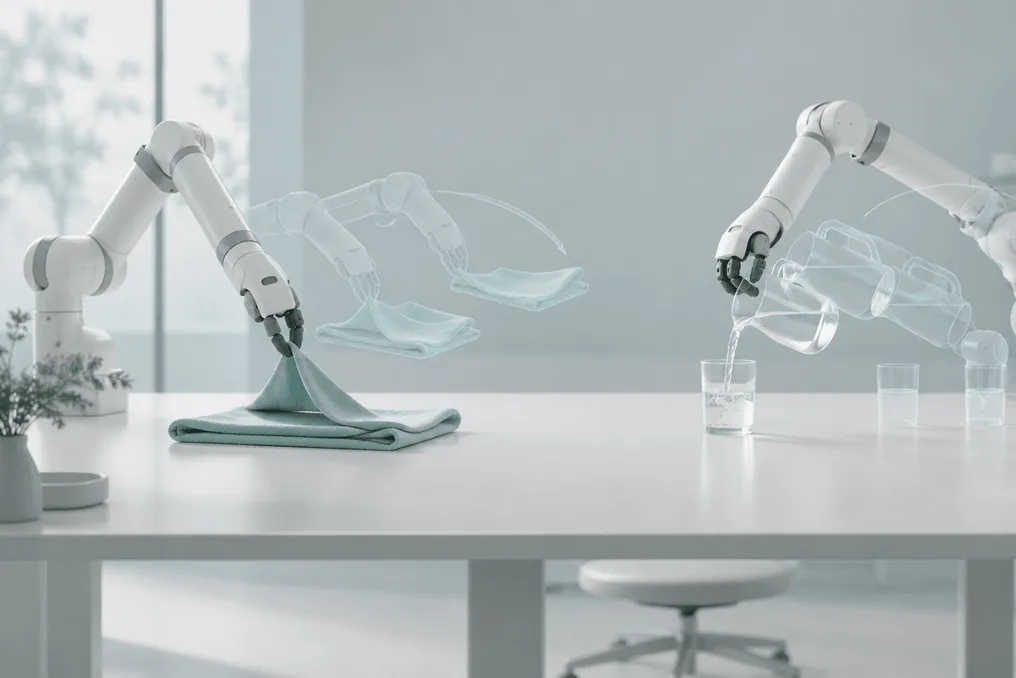
The final results of the WorldArena 2.0 competition, held as part of IROS 2026, demonstrated that various approaches to world model construction successfully handle different types of tests. WorldArena is a benchmark developed by the Tsinghua University team in collaboration with universities from China and other countries. Version 2.0 expanded functionality from visual input to visuotactile, from offline to online reinforcement learning tasks, and from simulation to working with real robots, according to Leiphone.
The competition included three independent tracks with a total prize pool of $7,000 USD, and the final results were published on September 16.
Results of the First Track
The first track assessed the model's ability to predict videos based on 15 metrics across 70 tasks. These tasks included 50 scenes within the distribution on white tables and 20 scenes outside the distribution with colored or textured surfaces. Among 81 ranked models, Visincept's WorldIncept model took first place with a score of 72.33, surpassing BWM-Turbo from the Spatial Intelligence team at Tongji University with 71.49. The difference was only 0.84 points. WorldIncept showed better results in adherence to physical laws, 3D accuracy, and semantic consistency, while BWM-Turbo led in background coherence and JEPA similarity. Visincept clearly utilizes the JEPA approach.
Zhongguancun Academy's Victory in the Second Track
The second track, presented this year, used a world model as an environment for online reinforcement learning in a bottle regulation task on the RoboTwin 2.0 robot, after which the trained policy was tested in simulation. The MW2 model from Zhongguancun Academy won with a score of 72.93 among 47 models, beating TTWM, which is a competitive version of a causality-oriented world model based on JEPA from another startup. The second-place team noted that training in their model increased the success rate of the pi0.5 policy from 55.46% to 72.40%.
Xiaomi Wins in the Real Robot Track
The third track, also new, was conducted on real robots AgileX with two arms and Franka Panda. Its tasks, including visuotactile operations such as chip picking, cucumber cleaning, and fork insertion, as well as vision-only tasks such as wiping tables, pouring water, and folding clothes. The ViTacX model from Xiaomi's MiRobot team achieved overall victory with a score of 76.64. Its advantage was due to the vision-only sub-ranking, where it topped the list with a result of 85.00, including perfect scores in three tasks. In the visuotactile task sub-ranking, it placed third with 66.67, while OmniFlow from Shanghai Technological University took second place in both sub-rankings.
Organizers emphasized that participation in each track was voluntary, so it has not yet been demonstrated that any single model surpasses the others simultaneously in video generation, policy learning, and real robot manipulation.