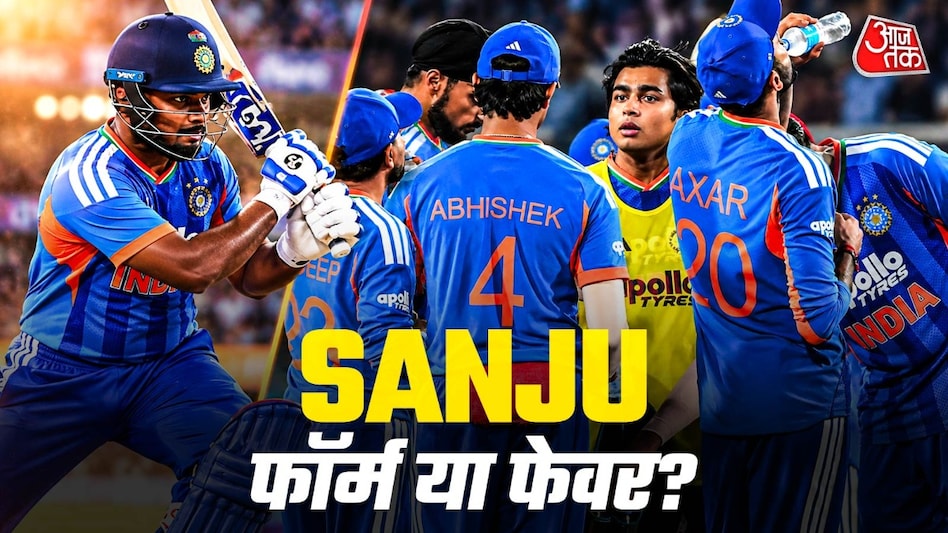
Question about Sanju Samson's future and the possible debut of Vaibhav Suryavanshi in the team
Read more
Aaj Tak
www.aajtak.in

Question about Sanju Samson's future and the possible debut of Vaibhav Suryavanshi in the team

The question arises as to how long Sanju Samson can remain in the team, especially against the backdrop of Vaibhav Suryavanshi's potential emergence. In the current T20 series against West Indies, Sanju scored 11, 82, and 3 runs. Although his innings of 82 runs in Ranchi cannot be ignored, the details of that game also warrant consideration.

During this innings, he missed a chance for a catch worth 6 runs, and a second opportunity was given to him at 42 runs. This means the opponent gave him two chances. A natural question arises: should his spot in the national team be based solely on one big innings and two such opportunities?

This question becomes even more relevant because there is a young batter in the team who has attracted global attention due to his explosive style—Vaibhav Suryavanshi. However, while Vaibhav is being given opportunities, Sanju continues to receive consistent chances. Three out of five planned matches in the series have passed. Only two matches remain, leading to the necessity of deciding: will the team management continue testing Sanju or dare to field Vaibhav?

Sanju's innings of 82 runs cannot be overlooked. Nevertheless, a player's assessment should not be based exclusively on his best performance. In T20 cricket, the true test lies in consistency. Sanju showed fluctuations across three innings: 11 runs in the first match, 82 in the second, and only 3 in the third. These ups and downs once again raise the long-standing question of his career: can Sanju turn his talent into consistent results?

The mention of two chances in Ranchi is significant, as batters are not always afforded such opportunities at a high level. If he had taken the catch, would his 82-run innings have been achieved? There is no definitive answer to this. But these points must be considered when evaluating his game. Scoring runs is good, but decisions cannot be made by looking only at the scorecard, forgetting the opportunities provided.

On the other hand, Vaibhav Suryavanshi is a talent that has received worldwide acclaim, yet he has to wait his turn in the Indian squad. What is a greater contradiction for a young player than being kept on the bench even after being selected for the team? Vaibhav impressed strong bowlers with his aggressive style, but he has failed to prove himself in international cricket. If the team management selected him, it means they believed in his abilities. So why refuse to test that trust? How many more attempts are needed to give Vaibhav a chance?

From an early age, Vaibhav Suryavanshi challenged strong bowlers with his batting. His fearless approach earned him particular recognition. Undoubtedly, there is a difference between IPL pressure and international cricket. Vaibhav will also have to prove his worth in the Indian team format. But how will his real test go if he is not allowed to take the field? Talent is tested not by what is kept on the bench, but by what is brought onto the field. How justified is it to pass judgment on him without giving him a chance?

Only two matches remain in the series. This is the moment when the team management must make decisions focused on the future. If they want to give Vaibhav a chance, why not do it now? Will they wait for another big innings from Sanju? And if Sanju cannot score consistently, is it fair to continue playing him based only on past achievements?

Sanju's average in T20 internationals has dropped below 27. This figure alone does not reveal the player's entire story, but when there is a large disparity between bad and good innings, the need to ask questions arises. A place in the Indian team cannot be permanent property of anyone. Here, results, team needs, and future plans must be equally considered.

The demand to drop Sanju does not mean he lacks talent; his talent is not in question. The question is about the results that this talent brings. How long will a spot be given based on hope? How long will one big innings hide previous failures? And how long will the decision to give another player a chance be postponed?

Now the picture is clear. The team management has a choice in the remaining two matches of the series against West Indies. They can give Sanju another chance, demonstrating confidence in his form, or field Vaibhav to see what the young batter can do at the international level.

However, this decision is not just about fielding one player or benching another. It is a matter of the entire team's mindset. Is India striving to prepare new options for the future, or will it be stuck on re-testing old options?

Sanju fully has the right to fight for his place, but Vaibhav also has the right to a chance. Sanju's failure itself does not guarantee Vaibhav's success, but denying Vaibhav a chance is stopping his trial before it even begins.

Similar stories

After losing the ODI in Mullumpur, captain Shubman Gill expressed dissatisfaction with the team's play and warned the players
Read more
www.aajtak.in

After losing the ODI in Mullumpur, captain Shubman Gill expressed dissatisfaction with the team's play and warned the players

In the final match of the three-match ODI series between India and West Indies, held at the Maharaja Yadvindra Singh International Cricket Stadium in Mullumpur on Saturday (October 3rd), the West Indies team won by five wickets.

Captain Shai Hope scored an unbeaten 162 runs, despite a hamstring injury, which helped the West Indies achieve an impressive total of 352 runs in just 10 overs after the game concluded.

After the match, Indian captain Shubman Gill commented on the reasons for the defeat, expressing serious concern about the quality of fielding and how the team handles the over-finish. Gill admitted that the Indian team's fielding did not meet expectations ahead of the World Cup.

During the game, the Indian squad dropped around six to seven catches. According to the captain, losing such opportunities is worrying for any team. He noted: 'There were many good moments, but there is definitely room for improvement in certain areas. Our fielding could have been better. We dropped about 6-7 catches. This is not a good sign before the World Cup.'

The main problem, in the opinion of the Indian captain, was the performance during the final overs. He stated that the team lacks clarity on when to attack and when to employ defensive tactics in the field. Shubman added: 'We need to work on our end-of-match play. When we bowl in the last overs, we are unclear whether we are attacking or defending.'

The Indian captain also mentioned that even if five or six opposing players are out, the team struggles to determine field placements and bowling strategies. Sometimes the strategy for the end of the match begins too early, when it might have required mid-game play.

The biggest contributor to India's loss was West Indies captain Shai Hope. He scored his 21st century in ODIs and secured a memorable victory for the team. This was the largest successful run chase for the West Indies in ODIs. It was Hope's second consecutive stoic innings; previously, he had also scored a century in a match in Guwahati, and in the third match, he surpassed it, dashing India's hopes.

After the game, Shai Hope shared an interesting secret about his brilliant innings. He revealed that a conversation with former Indian captain Mahendra Singh Dhoni helped him improve his approach to the game. Hope said: 'I had a good talk with the great player MS Dhoni. He told me that you always have more time than you think. So I don't focus too much on the result.'

Hope reported that he now tries to focus on the process rather than the final outcome of the match. His attention is focused on understanding the circumstances, breaking down his innings into small parts, and finding suitable moments to score boundaries at the end of the match.

Luan Dre Prietorius sets T20 record, surpassing Chris Gayle's achievement
Read more
www.aajtak.in

Luan Dre Prietorius sets T20 record, surpassing Chris Gayle's achievement

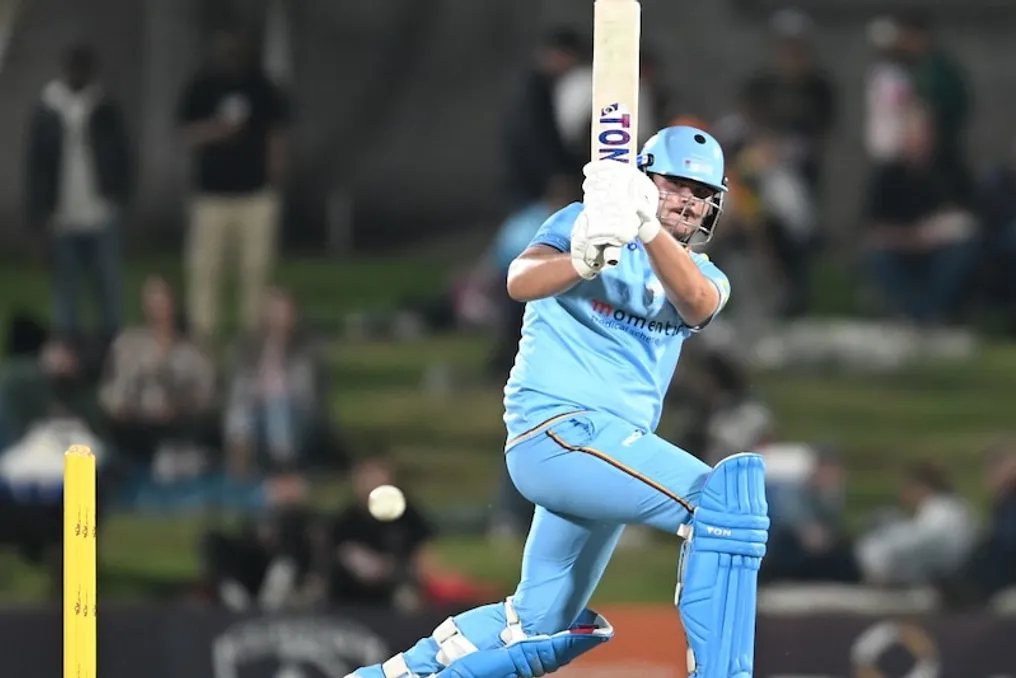
In a match within the CSA T20 Challenge, held on Friday (October 2nd), an incredible display in the world of cricket was demonstrated. A young South African player, Luan Dre Prietorius, created a real storm with the bat, breaking a 13-year record.

During the game at Mangungu Oval in Bloemfontein, playing for the Titans against the Knights, Prietorius scored 188 runs without getting out in just 79 balls. This left-hander hit 15 fours and 13 sixes in his innings. Through boundaries alone, the 20-year-old Luan Dre Prietorius earned 138 runs.

Thanks to this explosive performance, the Titans managed to score a substantial total of 267 runs, losing only 3 batsmen in 20 overs. In response, the Knights managed to score only 143 runs, allowing the Titans to win by a margin of 124 runs.

Luan Dre Prietorius set a new record for the highest score in a single T20 cricket innings. Previously, this record belonged to the explosive West Indian batsman, Chris Gayle. Gayle achieved this feat in 2013 during the Indian Premier League (IPL), playing for Royal Challengers Bengaluru (RCB) against Pune Warriors, where he scored 175 runs without being dismissed.

Now, after 13 years, Prietorius has surpassed this mark. Luan Dre Prietorius is part of the Rajasthan Royals (RR) team in the Indian Premier League, where Vaibhav Suryavanshi also plays, who showed outstanding performance in IPL 2026. Spectators expected Prietorius to score two hundred runs, given his style of play. He constantly hit powerful shots and kept the Knights players under constant pressure.

However, since the 20 overs were completed, and Prietorius did not receive additional balls to reach the 200-run mark, he fell slightly short of achieving a double century in T20 cricket. His game demonstrated not only aggression but also consistency in scoring. The Titans' score of 267 runs in the innings testifies to Prietorius's high level of play. He single-handedly set the pace of the innings, making it extremely unlikely for the opposing bowlers to recover.

This match also holds special significance for Luan Dre Prietorius, as his career has recently suffered due to injuries. Despite this, he continues to show impressive results after returning to the field. Last month, in a T20 friendly match against Namibia, Prietorius also scored a magnificent century, accumulating 101 runs off 53 balls.

Kuldeep Yadav reaches 200 ODI wickets, surpassing Shane Warne in balls bowled
Read more
www.aajtak.in

Kuldeep Yadav reaches 200 ODI wickets, surpassing Shane Warne in balls bowled

In the match between India and West Indies, players from the West Indies demonstrated strong play, dealing a serious blow to the Indian bowlers. John Campbell, Shai Hope, and Amir Jangu each scored a century, bringing the West Indies total to 405 runs. In rainy conditions, Kuldeep Yadav recorded a significant record.

In his 123rd ODI match, Kuldeep Yadav completed his 200th wicket, becoming the second fastest bowler in Indian history to reach this milestone. He is only surpassed by Mohammed Shammi, who took 200 wickets in 104 ODIs. Following him are Ajit Agarkar (133), Zaheer Khan (144), and Anil Kumble/Javagal Srinath (147).

Kuldeep secured his 200th wicket of Kemi Paul, who was caught by Virat Kohli in the long-on region after 45.1 overs. This moment marked Kuldeep's achievement of a double century in ODIs. Furthermore, Kuldeep surpassed Shane Warne in the number of balls required to achieve 200 ODI wickets, completing them in only 6319 deliveries. Among spinners, only Shaklan Mushtaq (5451) and Rashid Khan (5782) achieved this result with fewer balls. Following Kuldeep are Adam Jampa (6385), Adil Rashid (6881), and Shane Warne (6983).

Despite the record attack by the West Indies, Kuldeep remained among the few Indian bowlers who managed to partially contain the pace of the game. In his full quota of 10 overs, he took 2 wickets, conceding 65 runs, resulting in an economy rate of 6.50.

Before the West Indies reached 405 runs, Campbell scored 101 runs off 68 balls, Hope scored 104 runs off 94 balls, and Jangu scored 114 runs off just 77 balls. This was a rare sight in one ODI match where three batsmen score a century.

Popular