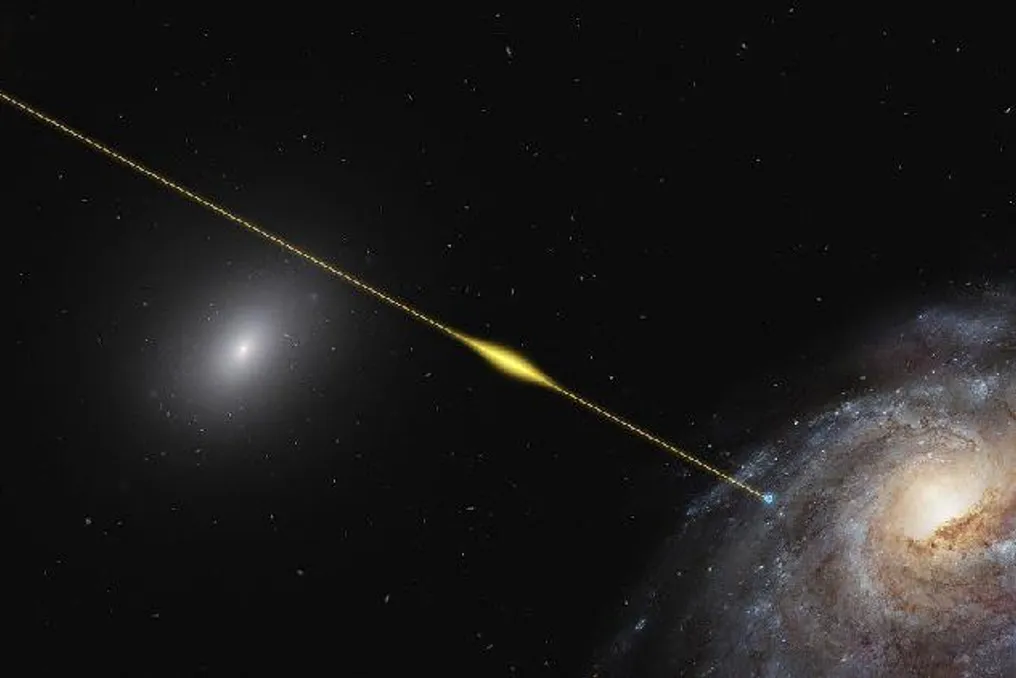
Astronomers have managed to identify the host galaxy of the most distant recorded fast radio burst (FRB). This was reported by the South African Astronomical Observatory (SAAO), which utilized the MeerKAT radio telescope from South Africa and NASA's James Webb Space Telescope.
In a statement published in the journal Science on Thursday, SAAO specified that the discovery is related to FRB 20240304B. This burst was detected on March 4, 2024, by the MeerTRAP team—an international consortium applying MeerKAT to search for FRBs and other short-duration radio signals.
The radio telescope was able to precisely locate the burst and determine its extreme distance. However, to accurately measure the distance, scientists needed to identify the host galaxy. Since this galaxy was too faint for detection by ground-based telescopes, the team turned to the Webb telescope. Webb's infrared instruments allowed the galaxy to be detected and its redshift measured at 2.148.
According to the study, the signal traveled a distance of more than 10 billion years before reaching Earth. The event occurred when the Universe was approximately 3 billion years old, which is about a quarter of its current age. This finding more than doubles the previous distance record for an FRB.
The host galaxy turned out to be unexpectedly small, having a mass about 1000 times less than expected for a typical FRB host galaxy, although it was actively forming stars. Manisha Kaleb from the University of Sydney, the lead author of the study, noted in the statement: 'We expected it to be a large, well-formed galaxy with many stars, but instead, it turned out to be a small dwarf galaxy, even though it was actively forming stars.'
The galaxy was observed during the period of 'cosmic noon,' when star formation throughout the Universe peaked, and most of its stars may have formed in just 30 million years. This makes an explanation via neutron star merger unlikely, as binary neutron stars typically require at least a billion years to merge. Instead, researchers suggest that the burst could have originated from a powerful event, such as a 'starquake' in a young magnetar—a neutron star with an extremely strong magnetic field—formed after the collapse of a massive star.
Kaleb emphasized: 'What is particularly interesting about our result is that we have now demonstrated the ability to identify and study FRBs from the early Universe.'