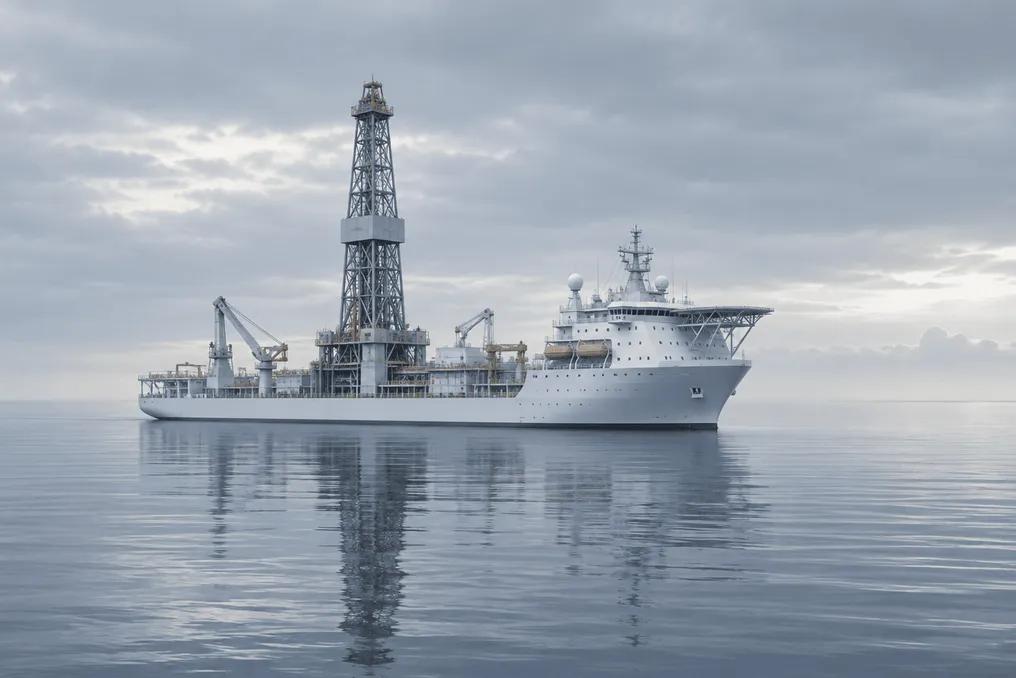
China Communications Construction Company (CCCC) has completed the technical study for a planned 10,000-ton deep-sea engineering and measurement vessel. This achievement paves the way for construction preparation, although the vessel itself has not yet been built.
This stage was marked by expert evaluation. The first phase of CCCC's major research project, dedicated to an intelligent deep-sea survey system based on BeiDou, passed certification after two years of work by a team comprising academics, leading engineers, and research specialists. The project was led by CCCC Highway Consultants, a subsidiary of CCCC.
Key Technical Developments
The central element is the design of a complete 5,000-meter deep-sea drilling complex. Engineers developed a large-range upper drive that supports various coring methods. A vertical oscillation compensation system with a moving block was also created, combining active and passive modes, providing compensatory movement within plus-minus 3 meters and designed for a load of 150 tons. Furthermore, an automated system for deck operations has been provided. The oscillation compensation system stabilizes the drill string during the vessel's up and down movement under wave action.
To conduct seabed tests, the team developed an integrated borehole sounding and static sampling method at the bottom using a cone. This method includes equipment planning for depths of 1,500 meters with a penetration force of 100 kN. A high-precision spatio-temporal BeiDou reference for marine surveys and mapping was also created. Geophysical investigation methods using the mother ship were determined, and both manned and unmanned vessels were equipped. Additionally, hydrological and meteorological equipment for surveys were specified, and an integrated platform for data fusion and multi-level warnings was developed.
According to information from The Paper, the project resulted in the creation of two hardware products, 31 technical drawings, 14 software copyrights, 22 scientific articles, and 39 invention applications. The overall assessment of the work was deemed internationally advanced, with some parts being named world leaders. The main equipment was tested as prototypes, and the team studied the principles of designing, constructing, and operating such a vessel.
It is important to note that the result is a blueprint, not a finished vessel. If realized, this vessel will combine drilling, surveying, in-situ testing, geophysical exploration, and oceanographic observations on a single platform for marine engineering, resource exploration, and scientific research. CCCC has not yet provided any timelines or construction costs.