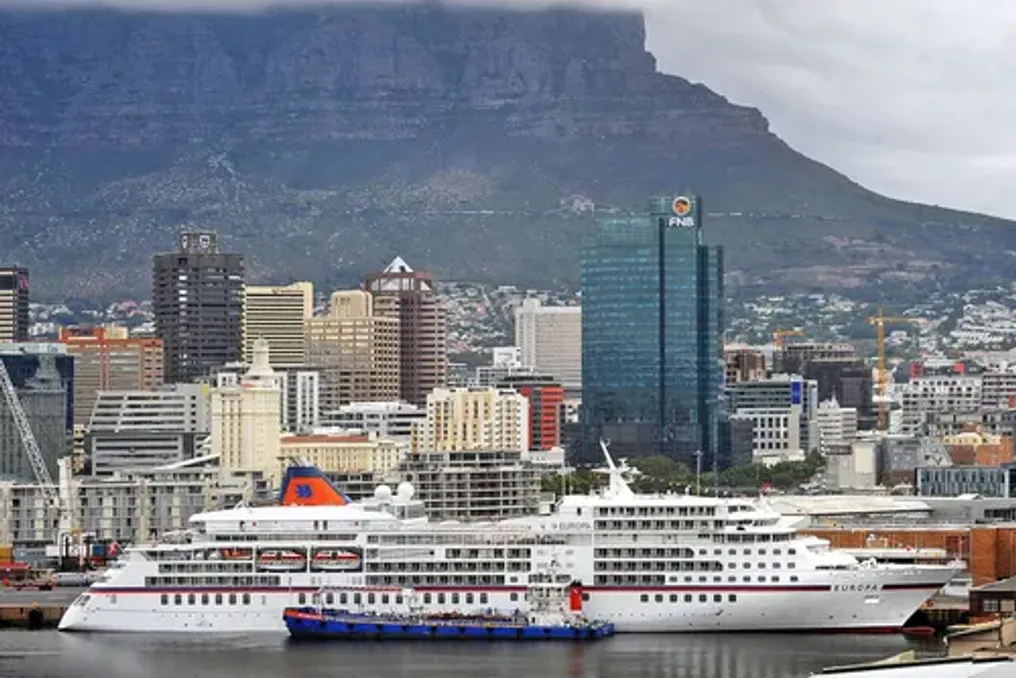
Africa has long struggled to attract cruise liners, and now its focus is on securing the funds spent by passengers after arriving in port.
The port in Cape Town serves as a gateway to Cape Town City and the Waterfront. According to Wesgro, the official agency for promoting tourism, trade, and investment for Cape Town and the Western Cape, the 2026/27 cruise season began on September 17th with the arrival of the Pacific World, carrying 1,397 passengers, predominantly from Japan, and 655 crew members.
This arrival followed three years of rapid growth. In the 2022/23 season, Cape Town hosted 70 cruise ships, carrying approximately 78,000 passengers. By the 2024/25 season, this number increased to 79 ships and 127,000 passengers, according to the Seatrade Africa E-report.
The average annual increase in passenger numbers during this period was 16%, exceeding the industry's global average of 9%. The economic contribution grew parallel to the rise in passenger flow: cruise tourism brought R4.34 billion to the GDP of the Western Cape and R5.32 billion to the South African GDP over three seasons. Furthermore, the sector generated a cumulative income of R3.04 billion in foreign exchange earnings, according to Wesgro.
Tourist spending is not limited to the main terminal. Visitors to the Bo-Kaap area can participate in masterclasses at private kitchens of multi-generational chefs, learning the art of blending Cape Malay spices, rolling rotis, and baking authentic bobotie.
Changing the Onshore Experience
In Mossel Bay, Hermanus, and Saldanha Bay, 32,000 passengers were registered across 26 ship visits in the 2024/25 season, generating R47.5 million in local spending, according to the Seatrade report. This broader reach is becoming increasingly significant as ports invest in infrastructure and destinations develop new products for visitors.
The Cape Town cruise terminal at E-Berth is part of a R20 billion land redevelopment project. In 2025, Mossel Bay opened a new cruise reception area, and Saldanha Bay is moving towards official entry and exit port status.
The onshore experience is also transforming. Passengers can now travel from Cape Town to the heritage areas of Bo-Kaap, or take food and entrepreneurship tours in Lange and Hout Bay, or explore wineries around Stellenbosch and Franschhoek. In Ghana, cruise operators offer tours of the Cape Coast and Elmina heritage sites, including markets and drumming workshops.
This shift is crucial because cruise passengers have limited time ashore. A port capable of linking a ship's arrival with a range of local businesses and attractions has a greater opportunity to retain spending until the vessel departs.
Time Constraints
Kenya is actively developing this link with the country's safari economy. In March, the Kenya Wildlife Service introduced a 30% group incentive for cruise travelers visiting national parks, including Tsavo East, Tsavo West, and Amboseli.
Currently, about 20% of cruise passengers extend their trips to parks and reserves. The government aims to increase this figure to 40%, which could boost total park revenue by up to 40%. The program was developed in collaboration with Pollmans Tours & Safaris to streamline group excursions according to cruise schedules, while international operators such as Abercrombie & Kent are also being attracted to the market.
The economic benefits are already evident. Calculations by the Ministry of Tourism, cited by the Kenya News Agency, showed that a short cruise stop can generate around Sh50 million (equivalent to R6.45 million). A group of 70 tourists heading to Maasai Mara was valued at Sh23 million, injected into the economy in just a few hours. Kenya aims to attract KES 2 billion from 12,000 cruise tourists.
However, time remains the primary constraint. Passengers in Mombasa must clear customs, reach inland areas, and return before the ship departs. The shorter the stay, the more important transport, park access, and excursion planning become.
Opportunities are also changing as cruise itineraries become longer and more specialized. According to Seatrade, the number of expedition calls to Cape Town has risen from five in 2023/24 to 16 in 2024/25. These passengers typically spend more and book extended onshore programs more frequently.
European Cruise Service launched African Cruise Service in Walvis Bay at the end of 2025, another sign that operators see potential in increasing expedition and onshore products around African ports. AmaWaterways added four African safari and wildlife itineraries in August 2026, combining its Chobe River cruise with onshore programs covering destinations like Namibia, Kenya, and Victoria Falls. One itinerary combines a Chobe River cruise with Victoria Falls and the NamibRand Nature Reserve in Namibia, Etosha National Park, and Skeleton Coast. Another links the river cruise with Amboseli and Maasai Mara.
Namibia is working to strengthen Walvis Bay as a tourism gateway. In July, the Namibian Tourism Board and the Ministry of Internal Affairs gathered port authorities, tour operators, state institutions, and private sector players to improve passenger service and promote the country in the cruise sector. Products around Walvis Bay extend beyond wildlife: Harbour Sandwich, the Namib Desert, and other coastal and desert experiences give passengers ways to spend money outside the terminal.
Visa Waivers for Short Stays
West Africa is showing another story of growth. In 2024, Cabo Verde welcomed 110,554 cruise passengers across 250 calls, compared to 86,945 passengers and 171 calls in 2023, according to Seatrade.
Global Ports Holding expanded its African operations to Mindelo in 2025 after initially entering the continent through La Guette in Tunisia. These investments integrate one of Africa's fastest-growing cruise markets into a major global port operator network.
Benin is strengthening its position in the Gulf of Guinea. The arrival of Seabourn Sojourn in 2025 marked a significant return of international cruise tourism after several years of limited activity. Benin is now waiving visa requirements for cruise passengers staying less than 72 hours and plans to create a dedicated cruise berth by 2027. This visa policy removes one of the biggest obstacles to short cruise visits, allowing passengers to quickly transition from the ship to local tourist experiences without undergoing the same entry procedure as long-term guests.
Mozambique is trying to distribute the value of cruise arrivals through Maputo. The port expects 15 cruise calls and nearly 16,000 visitors in 2026. Authorities are coordinating arrivals with the National Tourism Institute and FEIMA, where passengers can purchase local handicrafts and experience Mozambican cuisine and culture. In 2024, Mozambique hosted nine cruise ships carrying 4,492 tourists; approximately 2,069 passengers disembarked to visit attractions and spend money on local experiences.
Tanzania has also shown rapid tourism growth. By April 2025, the country recorded 5.3 million visitors, exceeding the target of five million, and tourist arrivals from January to May reached 794,102 people, a 54.3% increase over pre-pandemic levels. Dar es Salaam and Zanzibar are the country's main cruise gateways, hosting ships such as Seabourn Sojourn, Europa, Norwegian Dawn, and Viking Sky in 2025. From Dar es Salaam, short safari programs can connect cruise passengers with Mikumi and Ngorongoro National Parks.
Seychelles Islands include the economy in its national strategy. The island nation registered 41 cruise calls in the 2025/26 season, up from 35 in the previous season, including eight first-time calls. Its tourism authorities are targeting smaller, premium, and expedition vessels as part of a drive toward higher-yield cruise tourism. A UNECA cost-benefit analysis estimates that cruise tourism could directly contribute US$531 million to the Seychelles GDP between 2026 and 2033, and US$1.247 billion when considering multiplier effects. The analysis also identifies environmental costs of US$35.2 million and social costs of US$86 million over this period. It defines reducing economic leakage as one way to increase retained benefits. This is becoming a central business issue for African cruise destinations.
Red Sea Disruption Creates Opportunities
A passenger arriving in Africa does not guarantee that most of their spending will remain in Africa. Cruise operators, international suppliers, and other parts of the global tourism chain may capture a significant share before the money reaches local businesses. Connecting passengers with local guides, transport operators, restaurants, accommodation, crafts, cultural attractions, and national parks gives destinations a better chance to retain these expenditures.
The Red Sea disruption opens another opportunity. MSC Cruises changed the MSC Magnifica's itinerary for 2026 to avoid the Red Sea, adding calls to the Seychelles, Mauritius, Reunion, Durban, Cape Town, Walvis Bay, and Cabo Verde. This change incorporates more African ports into long-haul cruise routes as operators reroute to bypass Red Sea security risks. Mombasa is included in another Indian Ocean cruise itinerary following the end of the previous season in April. Kenya anticipates additional calls before the current itinerary concludes.