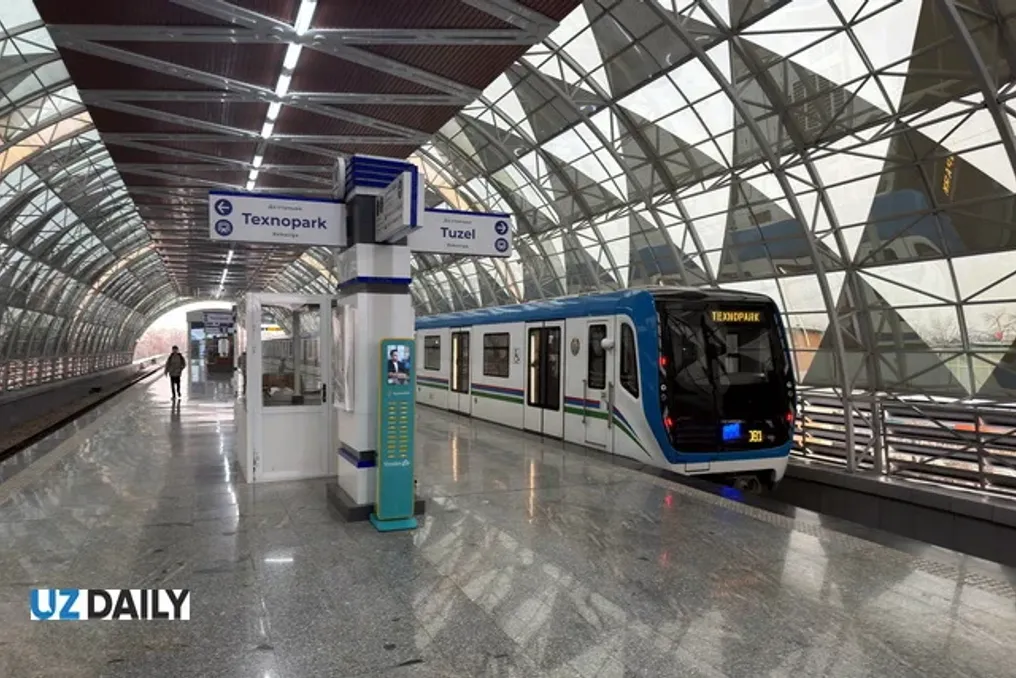
The City Council of People's Deputies of Tashkent has approved the concept for purchasing fourteen five-car trains for the capital's metro system. The total delivery will include 70 cars, and the preliminary project cost is estimated to be between $168.6 and $356.2 million, depending on the chosen manufacturer and financing terms.
The project was prepared by Tashkent Metro. Currently, the supplier and final price have not been determined. The need to update the fleet is due to the deteriorating condition of existing rolling stock, some of which has been in operation for many decades. Without new trains, the number of operational sets may decrease, the travel interval may increase, and the quality of service may decline amid growing passenger traffic.
The new trains are intended to replace outdated carriages and increase the metro's capacity, which will allow for shorter intervals between trains. Technical requirements dictate that each set must consist of five cars, as the length of existing station platforms is about 100 meters, making infrastructure reconstruction for six-car sets too costly.
The sets must comply with the technical specifications of the existing network, including a gauge of 1520 mm, 825 V contact rail power supply, and a maximum speed of 90 km/h. Compared to the 81-717/714 series, known as 'Numbered' trains, the new rolling stock is expected to be equipped with more powerful asynchronous motors, regenerative braking, modern air conditioning, lighting, and passenger information systems. Planned improvements also include faster acceleration and braking, low floors for improved accessibility for people with reduced mobility, and more spacious cabins.
Siemens from Germany reported that its solutions did not meet the technical requirements of the Tashkent Metro and therefore did not submit a commercial offer.
Official commercial offers were received from China's CRRC and Russia's Global Transport Solutions. Prices for five other manufacturers were calculated based on publicly available data on comparable deals. According to the concept, CRRC trains are valued at $118.3 million, with the total project cost amounting to $168.64 to $169.67 million. The proposed financing includes a 20-year loan from China Exim Bank at an annual interest rate of 3%.
For Hyundai Rotem, the train cost is estimated at $179.4 million, and the total project cost is from $184.13 to $184.22 million. Financing can be provided by Korea Eximbank at an annual rate of 0.05% over 20 years.
Alstom trains are valued at $125.6 million, and the total project cost ranges from $217.28 to $219.56 million. This option involves a 20-year loan from the European Bank for Reconstruction and Development (EBRD) at a rate of 5.65%.
For Spanish CAF, the trains are valued at $134.7 million, and the total project cost is from $229.95 to $232.37 million, with possible financing from the EBRD at 5.6% over 20 years. Trains offered by Russian Global Transport Solutions will cost $158.7 million, and the total project cost will be from $247.95 to $251.93 million. One of the considered financing options is a 12-year loan from International Development Projects at an annual rate of 9%.
Škoda Transportation trains are valued at $164.2 million, and the total project cost is from $279.99 to $282.29 million. Proposed financing terms from Czech Export Bank are 4.1% over 15 years with additional insurance.
Japanese company Kawasaki Rail Car offered trains for $279.1 million. The total project cost is estimated at $356.21 to $357.37 million, with a possible 20-year loan from the Asian Development Bank at an annual rate of 2%.
Purchasing trains from a manufacturer whose rolling stock is incompatible with the Russian railway platform would require the construction of a new depot and repair facilities, as existing capacities are designed for Soviet and Russian wagons. These additional costs are estimated at approximately $10.1 million and are already included in the total project cost.
The concept states that when selecting a supplier, not only the price of the trains but also borrowing costs and associated expenses should be taken into account. The document points to proposals from CRRC, Global Transport Solutions, and Hyundai Rotem as the most favorable options.
Preparatory procedures, supplier selection, securing financial guarantees, and signing the loan agreement are planned for 2026. Train deliveries are scheduled for 2027, with the sets arriving in three batches over approximately 10 months. It is expected that acceptance procedures will be completed, and the trains will begin operating by November 2027.
Tashkent Metro is a subsidized non-profit organization, meaning none of the considered options will make the project financially self-sufficient. Loan repayment is anticipated to be covered by the state budget.
According to estimates, the new trains will be able to transport 18.7 million passengers in 2028, 22.6 million in 2030, and 27.4 million in 2035. The project is also expected to create 61 jobs. Some residents are expected to switch from private cars and other modes of transport to the metro. This should ease road congestion and reduce harmful emissions by an average of 4,000 tons annually.
All figures presented are preliminary and will be adjusted after the tender and negotiations with manufacturers and banks. Oversight of the decision is entrusted to Suhrab Saifnazarov, Chairman of the Permanent Commission of the City Council on Foreign Investment and Tourism.