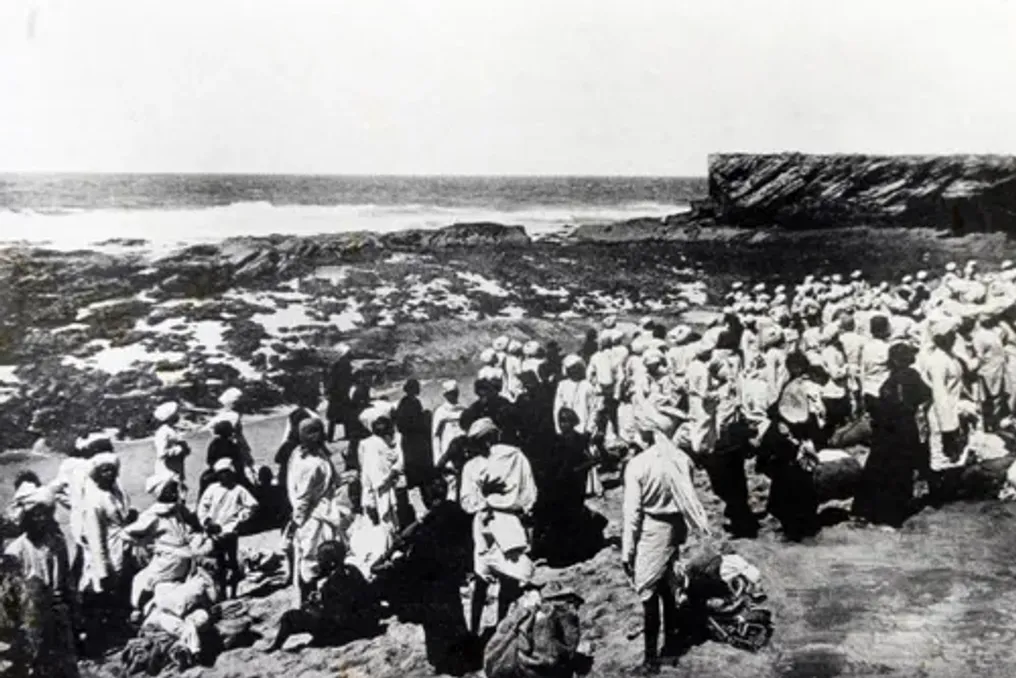
This week marks the 166th anniversary of the departure of the first two ships that brought contract workers to South Africa. The first ship, 'Belvedere,' sailed from Calcutta (now Kolkata) on October 4, 1860, and the second, 'Truro,' departed from Madras (now Chennai) in India on October 12, 1860.
The conditions aboard 384 ships that transported 152,184 contract laborers to colonial Natal between 1860 and 1911 require closer examination to illuminate the transformation of humans into commodities, and the abuses and violence within the mechanisms governing the colonial contract system, which was implemented in imperial colonies after the abolition of slavery in 1833.
Documents indicate that 14.2% of the passenger list of the 'Belvedere'—twenty-nine people—died in the Indian Ocean before arriving in South Africa on November 26, 1860.
A 1982 article in the journal 'History of Medicine,' prepared by Professor J. B. Brain and P. Brain, details the health status of Indian contract migrants in Natal during the period 1860–1911 aboard various vessels.
The journal shows that medical staff on some ships faced immense difficulties in preventing the spread of diseases. For instance, the 'Belvedere' encountered a severe outbreak of cholera, which began 10 days after departing from Calcutta.
The ship 'Kwatlamba,' during its third voyage, lost eight passengers and two white crew members to cholera. It was quarantined in Bluff for three weeks between December 1888 and January 1889, after which passengers were allowed to disembark, their clothing having been burned by authorities. Passengers on the 'Malabar' suffered from a particularly severe form of measles, leading to several deaths.
In 1893, the Emigration Agent in Calcutta received a telegram coded from Natal: 'Measles Pongola azygos clothing noontide - Congella,' meaning 'Pongala Measles associated with clothing must be prevented.' He responded that the clothing provided to emigrants on 'Pongala' was new, except for forty unused items from another ship where there were no cases of measles. He opined that measles might have been latent in some migrants, and although the usual incubation period was 14 days, he often saw cases arising 2 or 3 months after infection. When the 'Coldstream' arrived in Port Natal in 1883, an investigation into the 'scurvy condition' of its passengers was initiated.
On October 1, 1910, the newspaper Indian Opinion published an article titled 'Outbreak of 'Fever' on Board the 'Umhloti',' reporting the arrival of SS Umhloti in Durban harbor in early September 1906, which brought more than just the expected cargo of human labor.
A group of Indian contract workers was aboard, destined for plantations and enterprises in the Colony of Natal. However, hidden beneath the routine logistics of imperial immigration was a deadly pathogenic threat.
Shortly after arrival, an outbreak of 'Fever' was discovered among the passengers, which is medically classified as encephalitis. The appearance of this highly fatal disease triggered a tense sequence of official secrecy, public anxiety, and strict quarantine containment, exposing the vulnerabilities of Natal's colonial medical infrastructure.
By the end of September, the true medical burden of this journey became evident. Colonial authorities officially registered 13 imported cases of encephalitis directly linked to the transport of workers on the SS Umhloti. The pathogen's virulence was immediate and devastating.
Of those who fell ill, seven deaths were formally recorded by the end of the month, representing a mortality rate exceeding 50%. The rapid deterioration of patients underscored the aggressive nature of the disease, which attacks the mucous membranes of the brain and spinal cord, causing severe physical pain and rapid neurological collapse.
Despite the high mortality rate, colonial officials initially chose a policy of information concealment. News of the deadly infection leaked into the public sphere of Durban through unofficial channels rather than official reports. This administrative silence provoked anger among the local press, particularly the Indian Opinion—a newspaper that actively supported the welfare and rights of the Indian diaspora.
The editor of Indian Opinion launched a persistent campaign of investigations, repeatedly demanding explanations from the Protector of Indian Immigrants. The newspaper required clear information about the nature of the disease, the exact number of infections, as well as the names and condition of the patients. This journalistic pressure forced the colonial bureaucracy, which preferred to hide public health crises from attention, to provide a degree of accountability to the public.
In response to the growing medical emergency, authorities implemented strict containment protocols to protect the general population of Durban from infection. Affected individuals were quickly isolated at the Immigration Department Complex located on Shepstone Street. This complex was converted into a temporary isolation ward and was under strict medical observation. In addition to isolating the actively sick, medical staff faced the complex task of monitoring the entire cargo of workers who shared the confined space of the SS Umhloti.
This entire group was under close observation to ensure that any incubating cases could be identified before the infection could escape the complex and cause a generalized epidemic in the colony.
The outbreak did not occur in a vacuum; rather, modern observers view it through the lens of early 20th-century sanitary science. In the medical terminology of that era, encephalitis was classified as an infectious 'filth disease,' reflecting the contemporary understanding of how overcrowding and poor sanitation exacerbated the spread of filth-borne pathogens. The conditions aboard migration ships, where hundreds of workers were confined in close contact for weeks, created an ideal environment for such an organism.
Furthermore, the arrival of Fever marked a grim milestone for the Colony of Natal. It was the third major 'Orientalist' infection introduced to the region via maritime trade routes in one decade. The colony was already suffering from previous public health crises: cholera was introduced in 1903, causing widespread panic and socio-economic upheaval, and hookworm was introduced just two years earlier, in 1904.
The arrival of the SS Umhloti and its infected passengers highlighted the constant biological risks associated with the global network of labor contracts, turning the complex on Shepstone Street into a critical battleground for disease control in the colony.
Selvan Naidu
Selvan Naidu is the great-great-grandfather of Kamachi, contract number 3297. He is also a co-author of the book 'Indians Africans' with Paul David, Kiru Naidu, and Ranjit Chunillal.