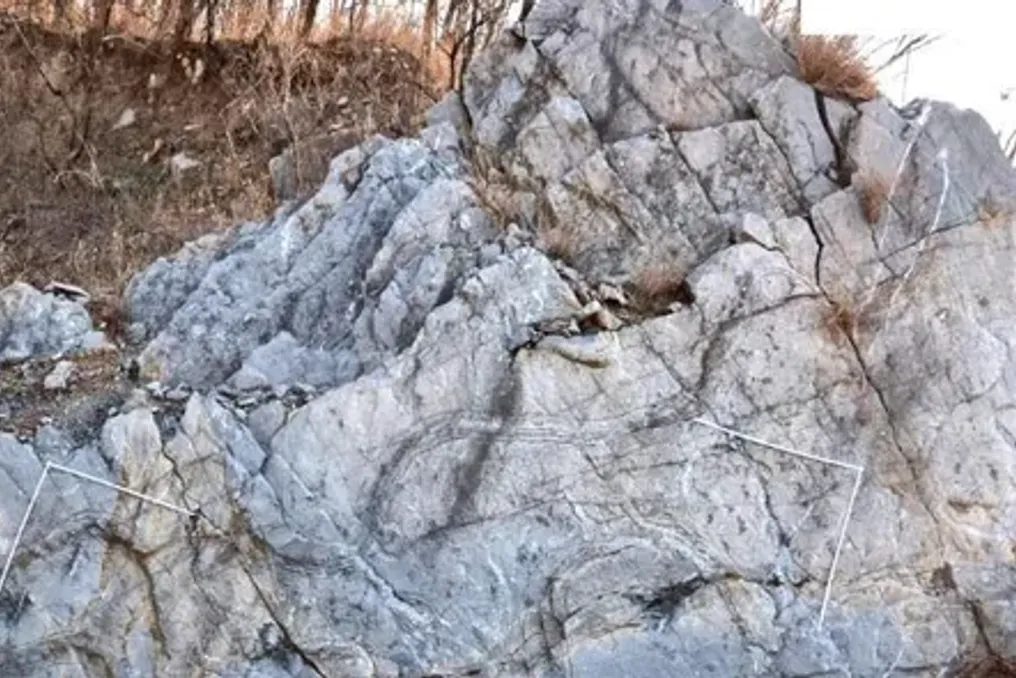
A new study has revealed traces of fossils belonging to a large species of three-legged crab, dating back over 240 million years. These findings were made in shallow waters that have long since disappeared in eastern China.
These discoveries provide valuable information about ocean life after the most severe extinction in Earth's history. The fossils were found in a mountain formation in Chaohu city, Anhui province, which is now an inland region.
Researchers identified nine complex tracks and trails, which were curved or straight and reached lengths of up to 5 meters. They found that these tracks were marked with parallel scratches. After comparison with tracks from fish and invertebrates such as insects and spiders, scientists concluded that the three-legged crab was the creator of these tracks.
Three-legged crabs are marine arthropods, meaning invertebrates with an exoskeleton and jointed limbs. Despite their name, they are not true crabs but are more closely related to scorpions and spiders. Since their basic structure has changed little over hundreds of millions of years, they are often called 'living fossils.'
In the new study, published in the 'Journal of Paleontology', the authors noted that the size of the tracks indicates that the animal was a true giant, potentially exceeding 70 centimeters in length, making it one of the largest three-legged crabs ever found.
Co-author Xin Lida from the University of Earth Sciences (Beijing) mentioned that previously found fossilized three-legged crabs were predominantly small. Among the records are larger tracks found in France, whose creator was estimated at approximately 85 cm, as well as records from northern China indicating a body length of up to 89 cm.
Based on the shape of the tracks, the new study suggested that the ancient three-legged crab lived in a shallow sea and moved or swam near the seabed. Its appendages or parts of its shell sometimes touched the bottom, leaving characteristic scratches.
Unexpected turn and new questions
Interestingly, modern three-legged crabs swim on their backs, belly up. However, the tracks suggest a backward swimming posture, indicating that ancient three-legged crabs might have behaved differently from modern species.
Co-author Gabriel E. B. de Barros from the Federal University of São Carlos, Brazil, stated: 'This is a big surprise and raises new questions about how these animals behaved in the past.' He added that this finding highlights how trace fossils can reveal the secrets of animal behavior.
Barros reported that his main contribution to the international study was comparing the tracks with other known tracks and determining the probable creator of the tracks. He has been studying trace fossils from glacial and lacustrine environments since his undergraduate studies.
By identifying differences between extinct and modern three-legged crabs, the study provides rare evidence of the recovery of shallow marine ecosystems after the mass extinction in the Permian-Triassic period, a global catastrophe that occurred about 250 million years ago, as noted in the paper.
Members from Anhui, the home of Lake Chaohu, China's fifth-largest freshwater lake, were also part of the research group. Before this study, the fauna of Chaohu had already been discovered in the region—a highly diverse early Triassic marine community. The presence of large three-legged crabs adds a new species to this fauna, thereby enriching the region's biodiversity at that time.
The researchers concluded: 'We believe that the future will bring even more discoveries in this region.'
>