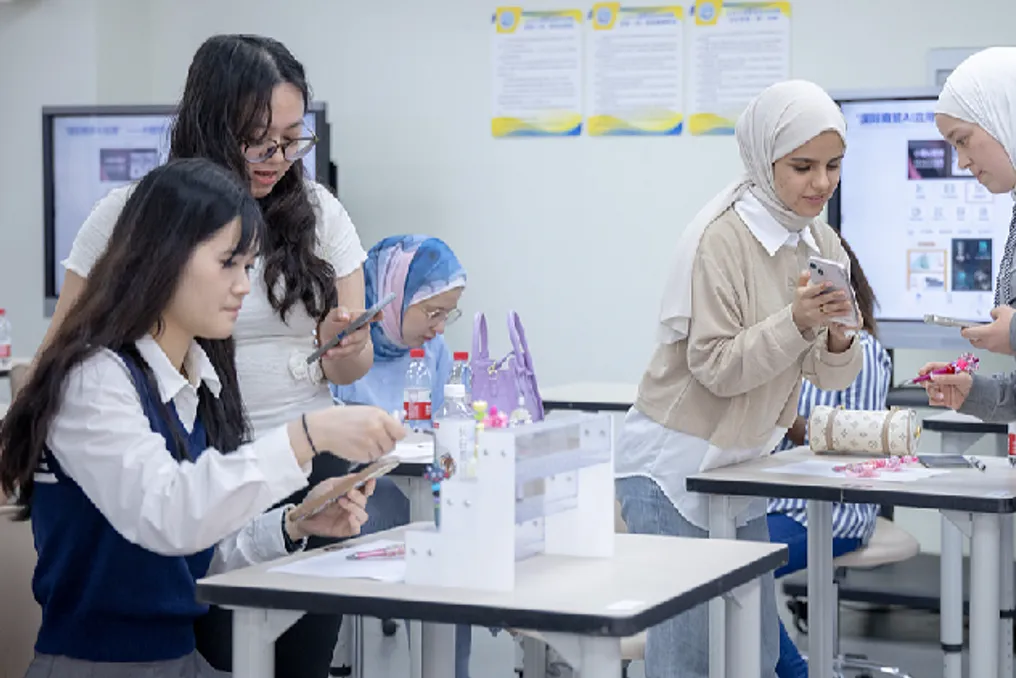
China uses digital technologies to empower women worldwide
Read more
CGTN
cgtn.com

China uses digital technologies to empower women worldwide

During a training program in Dongguan, Guangdong province, southern China, in June 2026, Saba Aliyeva, a participant from Azerbaijan, realized the necessity of mastering technology after her first encounter with AI photo editing. She was one of 51 women from 10 countries who took part in two training programs focused on digital entrepreneurship, technological empowerment, and artificial intelligence. These programs were organized to help women from developing countries acquire skills for the digital age.

The experience of these participants reflects China's continuous efforts to transform digital technologies into real opportunities for women. This concept is also highlighted by Peng Liyuan, wife of Chinese President Xi Jinping and UNESCO Special Envoy for Girls' and Women's Education. During a video address at the 2026 UNESCO award ceremony for girls' and women's education on Friday, Peng called on the international community to strengthen professional education and training for women, as well as expand digital and intellectual education to enable them to use and benefit from these technologies.

She noted that China's application of artificial intelligence to improve educational quality has contributed to progress in gender equality in education and the comprehensive development of women, providing valuable experience for Global South countries. The demand for such empowerment is significant. A study by the International Finance Corporation showed that greater participation of women in e-commerce markets in Africa and Southeast Asia could bring over $300 billion in revenue between 2025 and 2030.

China is expanding women's digital skills through national digital literacy and rural development initiatives, including training courses and support for women-led e-commerce enterprises. In 2024, 14,147 women received professional skills certifications as AI trainers, accounting for 42.3% of the annual total. Furthermore, women constitute more than half of entrepreneurs in China's internet sector and about a third of workers in new fields such as digital commerce, e-commerce, and streaming.

China also shares its experience internationally. The Center for Global Exchange and Cooperation on Women's Digital Empowerment, established in July 2025, reflects the goals outlined by President Xi in his congratulatory letter at the SCO Forum on Women in 2024. In this letter, he expressed China's readiness to work with all parties to promote scientific and technological innovation and women's development through digital empowerment.

Beyond skills training, China advocates for inclusive digital governance. Through its Global AI Governance Initiative, launched at the third Belt and Road Forum, China has called for eliminating gender bias in AI development. Moreover, China supported the UN General Assembly resolution on 'Enhancing International Cooperation in Artificial Intelligence Capacity Building' to improve digital inclusivity and advance gender equality.

As Peng said on Friday, educating girls and women sows seeds of hope, nurtures dreams, and brings happiness. By combining practical skills training with international exchange and cooperation, China contributes to efforts to ensure that more women can utilize digital technologies, participate in the digital economy, and benefit from digital transformation.


Similar stories

Uzbekistan hosts training for specialists in detecting weapons and explosives with OSCE participation
Read more
podrobno.uz

Uzbekistan hosts training for specialists in detecting weapons and explosives with OSCE participation

A five-day regional training course on the detection of explosives, ammunition, and weapons was held in Tashkent from October 5 to 9. The event was organized by the Organization for Security and Co-operation in Europe at the National Canine Center of the Customs Committee of Uzbekistan.

Fifteen employees from the border and customs services of Kazakhstan, Kyrgyzstan, Tajikistan, Turkmenistan, and Uzbekistan participated in the training. The goal of the intensive course was to enhance practical skills in identifying illegally transported firearms and explosives, as well as to standardize evaluation criteria for the work of canine units in Central Asian countries and improve instructor training.

The practical part of the training included studying methods for analyzing air currents, ways to eliminate the influence of extraneous odors, and inspecting various objects such as vehicles and crowded areas. Additionally, separate sessions were conducted concerning maintaining operational readiness and the well-being of service dogs.

Significant attention was paid to strengthening interaction between various agencies and information exchange. Participants were able to agree upon unified standard operating procedures, which should increase the effectiveness of preventing the illegal movement of prohibited items across borders.

The Director of the Customs Agency's National Canine Center, Colonel Farrukh Kakhhorov, emphasized the importance of further joint training events and the development of cooperation between regional agencies. The OSCE Project Coordinator in Uzbekistan, Ambassador Antti Karttunen, noted that Uzbek instructors shared experience gained in Great Britain, which will allow the benefits of this training to extend throughout the Central Asian region.

This training was conducted as part of an OSCE non-budgetary project aimed at strengthening capabilities to counter cross-border threats, funded by Germany, Sweden, the United States of America, Finland, and France.

Parliamentary Committee Recommends Online NEET Format and Introduces Changes to Prevent Exam Material Leaks
Read more
www.aajtak.in

Parliamentary Committee Recommends Online NEET Format and Introduces Changes to Prevent Exam Material Leaks

Millions of students preparing for NEET take exams hoping to gain admission to medical colleges based on their efforts. However, reports of leaks or irregularities in examination materials cast doubt on both the students' efforts and the fairness of the testing system itself. Following disputes related to NEET-UG in recent years, the need for significant transformations in the examination system has been proposed.

The Standing Parliamentary Committee on Education, Women, Children, Youth, and Sports, chaired by Rajya Sabha member Mukul Vasani, recommended conducting NEET-UG in Computer Based Testing (CBT) format instead of the traditional paper-based format. The committee also suggested establishing at least 1000 secure government examination centers across the country, ensuring at least one such center in every district. Its 382nd report was presented on October 9, 2026.

It is worth noting that disputes surrounding NEET-UG were actively discussed in 2024 when allegations of exam material leaks and irregularities surfaced. Questions arose regarding exam results, grace marks, and unusually high scores obtained in some centers. This issue reached the Supreme Court, and the Central Bureau of Investigation (CBI) conducted an investigation into the alleged violations. Subsequently, an expert committee was formed to improve the examination system, with an emphasis on enhancing testing security.

However, the problems did not cease. In May 2026, the incident of NEET-UG material leakage resurfaced. Based on a complaint from the Ministry of Education, the CBI registered a case on May 12, 2026, regarding the alleged leak of materials and irregularities. According to preliminary information gathered during the investigation, rumors about newspaper leaks before the exam heightened tensions. The investigation confirmed that the material leak had indeed occurred. After the cancellation of NEET-UG 2026, the parliamentary committee acknowledged that procedural and institutional improvements are necessary to ensure exam security, despite the use of biometric verification, mobile jammers, and AI-based video surveillance.

In light of this, the parliamentary committee put forward a strong recommendation in favor of transitioning to the CBT mode. The committee believes that computer-based testing can reduce the need for printing and distributing question papers to centers. This, in turn, may help decrease the probability of material leaks. Nevertheless, the committee emphasized that before initiating online exams, it is essential to ensure the availability of sufficient government centers and technical infrastructure. Special attention was given to expanding CBT capabilities for students from rural areas and small towns.

The committee also proposed providing students with the opportunity to familiarize themselves with the online exam format through digital mock tests. For regions where there is currently insufficient computer access or internet connectivity, a temporary solution was suggested: sending encrypted questions directly to the center for printing.

The committee did not only determine the exam format but also opined on the number of shifts in which it should be conducted. It was suggested to consider conducting NEET-UG in two phases. This could involve holding a general preliminary exam, followed by a specialized main exam for different courses. The goal of this proposal is to achieve a more detailed understanding of the needs of candidates applying for MBBS, as well as those applying for courses such as AYUSH, dentistry, and nursing. The committee also believes this will help reduce unnecessary competition and pressure on students. Furthermore, it was recommended to review cut-off criteria and percentiles for better alignment between the number of qualified candidates and available seats.

The committee proposed that the National Testing Agency (NTA) develop an extensive and continuously updated digital question bank across various subjects. To achieve this, it is recommended to involve experts from leading institutions such as IIT, AIIMS, and IIM. Emphasis was also placed on preparing examination materials closer to the exam date and verifying the background of experts for potential conflicts of interest. The committee recommended creating a public national list of companies providing examination-related services that have been blacklisted by any state or examination agency to prevent these companies from securing contracts again.

The report also raised the issue of staff shortages at the National Testing Agency. According to the committee, out of 39 sanctioned positions at NTA locations, only employees in 23 positions were working, meaning approximately 41 percent of positions remained vacant. The committee recommended hiring permanent staff with experience in fields such as psychometrics, cybersecurity, digital technologies, data analysis, and examination management. Furthermore, NTA should prioritize its focus on higher education entrance examinations.

Popular