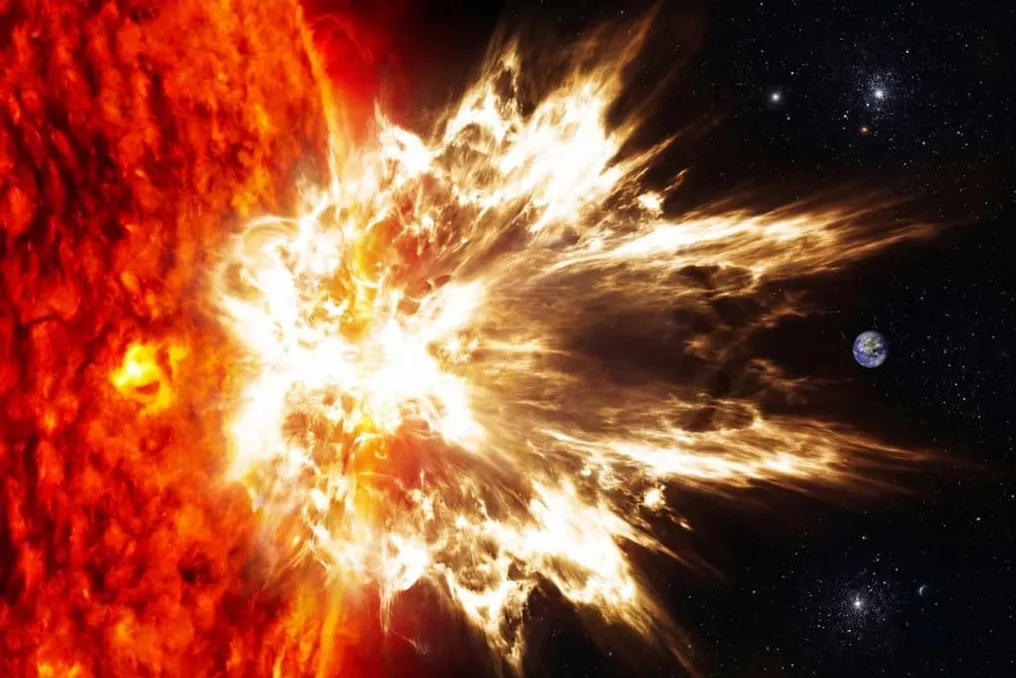
The solar system may lose its stability significantly earlier than previously assumed as the Sun approaches the end of its life cycle. The study indicates that uneven mass loss from the star can destabilize the orbits of gas giants and eject some of them into interstellar space.
The work, published in The Astrophysical Journal Letters, demonstrates that this reconfiguration could happen up to one hundred times faster than previous estimates suggested. Traditional models assumed that the Sun would gradually lose mass as it aged. In such a scenario, outer planets could remain in stable orbits for billions of years, even after the star turns into a white dwarf, its final evolutionary stage.
Konstantin Batygin and Jim Fuller from the California Institute of Technology (Caltech), along with Fred Adams from the University of Michigan, studied what happens when this mass loss is not uniform. Instead of continuous ejection of matter, the dying Sun might expel its outer layers in thousands of discrete episodes. Each such ejection caused a small change in the star's velocity, thereby altering its gravitational influence on the planets.
To study this scenario, researchers analyzed data from the European Space Agency's Gaia observatory, which has studied binary star systems, including those containing white dwarfs. They then ran simulations to assess how these disturbances would affect the Solar System. In the most realistic models, each episode ejected matter equivalent to about 33 Earth masses. Over approximately 4600 such ejections, minor changes in the Sun's trajectory could accumulate and jeopardize the stability of the outermost planets.
Consequences for Planets
In 37 out of 48 selected simulations, the gas giants unexpectedly began crossing their orbits. In some cases, this occurred when the Sun had lost only 10% of its mass, even before completing the ejection of its outer layers. The consequences could go beyond just shifting the planets' positions. For example, Uranus and Neptune might swap places or move closer to Jupiter's orbital region. Saturn also risks being ejected from the solar system.
In nine out of ten simulations, at least one gas planet ends up ejected into interstellar space. Konstantin Batygin, a theoretical astrophysicist at Caltech, noted that this result could help explain the existence of rogue planets that move through space without orbiting a star. In 90% of the simulations, the Solar System lost its original configuration within three billion years after the Sun turned into a white dwarf. Some scenarios showed that the destabilization could begin even before this stage.
The study's conclusion echoes the question raised by Isaac Newton regarding planetary stability, but points to a different cause than the scientist assumed: instead of an external star disrupting the system, the aging of the Sun itself could trigger this process. Explaining the change in results, Batygin emphasized that considering mass loss as a series of discrete events rather than a continuous process radically changes predictions about the fate of planets. The discovery may also influence the study of other planetary systems. According to the researcher, about 97% of stars end their lives as predicted for the Sun. If uneven mass loss also occurs in these systems, stellar death could profoundly transform the orbits of the planets around them.