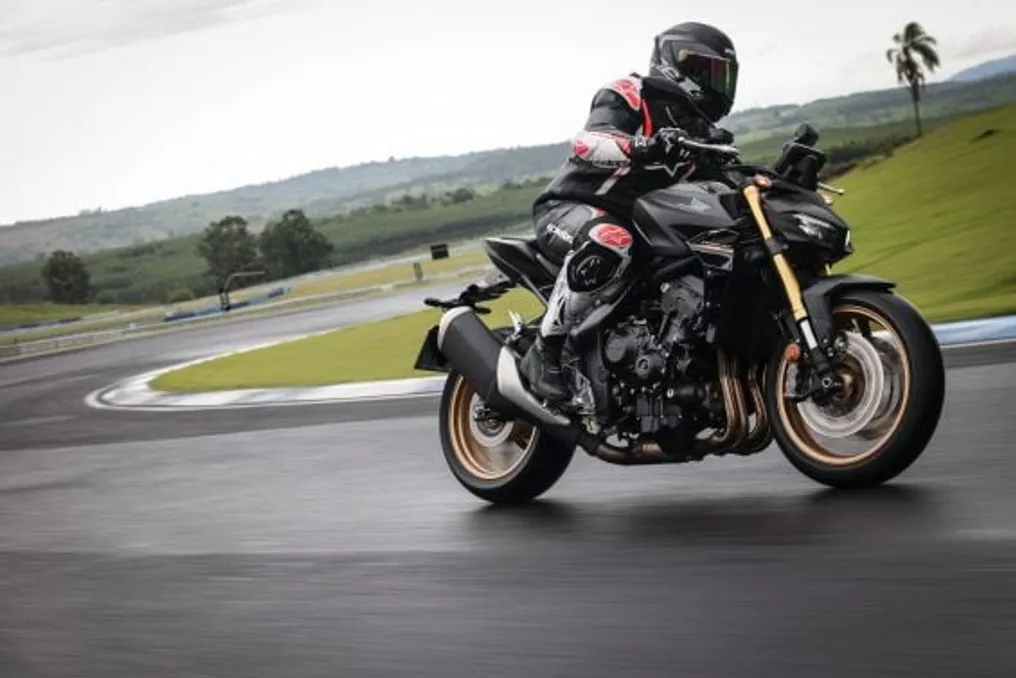
The Honda CB1000 Hornet represents the latest and most anticipated addition to the Japanese manufacturer's new motorcycle line. Being the largest and most powerful model ever produced in the Hornet line, it attracted great public attention thanks to its four cylinders, returning to the Brazilian market after more than ten years of absence.
This new model began being sold in Brazil in September. To evaluate its performance, AutoPapo participated in an event held by Honda in Mogi Guaçu (SP), at the Velocitta Autodrome, where they were able to test the vehicle both on the track and under road conditions.
After covering about 70 km to the autodrome, it was possible to observe the behavior of the new Honda CB1000 Hornet in urban and highway environments. It became evident that this motorcycle is not intended for beginner riders, given that it delivers 147.4 hp of power and 10.3 kgfm of torque in a 197 kg chassis, characteristic of a sport bike.
Although these figures may seem high on initial acceleration, more experienced riders noted that the onboard technologies facilitate control of the bike compared to other powerful competitors. The CB1000 Hornet's electronics include the Throttle By Wire (TBW) electronic throttle, which offers three pre-configured riding modes—Rain, Standard, and Sport—in addition to two customizable modes.
The rider has the option to adjust the engine power and engine braking in three levels, in addition to having HSTC traction control, available in four levels and capable of being deactivated. The system also incorporates pitch control, assisting in maintaining front wheel control during acceleration. The equipment package also includes dual-channel ABS brakes, Emergency Stop Signalling (ESS), assisted and slipper clutch, and a five-inch color TFT panel with smartphone integration via Honda RoadSync.
In the top-of-the-line version, named SP, there is also an adjustable quickshifter in three levels, allowing gear shifts and downshifts without needing to engage the clutch, with automatic acceleration on downshifts. This powerful and technologically advanced setup results in a very linear acceleration, achieved by adjusting the engine's camshaft for a more diagonal configuration, prioritizing this characteristic.
This helps smooth out jolts caused by accidental vigorous accelerations, allowing the rider to maintain stability even at lower speeds without oscillation. The combination of high power and torque gives the bike a common characteristic of large vehicles: constant 'breath,' meaning that even in high gears and low speed, the model does not lose power.
The Hornet's appearance may seem discreet at low speeds, but it transforms when pushed. By configuring the riding modes to maximize power and torque, using appropriate suspension for ideal compression and rebound, and deactivating traction control, the rider can shape the Hornet's performance. The setup proved to be very well calibrated for track days, showing good acceleration, excellent recovery, and a tuning that assists the rider in maneuvers and curves.
The main advantage lies in the bike's ability to be easily adaptable while maintaining an extreme level of power and efficiency. Although not perfect, the CB1000 Hornet presents typical flaws of naked bikes, such as inferior aerodynamics due to the absence of fairings and windshields, which generates considerable turbulence above 180 km/h.
Weight is another factor.
Weight is also an aspect to consider, given the robust engine and the amount of essential components for high-speed stability. Although relatively easy to handle compared to rivals, those seeking lightness might prefer to consider the 750 sibling.
Despite these points of attention, they do not represent major problems, as the positive aspects outweigh these reservations. However, press and social media user opinions pointed to criticism regarding the exhaust. Although the exhaust has no functional defects—allowing the sound of the four cylinders to be clearly audible—its aesthetics were not well received, suggesting a simpler and more compact design.
In conclusion, the new Hornet established itself as a complete motorcycle for those planning to participate in track events as well as weekend rides, while also offering competitive advantages in terms of price. In the standard versions (white and red), the suggested initial value is R$ 68,800, which, even including shipping, tends to be more accessible than direct competitors Kawasaki Z1100 and Suzuki GSX-S1000, both quoted around R$ 76 thousand.
The price becomes higher in the black variant, the SP. The Honda CB1000 Hornet SP, equipped with quickshifter, more refined rear suspension, and Brembo brake calipers, has a suggested price of R$ 76,750, similar to competitors, but potentially reaching R$ 84,803, according to the Fipe Table.