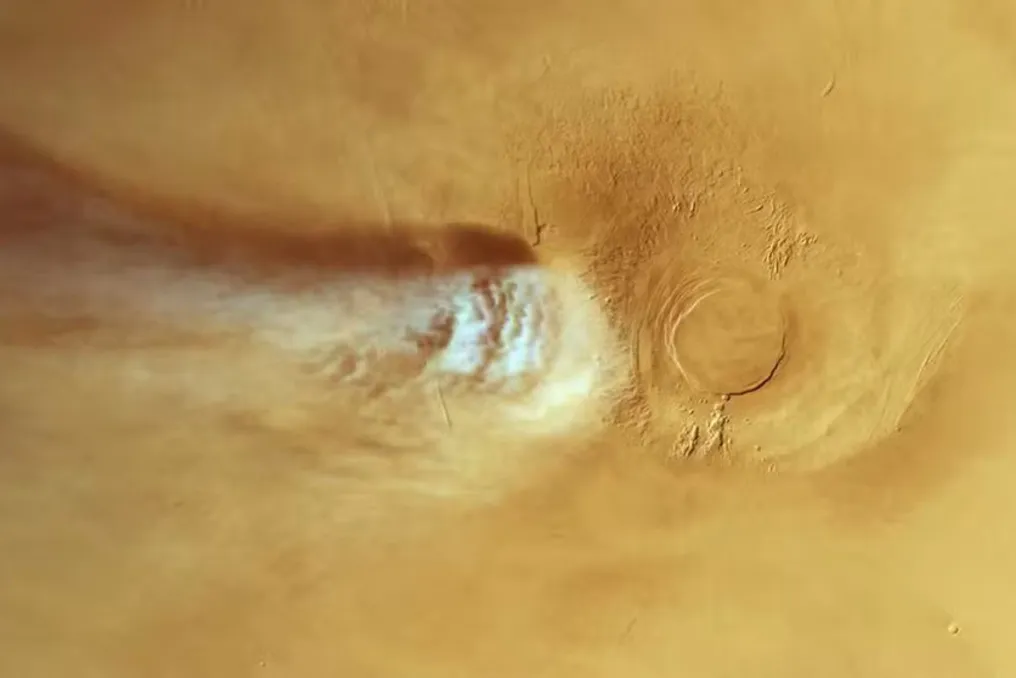
The cloud, stretching up to 1800 kilometers above Mars, may have a more unusual origin than previously thought. Research published in Nature Geoscience indicates that its formation involves a process not yet directly observed in the atmosphere of another planet.
This structure, known as the Arsia Mons Extended Cloud, is located near a Martian volcano about 20 kilometers high. It was captured by the European Space Agency's (ESA) Mars Express mission and rapidly expands in the morning, disappearing a few hours later.
On Earth, water vapor condensation usually occurs around fine suspended particles such as dust, salt, or soot, which initiate the formation of droplets or ice crystals. However, researchers on Mars propose an alternative mechanism: water vapor may turn directly into ice particles without relying on such particles as a starting point.
This hypothesis arose because previous models could not reproduce the cloud's formation. The results improved when scientists included this possibility in their simulations. As noted by the lead author of the study, Jorge Hernandez-Bernal, this was completely unexpected since such a phenomenon has never been observed in the planet's atmospheric environment.
The proposed explanation is linked to the combination of Mars' thin atmosphere and the elevation of Arsia Mons. When winds encounter the mountain, moist air is forced to rise rapidly. Under such movement, the temperature can drop by approximately 30°C in just ten minutes.
Details of formation and model limitations
This sharp temperature drop creates conditions favorable for the direct freezing of water vapor. This mechanism helps explain how the cloud reaches such large sizes in a short time. Although it can reach an extent of 1800 kilometers, its size varies; for example, an image distributed by ESA using Mars Express shows a structure about 980 kilometers in size.
Despite the findings, the model still does not perfectly reproduce all details observed by the probes. Therefore, this hypothesis offers only a possible explanation that still requires verification. The study may also contribute to the study of other worlds' atmospheres, among the questions researchers can investigate is why simulations do not reflect all the cloud's details. New observations will help determine whether the proposed mechanism explains its unusual behavior.