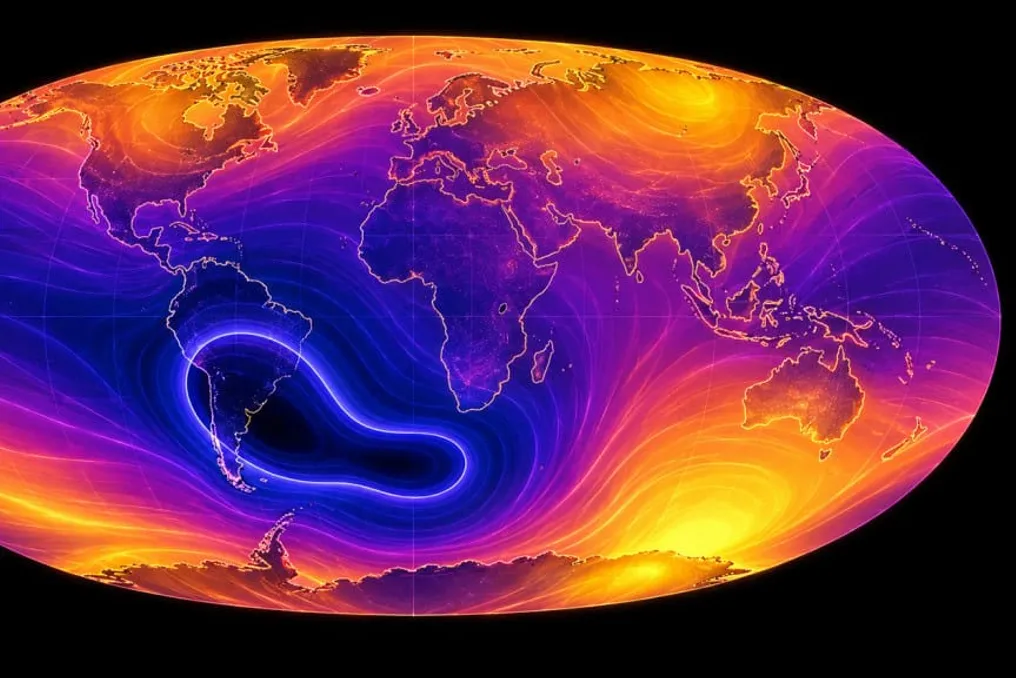
This week, various space phenomena were studied, including the Magnetic Anomaly over Brazil (which is now divided into two parts), an unfiltered sunrise on Mars, and access to 11,000 previously unpublished photos of the Moon obtained by NASA's Artemis 2 mission. Among the main events were the awarding of the Nobel Prize in Physics and two meteor showers.
Researchers from the National Institute for Space Research (INPE) are working on creating new instruments for satellites to conduct a detailed analysis of the South Atlantic Magnetic Anomaly (SAMA).
This vast region is characterized by a noticeable weakening of Earth's magnetic shield over Brazil, other countries in South America, the Atlantic Ocean, and the southern part of the African continent. The magnetic field performs a critically important protective function for Earth by preventing a constant stream of particles coming from the Sun.
According to Helvam Andre Hartman, a professor at the Institute of Geophysics at the State University of Campinas (Unicamp), 'it forms, together with the atmosphere, the magnetosphere, which functions as a kind of shield, deflecting most of these particles and reducing their direct interaction with the atmosphere.'
Expert Commentary
In an interview with Olhar Digital, this geophysics specialist emphasized the significance of this protection for long-term ecological stability. He noted: 'This protection is especially important because the solar wind is capable of interacting with the upper layers of the atmosphere and, over long periods, contributing to the loss of atmospheric particles into space. Therefore, the magnetic field is one of the factors that helps maintain the conditions making Earth habitable.'
Regarding SAMA, recent studies show that the anomaly has formed a second center of minimum intensity, altering the behavior of the Earth's shield. A paper recently published in the Journal of Geophysical Research: Solid Earth indicates that this division reflects the dynamism of liquid iron flows in the outer core. Deep changes affect the force lines on the surface, creating complex configurations that change over time.
NASA's Curiosity rover captured a detailed image of so-called yardangs—wind-eroded rock formations on Mars. These structures are visible in the distance, under the light of early morning, in a panorama taken by the instrument while exploring Sharp mountain. The recording was obtained on August 11th by the Mastcam and includes six stitched photographs after transmission to Earth. Without traditional white balancing, the image retains the appearance of a Martian sunrise and may help scientists study the origin of yardangs.
Francis Halsen, a US citizen of Belgian descent, received the Nobel Prize in Physics in 2026 for his role in creating IceCube—an observatory installed deep within the Antarctic ice capable of detecting high-energy neutrinos and revealing new information about the most extreme environments in the Universe. Halsen proposed the idea of turning the Antarctic ice into a massive particle detector in 1988. After many years of construction, IceCube was completed in 2010, when thousands of sensors occupied about a cubic kilometer of ice.
The coming days promise an incredible celestial spectacle. In fact, two: the Draconid and Southern Taurid meteor showers. Meteor showers occur when Earth passes through a cloud of debris left behind by comets. In the case of the Draconids, these fragments originate from comet 21P/Giacobini-Zinner. The name of this shower is related to the constellation Draco, where its radiant is located, more specifically near the dragon's head.
As for meteors in the Taurid stream, they are formed from fragments of 2P/Encke, the second periodic comet discovered (the first being the famous 1P/Halley). The radiant of this shower is located in the constellation Taurus (Touro), from where it gets its name.