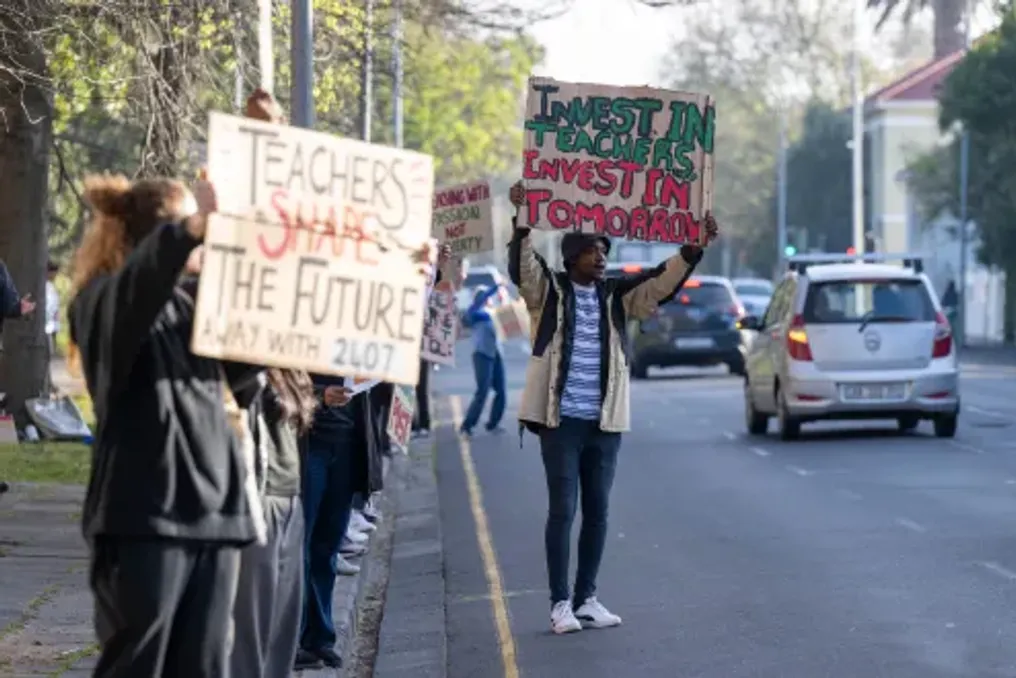
Teachers, academic staff, and students of the University of KwaZulu-Natal's School of Education held a picket line along the Main Road near the Faculty of Humanities. The province of KwaZulu-Natal faces a serious choice regarding the threat of cutting teaching positions: either reduce pressure on the department, where salaries consume most of the education budget, or risk increasing class sizes and intensifying the workload on teachers.
The SADTU union is threatening a strike over the potential loss of around 4,000 teaching posts in KwaZulu-Natal. This prospect is extremely difficult for teachers who are already working in overcrowded classrooms. For the department, which is struggling to pay bills, these positions represent significant financial obligations.
Considering an approximate annual cost of employment at R600,000 per teacher—including salary, bonuses, housing allowances, and employer contributions to pensions and medical insurance—multiplying this amount by 4,000 yields R2.4 billion annually, which is R200 million monthly. Although this is an estimate and not an exact calculation of the cost of the discussed positions, it helps explain why the department is considering cuts that teachers deem unacceptable.
The R2.4 billion figure accounts for approximately 3.4% of KwaZulu-Natal's total education budget of about R71.2 billion. This would provide consistent savings by reducing personnel costs in subsequent years. Postponing payments to schools and suppliers does not offer similar relief, as the bills must eventually be paid.
Beyond salary expenses, there is very little left. A World Bank comparison for 2024/25 showed that the proportion of wages in KwaZulu-Natal was 82% of the education budget, compared to 71% in the Western Cape. For every R100 in KwaZulu-Natal, R18 remained for all other needs, whereas in the Western Cape, it was R29.
Using this 82% share against a later budget, saving R2.4 billion would allow personnel costs to drop to just under 79%. If these funds remained within the education sector and could be redirected, the amount available outside of salaries would increase by nearly one-fifth. This could help fund consumables, services, and school payments mentioned by the teachers themselves.
However, this saving comes at the cost of hiring 4,000 fewer teachers. Students will still attend school. As student numbers grow, even maintaining the same teaching staff means distributing their work among more children. Job cuts create additional pressure: classes become larger, marking loads increase, and teachers have less time to assist individual students. Some schools may struggle to offer subjects for which they can no longer find a teacher.
Hiring more teachers would help. However, it would also increase the payroll, leaving too little money for other necessary things. KwaZulu-Natal finds itself in a difficult position. It is worth noting that in our illustrative calculation, a teacher who costs the government almost this much might take home around R27,000 net per month after taxes, pension contributions, medical insurance, and other deductions, with an annual bonus paid separately.
Teachers also require salary increases due to the rising cost of living. Nevertheless, when staff already constitutes such a large portion of the education budget, an increase might leave less money for school operational activities unless funding keeps pace. The weak economy makes finding additional funding difficult, while the need for children's education continues regardless of circumstances.
The author understands the department's difficulties: it cannot take on further commitments without knowing how to finance them. It also cannot indefinitely protect teaching positions, allowing schools to suffer from material shortages or payment delays. The author also understands SADTU's resistance: teachers are being asked to absorb the educational consequences of these financial decisions. When a position disappears, colleagues pick up the slack; when there is no replacement, someone covers; when materials don't arrive, teachers improvise or pay for them themselves.
Their willingness to do so has been widely utilized. The author sees this among undergraduate and postgraduate students in their courses. It is becoming increasingly difficult to organize university classes on weekends and holidays because these periods are occupied with additional graduate training. Teachers trying to improve their qualifications are forced to adjust their studies to meet these extra demands. Some also purchase materials out of pocket.
In this picture, there is virtually no unused time or money. KwaZulu-Natal's strong student results for 2025 deserve recognition, but they cannot be seen as proof that teachers have extra capacity to cover deficits. These results were achieved through significant effort, including work outside the regular school week. It is expected that these standards will need to be maintained or improved in 2026 and 2027. If student numbers rise, and positions and resources come under even greater strain, we will ask teachers to achieve these results amid growing difficulties.
A strike will result in lost learning time for students, and SADTU must take this consequence seriously. Parents have the right to worry. The union's argument is that further cuts will also incur costs for students through larger classes and less individual attention throughout the year. National and provincial governments must show how both staffing obligations and school operations will be funded. The union must engage with financial constraints, including fair distribution and efficient use of existing positions. Neither side can reasonably assume that teachers will continue to cover the deficit through additional personal sacrifices.
The 'back-of-the-envelope' calculation leaves them with a difficult choice: R2.4 billion could provide significant financial relief, while 4,000 teachers provide substantial teaching capacity. KwaZulu-Natal needs both money and teachers, and the people already working in its classrooms can give almost nothing.