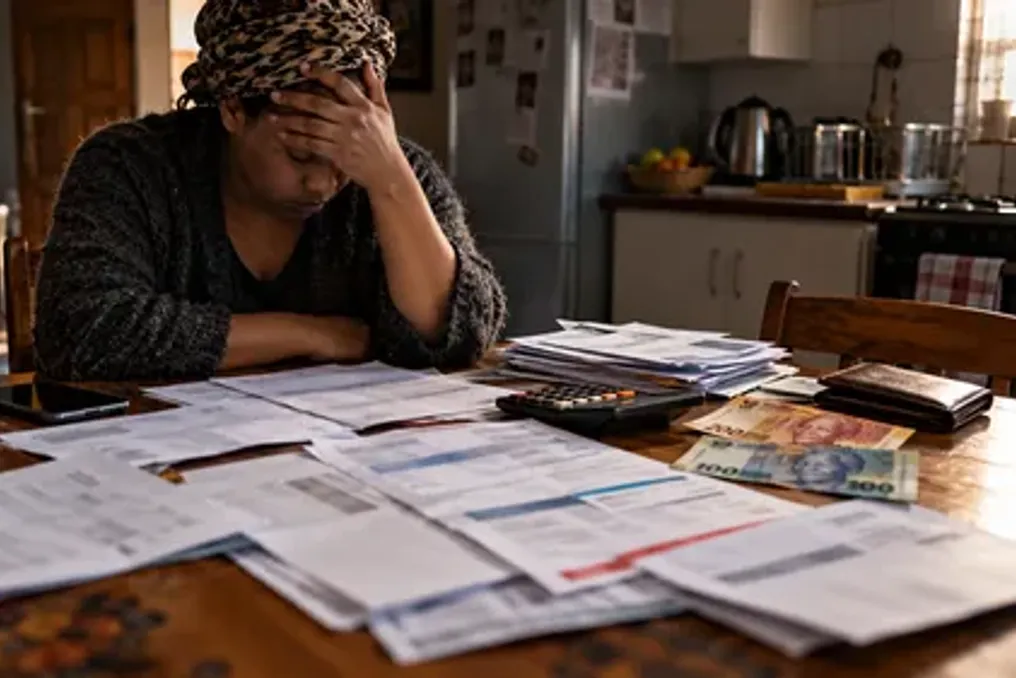
Growing financial strain among South African residents is forcing them to make difficult decisions regarding monthly spending, and insurance coverage is increasingly under pressure. As households struggle with debt repayment and the rising cost of living, some consumers are reducing their insurance policies or allowing them to lapse, which could expose them to financial shocks such as illness, death, or loss of income.
According to the DebtBusters Money-Stress Tracker study, conducted among 18,000 respondents, 72% of participants experienced financial stress, higher than the 70% recorded the previous year. Furthermore, 53% of those surveyed spent more than 40% of their net income servicing debt.
A deeper analysis presented by the South African Financial Pressure Index (SAFPI), compiled by Debt Solutions 4 U based on debt restructuring applications, showed that the median applicant directed 58.4% of their net income towards debt repayment before accounting for rent, transport, food, and other living expenses. Among the most vulnerable segments of the population, 56% spent over half of their income servicing debt.
However, it should be noted that SAFPI does not reflect the picture of all South African households, as it only covers those who have already sought help with debt issues. This situation creates a complex dilemma in the insurance sector.
The insurance dilemma
Jura Kaliasing, Senior Director of Actuarial and Insurance Solutions at Deloitte Africa, noted that the growth in life insurance policy sales remains modest, with most growth concentrated in the lower price segment dominated by cheaper funeral policies. Simultaneously, according to estimates from the South African Savings Institute, the gap between the insurance coverage held by South Africans and what is needed continues to widen.
Kaliasing argues that the consumer in South Africa is becoming increasingly underinsured because 'free disposable income for insurance simply does not exist under current conditions.' Although Kaliasing has not yet observed an 'inflow' of consumers reducing coverage or cancelling policies, there are signs of increasing delinquency rates. He warns that if current economic conditions persist, including low growth and rising fuel prices, he does not rule out an acceleration of delinquency rates, as the availability of insurance policies will come into question.
When insurance is reduced
FNB Insurance is already registering the impact of financial pressure on households through claims and customer churn data. CEO Himal Parbhu explains that the rising cost of living, fluctuating fuel prices, exchange rate pressure, and general international uncertainty have burdened disposable income, forcing insurance premiums to compete with essential expenses such as food, transport, debt repayment, and utilities.
According to Parbhu, the largest spike in churn occurs approximately six and nine months after policy issuance. FNB's analysis shows that increased early churn is concentrated among clients in the Entry Wallet, Entry Banking, and Middle-Income segments. Nevertheless, there are signs of some temporary relief: FNB collections in July exceeded the June figure by approximately 20 million rand, and manual payments rose by 19.2% compared to the previous month, reaching about 4.4 million rand. Parbhu cautions that this data is based only on the monthly report and does not yet indicate a clear trend toward improvement.
Yazid Adams, Head of Strategy, Management and Transformation at MiwayLife, believes that insurance premiums begin to be perceived as an expense rather than protection when households are forced to cut costs. Adams notes that clients more often seek advice on adjusting policies rather than canceling them entirely, which is a more sustainable approach. He emphasizes that the financial need the policy was supposed to cover does not disappear just because the household can no longer comfortably afford the premium.
Protecting against the wrong risk
There is also a danger that consumers, forced to reduce insurance coverage, may start protecting themselves against the wrong financial shock or simply purchase insufficient coverage for existing risks. Kaliasing points out that South Africans are often underinsured against serious illnesses, critical diseases, and disability, as it is easy to underestimate the full financial cost in the event of one of these occurrences. Parbhu similarly highlights disability and critical illnesses as significant areas of underinsurance.
Adams says that people often base insurance coverage on debts, such as mortgages or car loans, without considering future expenses, such as children's education, inflation, household needs, and the number of years the family might require financial support. He suggests asking not 'What is my debt?' but 'How long can my family maintain its current lifestyle if I were to pass away tomorrow?'
However, death is not the only event that can deprive a family of income. Bidvest Life's 2024 claims data showed that the company's clients were 4.5 times more likely to file income protection claims than lump-sum critical illness claims, 15.3 times more likely than death claims, and 43 times more likely than lump-sum disability claims. Moreover, about 52% of income protection claimants had made previous claims.
Risks for women
This issue is particularly important for women whose careers may involve reduced working hours, childbirth, caregiving responsibilities, or periods outside formal employment. In 2024, women accounted for 51% of income protection claimants at Bidvest Life, and childbirth led to 19% of all income protection claims. Among the top 10 claimants for policies designed for professions that do not meet traditional income protection criteria, homemakers were included. Claudelle Jacobs, Head of Claims at Bidvest Life, insists that financial planning consultations with advisors must go beyond creating long-term capital and retirement, focusing on what will happen if a person's earning capacity is disrupted. She stresses: 'Instead of recommending risk products that meet general client needs, we must examine how a woman earns income, who depends on it, how her career might change, what responsibilities she holds, and what will happen to her financial plan if her income is interrupted.'