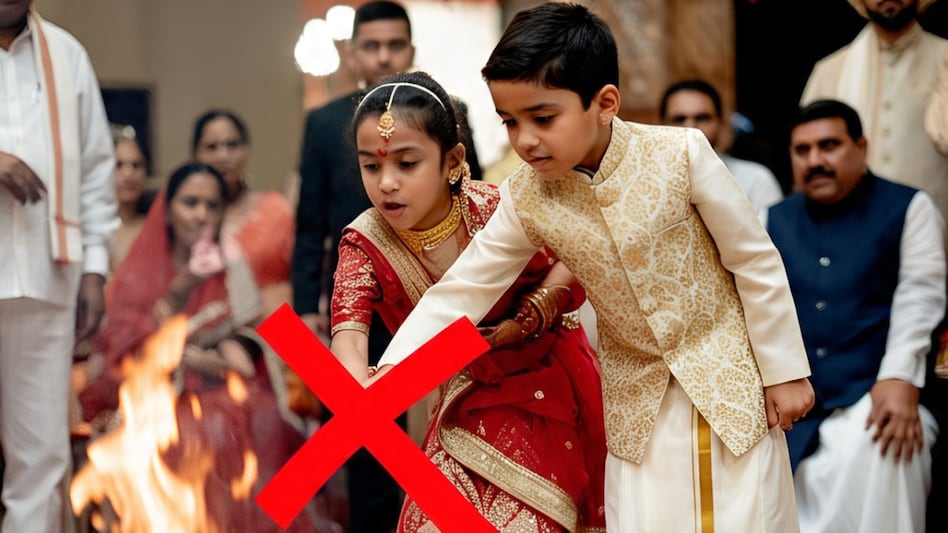
In 21st-century India, discussions revolve around skyscraper dreams, artificial intelligence revolutions, and gender equality. However, during the celebration of International Day of the Girl, dedicated to the theme 'Ending Child Marriages,' deep concern arises. This pernicious tradition, which may have originated in some ancient era, has not yet completely disappeared despite numerous declarations.
On one hand, the fight for equality is underway, while on the other, the young fingers of innocent daughters are forced to hold henna instead of picking up books. Nevertheless, in India, this practice is no longer as entrenched and invincible as it once was. History shows that many social reformers, from Raja Rammohan Roy to Ishwar Chandra Vidyasagar, raised their voices against this evil, conducted sharp campaigns, and endured boycotts from their own peers.
Even today, individuals like Bhuvan Vibhu have been actively fighting for the salvation of every innocent girl for the last 20–25 years. In connection with the International Day of the Girl, Bhuvan Vibhu from 'Child Marriage Free India' shared not only the problems but also presented a new, hopeful picture of changing India, which is quietly taking shape at the grassroots level. The following details how, according to Bhuvan Vibhu, the face of India is changing and when the country can completely eliminate this vicious habit.
Bhuvan stated with great optimism that rural daughters are no longer a generation that silently endures. Now, girls from rural India themselves call the number 1098, express their opinions through Reels and social media, and openly refuse to sit in wedding tents. Data from the National Family Health Survey (NFHS) confirms that the rate of child marriages in India has significantly decreased over the last three years—by approximately 10%. This is proof of significant and decisive changes in public consciousness.
Alongside these changes is a bitter truth: this problem has not completely vanished even by 2026. Bhuvan Vibhu explains that the root of child marriage is not solely poverty. The main danger lies in public opinion, which considers a daughter 'someone else's property' and believes it is best to give her away as soon as possible. India has the right to free and compulsory education until the age of 14. However, since legal rights are limited beyond this age, parents in rural areas often stop their daughters' education out of fear for their safety. Furthermore, in the digital age, the fear of misuse of social media and human trafficking is also a serious reason, causing families to rush to marry off their daughters at an early age.
The clearest evidence of changing India is that the focus is now not just on preventing marriages but also on providing girls with a lifelong shield of safety. 'Niti Aayog' and 'Child Marriage Free India' are jointly creating 'Safe Villages for Children' in over 100,000 villages across the country. To date, over 600,000 child marriages have been successfully prevented. Moreover, girls saved from marriage are directed straight into schools, receive vocational training, and gain access to government programs. Only in 2025 were over 1.2 million children who had dropped out of school returned to the threshold of schools.
Bhuvan notes that this vicious tradition is also supported under the guise of religious beliefs. Therefore, more than 328,000 spiritual leaders from temples, mosques, and other religious places have taken a public oath within the 'All India Faith Leaders Forum' that they will not allow child marriages.
Previously, one-third of all child marriages globally occurred in India. It should be noted that the fight against this problem is being waged not only by Bhuvan Vibhu but also by many other organizations in the country. However, after a national campaign launched by the Government of India on November 27, 2024, this has become a national vision for 140 million citizens. India is not just fighting; it is moving towards victory. If this pace and enthusiasm are maintained, India will completely bury such a shameful practice in its history by 2030. The 21st century will not be considered fully free until the last daughter of the country receives the full right to fly under the open sky, protected by the wings of her homeland. On this International Day of the Girl, a pledge must be made that no innocence will be sacrificed to child marriage.