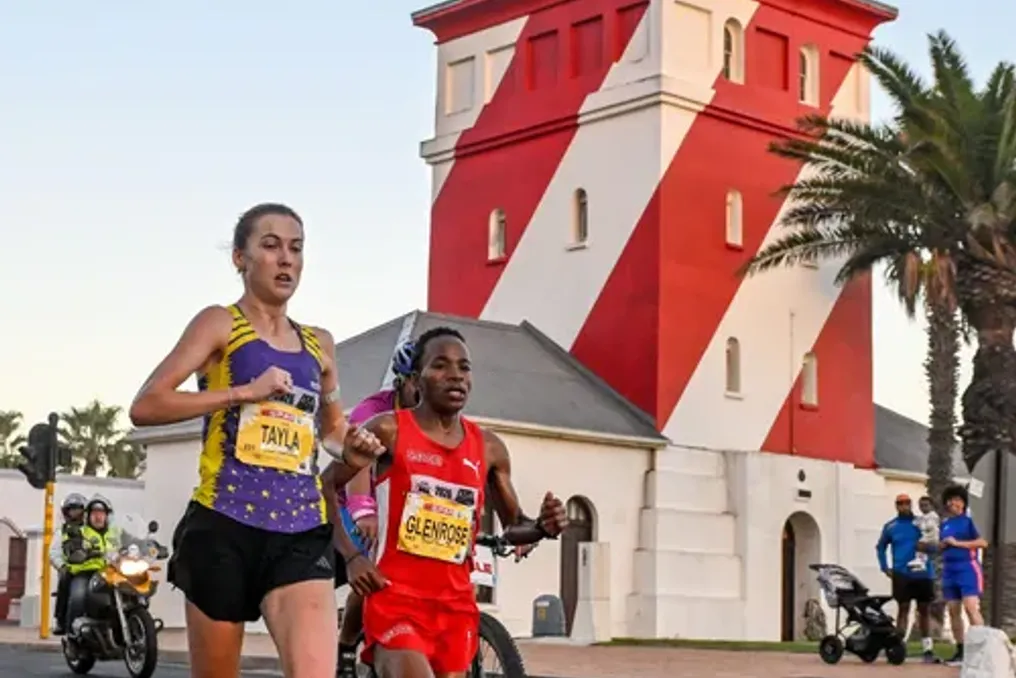
Teyla Kavanagh of Hollywood AC made the risky decision to forgo participation in the lucrative Spar Grand Prix series after victories in the first two stages in Cape Town and Durban. This move meant giving up potential prize money exceeding R200,000 but allowed her to focus on competitions in Europe.
This bold choice led to the most successful road running campaign in modern history for the South African runner. Her European marathon began with a historic fourth place at the 5k race at the World Road Running Championships in Copenhagen. There she ran 14:51, breaking Elana Meyer's national record of 15:10, and finishing just one second behind the world bronze medal.
Two weeks later, at the Race Festival in Brașov, Romania, the 25-year-old star of Hollywood doubled down on the 10k distance. She set an astonishing time of 30:50, surpassing Glenrose Shaba's 10k national record of 31:12. Thus, she became the first woman from South Africa to break the 31-minute barrier in a road race.
Her performance in Brașov was impressive: 30:50 became an absolute national record in the women's race. Kavanagh achieved this result without a designated pacemaking runner, demonstrating resilience with paces of 15:28 and 15:22 over the 5k segments. This was another clear indicator of her progress on the international stage.
Before starting this campaign, at the Commonwealth Games in Glasgow, Kavanagh demonstrated her versatility on the track. Debuting in the 5000m final, she competed with world elites, finishing eighth and breaking the 15-minute track barrier for the first time by running 14:58.49.
Speaking for the first time since returning to South Africa, Kavanagh explained the reason for her focused approach to the European risk. She stated that her main goal this year was to achieve faster results, and for this, she had to meticulously plan races and make difficult decisions.
Although domestic road races guarantee financial rewards, Europe offered a rare opportunity to elevate her international status due to fast tracks, high competition, and ideal weather conditions. Kavanagh emphasized the need to seize such opportunities when they arise.
Executing her strategy flawlessly in Romania, Kavanagh reduced the previous national standard by 22 seconds, achieving a second national record in just 15 days. She expressed satisfaction with her season, noting pride in concluding it with two strong performances in Europe and setting two national records.
Despite the refusal of local prize funds being a difficult short-term financial step, Kavanagh is confident that the career capital gained in Europe significantly outweighs the potential income she left behind. These results will allow her to gain more opportunities next year.
Now holding two national records, the Durban athlete is resting before targeting the world stage again. She plans to take a well-deserved break for physical and mental recovery, after which she will begin preparing for 2027, viewing the World Championships as an exciting possibility if she can qualify.