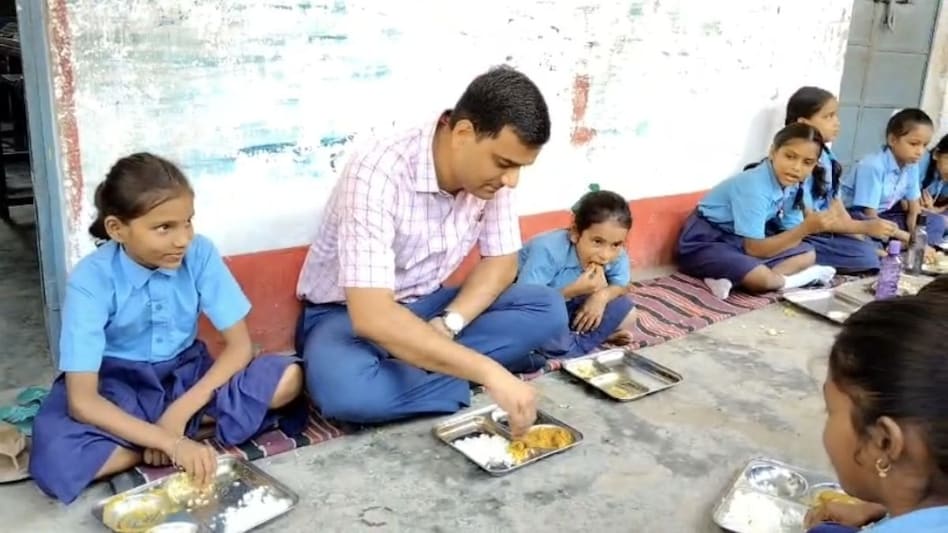
When the district director (DM) visits a school, there is usually a commotion among students and teachers: some start going through registers, others run to the classroom, and everyone wonders what the supervisor will see. However, the DM's visit to the school in Katihar, Bihar, turned out to be completely different for the children.
The DM arrived for an inspection but instead started teaching in the classroom. When it was time for lunch, he sat on the ground among the children and ate the school meal. After eating, he washed his own plate.
District official Ashutosh Dwivediji visited Rautara Middle School in Kodra block, Bihar, for an inspection. But his visit demonstrated not only the reporting documents and the organization of the school but also a deeper picture.
During the school tour, Ashutosh Dwivediji went to the tenth grade. He started a conversation with the students, which moved to physics, specifically the topic of 'The Human Eye.' He asked questions about types of light related to this topic. In the presence of the DM, this was likely not a regular lesson, but the children tried to answer the questions. The DM called some students to the board to write down the answers. The children explained their understanding using written, oral, and drawing methods.
One student drew on the board, while the others participated in the discussion. Thus, during the inspection, an atmosphere of learning developed in the classroom. The DM did not just come to check if teaching was happening in the school, but also to assess how well the children were absorbing the studied material.
After the inspection, Ashutosh Dwivediji shared his opinion regarding the students' answers. He reported that about 80 percent of the children answered the questions. For the remaining 20 percent, he ordered the organization of additional classes known as remedial classes. The goal of this is to pay special attention to those children who require more help in mastering the subject, as simply answering in class is not enough; it is also important to monitor what is being done to advance lagging students.
While the lesson continued in the classroom, it was time for the midday meal. The children started gathering to eat. The DM still asked questions of the students, but instead of staying at a distance during the meal, he decided to sit among them. Ashutosh Dwivediji went to the school porch and began eating with the students, sitting on the ground. He continued to converse with the children sitting nearby while they ate.
What the DM did after the meal brought up another point of discussion. After finishing the meal, Ashutosh Dwivediji took his plate and went to the nearest tap where he washed it himself. He did not assign this task to any staff member nor leave it to anyone else's discretion.
Ashutosh Dwivediji emphasized that every person must do their job. He noted that no job is too small or too big. Since children learn by watching adults, adults must also set an example with their behavior. His thought was that if children get used to doing their own things from childhood, it will increase their self-sufficiency. This will help them understand that taking responsibility for their actions is not insignificant, regardless of position or status.
It wasn't just about washing a plate. The question of how we treat everyday tasks around us—whether at home or at school—is also part of the process of educating children. We can advise them to become self-sufficient, but when they see us performing our duties ourselves, the meaning of that advice becomes much clearer.
Afterward, Ashutosh Dwivediji met with the children on the school grounds and spoke with them. The level of education was also addressed during the inspection. Based on the answers of the tenth-grade students, an order was given to organize remedial classes for weaker students. A special aspect emerged during the visit to Rautara Middle School: he asked academic questions in class, then ate with them, and afterwards washed his own plate. Three moments develop simultaneously in this story: firstly, assessing the level of children's education; secondly, organizing supplementary education for those in need; and thirdly, demonstrating through his own behavior to the children that the path to self-sufficiency begins with small daily tasks.
Perhaps the children will remember the day the DM came to the school for a long time. He not only conducted a lesson but also had lunch with them, and at the end of his visit, by washing his own plate, taught them an important lesson—to do their own work.