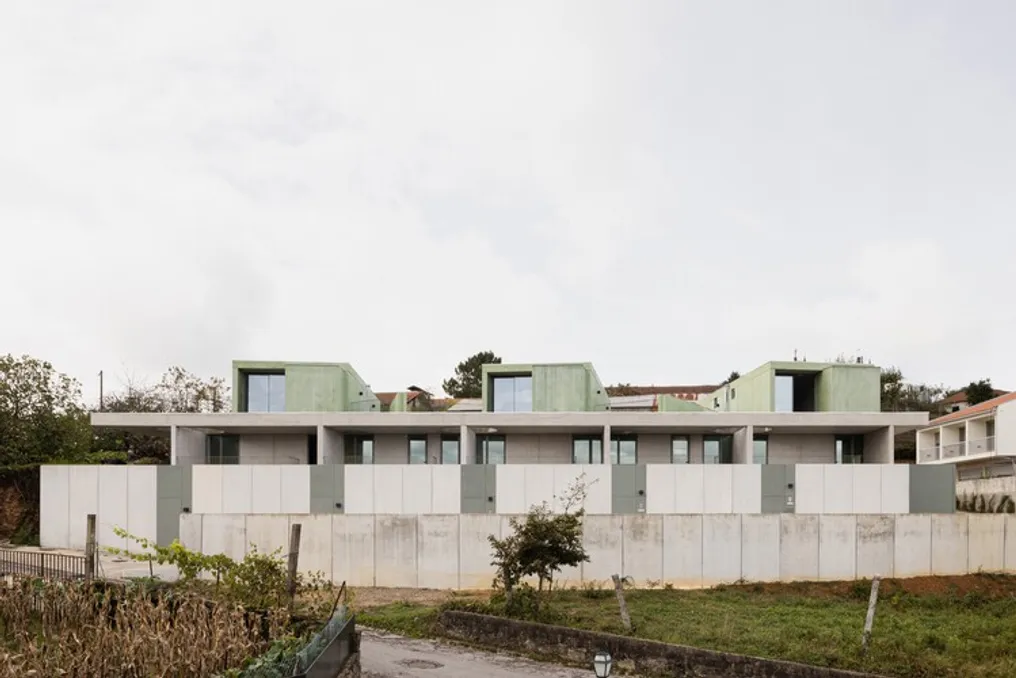
The Casas G – 5 Project is a residential complex based on the technology of complete prefabrication using reinforced concrete. All construction elements, including facades, roofs, and internal partitions, are made using modular panels. The standardization of elements has allowed for an accelerated and simplified construction process while forming a unique architectural image of the building.
The overall scope of the project includes five residential blocks: three two-story and two single-story. On the first floor, each block has a rectangular layout and features two open facades. The upper level consists of three separate parallelepipeds, irregularly positioned above a large roof slab of the ground floor. The space between these blocks is designed with terraces accessible via single-flight staircases from the rear of the building, facing east and overlooking Serra da Freita.
The prefabricated wall panels create a clear span of 6.30 m, acting as vertical load-bearing elements upon which the precast floor slabs supporting the first-floor roof rest. This slab serves as a visual divider: below it, all modules are made of natural-colored concrete, and above it, the concrete is painted green, visually separating the three blocks from the base they rest on.
Each residential block has an individual street entrance leading into a covered outdoor space. This is where the door to the common areas of each house is located. The access design is maximally linear: residents enter the house through the living room, from which other rooms and passages branch out, minimizing circulation zones and eliminating the need for atriums.
The internal configuration is determined by the prefabricated panels, which serve a dual function: they act as transverse connecting elements and structural reinforcement, eliminating the need for additional brickwork. Consequently, concrete is the most prevalent material inside the building. However, due to the specific shapes used in the production of these components, each panel has two different surfaces—smooth and rough. The project accounted for this limitation by striving to use smooth surfaces wherever possible and concealing rough surfaces in areas covered by kitchen equipment, cabinets, or ceramic tiles in bathrooms.
Both the first and second floors feature two facades (east and west), which promotes natural cross-ventilation and good solar illumination. This factor eliminated the need for any mechanical air conditioning or ventilation systems.